Last updated: July 30, 2026 · Prices reviewed quarterly
Most California homeowners pay $1,200 to $5,000 to dry out and restore a water-damaged home, against a national average of $3,867 (Angi / HomeAdvisor, 2026 data). What moves you inside that range is not your ZIP code. It is how dirty the water was and how fast you got air moving. Clean supply-line water runs $3.00 to $4.25 per square foot in Los Angeles. Sewage runs $7.00 to $12.00. Three numbers, and they decide almost everything else.
California water damage restoration cost at a glance
| Scenario | Typical California cost | Source |
|---|---|---|
| Category 1 — clean water, per sq ft (Los Angeles) | $3.00 – $4.25 | Disaster Responders, 2026 LA data |
| Category 2 — gray water, per sq ft (Los Angeles) | $4.00 – $6.50 | Disaster Responders, 2026 LA data |
| Category 3 — black water / sewage, per sq ft (Los Angeles) | $7.00 – $12.00 | Disaster Responders, 2026 LA data |
| All categories, per sq ft (national benchmark) | $3.00 – $7.50 | HomeGuide and Angi, 2026 |
| Water extraction only | $1,000 – $5,000 | Uplift Restoration, 2026 California guide |
| Structural drying and equipment days | $1,500 – $8,000 | Uplift Restoration, 2026 California guide |
| Ceiling repair after a leak | $500 – $5,000 | Uplift Restoration, 2026 California guide |
| Flooring tear-out and replacement | $1,500 – $15,000+ | Uplift Restoration, 2026 California guide |
| Mold remediation add-on ($15 – $30 per sq ft) | $1,500 – $15,000+ | HomeGuide 2026; Angi mold average $2,225 |
| Typical whole job, California | $1,200 – $5,000 | Good Life Restoration, 2026 California data |
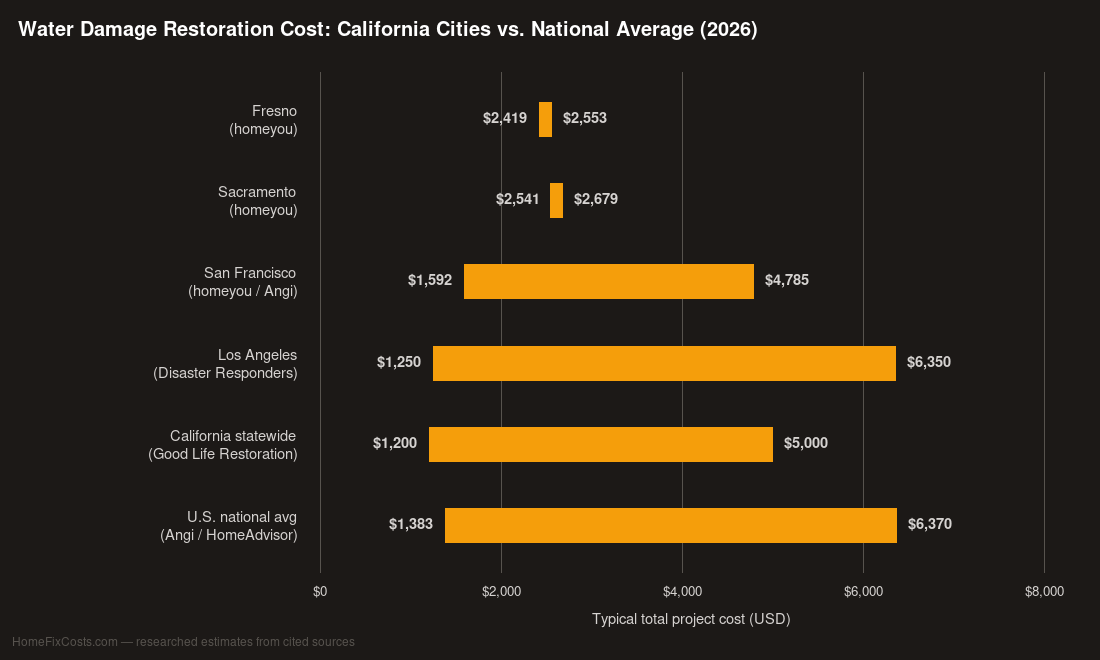
| U.S. national average, for comparison | $3,867 (range $1,383 – $6,370) | Angi / HomeAdvisor, 2026 |
Why California bills run higher than the national average
Restoration is not a product you buy. It is labor-hours plus equipment-days, and California prices both of them above the national line.
Start with wages. Construction and extraction occupations in California carry a median annual wage of $71,670, roughly 20% above the national figure, per the U.S. Bureau of Labor Statistics May 2025 OEWS release. Every hour on your invoice — the extraction crew, the daily monitoring visit, the drywall cut-out, the reinstall — prices off that base.
Then equipment-days. A normal dry-out runs air movers and dehumidifiers continuously for three to five days. The rental benchmark is $40 to $80 per day for a commercial dehumidifier and $30 to $60 per day for each air mover, per HomeGuide’s 2026 data. A larger footprint means more units, more days, and a bigger line item — before anyone rebuilds anything.
California also has two water problems instead of one. Winter atmospheric rivers hit the whole coast. Separately, intense wildfire bakes a water-repellent layer into the soil, so a burn scar sheds rain instead of absorbing it. Neighborhoods below a scar flood on storms that never used to reach them, and that changes both your risk and what your policy will actually pay.
The last multiplier is delay, and it is the one you control. Mold begins growing within 24 to 72 hours of water intrusion, and Category 1 clean water degrades into Category 2 within 24 to 48 hours as bacteria multiply. Waiting a weekend can move your job from the $3.00 to $4.25 row of that table into the $7.00 to $12.00 row. Same house, same leak, triple the per-foot rate. If you want the mechanics of that jump, we broke it down in water damage categories 1, 2 and 3.
Water damage restoration cost by California city
| City | Typical project cost | Source |
|---|---|---|
| San Francisco | $1,592 – $4,785 (average $3,159); $2.46 – $6.14 per sq ft | homeyou and Angi, San Francisco data |
| Los Angeles | $1,250 – $6,350 typical; $3,000 – $30,000+ for severe loss and full rebuild | Disaster Responders, 2026 LA data |
| Sacramento | $2,541 – $2,679 (average $2,576 – $2,645) | homeyou, Sacramento 2026 |
| Fresno | $2,419 – $2,553 (average $2,453 – $2,520) | homeyou, Fresno |
Look at the shape of that data, not just the numbers. Fresno and Sacramento sit in a narrow band around $2,400 to $2,700 because most inland jobs are a single known source — a supply line, a water heater, an appliance hose — caught reasonably early.
San Francisco and Los Angeles show ranges four to five times wider. Crew rates are not what widens them. Older housing stock, multi-story and condo work that spreads one leak across two units, and aging sewer laterals that produce Category 3 backups are what widen them. In those two markets the same square footage can land anywhere in the table, which is exactly why a per-foot quote with no category assigned to it tells you nothing.
For the underlying math on how crews price by area rather than by room, see water damage restoration cost per square foot. Our national water damage restoration cost guide carries the full category-by-category breakdown, which is the fairest benchmark for judging whether a California quote is high because of this market or high because of this contractor.
The California rules that change what you pay
Three state-specific rules do more for your negotiating position than any amount of haggling.
Licensing has a hard line at $500 and at your drywall. Under California’s Contractors State License Law, altering a fixed structure — removing drywall, floorboards, carpet or walls — requires a Class B general building license or a C-61/D-64 limited specialty license. Unlicensed operators may only handle cleanup where no structural work is involved and the total of labor and materials stays under $500. Run any company through the license lookup at cslb.ca.gov before you sign. An unlicensed crew that cuts open your walls has no license to suspend and no bond to claim against.
Visible mold is a code violation, not just a complaint. Senate Bill 655 added visible mold growth that is not minor to California Health & Safety Code section 17920.3, effective January 1, 2016, making it a substandard housing condition that local code enforcement can cite on its own. SB 610 (2025) went further and requires landlords to remediate mold and other hazards after natural disasters. If you rent, that is real leverage. If you own in a condo or HOA, it reshapes the argument about who pays for what.
Permits attach to the rebuild, not the dry-out. Drying your house needs no permit. Rebuilding the wall, re-piping the run, or moving a circuit does. Los Angeles issues a building permit for structural work plus separate trade permits for plumbing, electrical and HVAC, and most reconstruction needs both. LADBS fees run from roughly $200 for minor work up to $15,000 or more for major construction, with a bathroom landing around $400 to $900. Ask which permits your scope includes, in writing, and who pulls them.
One more filter worth applying: CSLB licensing is the legal floor, while IICRC certification is the technical standard for water restoration work. A crew with both is telling you something a crew with neither cannot.
Where your insurance stops and your wallet starts
Sudden and accidental damage is the covered lane. A burst pipe, a failed water heater, a split appliance hose — a standard California HO-3 generally covers extraction, structural drying, and mold remediation tied to that covered loss.
Flood is excluded from every standard California homeowners policy: rising surface water, river or stream overflow, mudflow, coastal surge. The California FAIR Plan does not fill that gap either, because it is a wildfire product. Flood coverage means a separate NFIP policy or a private flood policy, per the California Department of Insurance.
California carries roughly 190,000 NFIP policies at an average premium near $840 per year, and there is a 30-day waiting period before a new policy takes effect. Buying once the forecast turns is not a strategy.
Burn-scar homeowners have a specific angle. The Department of Insurance has stated that insurers have a legal duty to cover mudslide, debris-flow and similar damage caused by recent statewide wildfires that weakened hillsides. If you sit below a scar, get the causation question answered in writing rather than argued after the fact.
Gradual damage is where claims die. Slow leaks and deferred maintenance get denied or reduced, which is why photographs and dated moisture readings are the cheapest money you will spend on the whole job. Context for the pressure you may feel from an adjuster: Stanford research published in 2026 found California homeowners premiums up 84% since 2020, and a tight market scrutinizes harder. Our guide on what homeowners insurance actually pays for water damage goes through the denial language line by line.
Six ways California homeowners cut this bill
1. Photograph everything before anything moves. Wide shot of the room, close shot of the damage, and a clear shot of the source. Adjusters pay for what they can see, and the crew will start hauling material out within the hour.
2. Kill the water and start air movement yourself. A rental dehumidifier is $40 to $80 per day and an air mover $30 to $60 per day. Hours matter more than equipment quality here, because Category 1 turns Category 2 in 24 to 48 hours.
3. Require moisture readings in writing, before and after. A scope built on documented readings is auditable. A scope built on how damp a wall felt is negotiable in the contractor’s favor, not yours.
4. Split mitigation from reconstruction and bid them separately. Mitigation is genuinely urgent and you take whoever can be there today. Reconstruction is not urgent. Get three written bids for the rebuild, after the house is dry.
5. Verify the license before you sign anything. Thirty seconds at cslb.ca.gov. Under $500 with no structural work is the only legal unlicensed lane in this state.
6. Decide who your carrier’s preferred vendor works for. You may choose your own licensed contractor. A preferred vendor’s scope is written with the carrier’s cost containment in view, so if their number and an independent number are far apart, get the independent scope and put the two side by side.
If mold has already taken hold, price that separately before you agree to a bundled figure — see mold removal after water damage for what that add-on should actually cost.
Official resources & free help
- California Department of Insurance — insurance.ca.gov · 1-800-927-4357 (TTY 1-800-482-4833). Claim disputes, delays, and expedited review when a withheld payment is blocking basic necessities.
- FEMA FloodSmart / NFIP — floodsmart.gov. Flood zone lookup and policy quotes. Remember the 30-day waiting period.
- DisasterAssistance.gov — disasterassistance.gov · 1-800-621-3362. Federal assistance after a declared disaster.
- Contractors State License Board — cslb.ca.gov. Verify any license and check for disciplinary history before you sign.
- EPA mold guidance — epa.gov/mold. Where DIY cleanup is reasonable and where it stops being reasonable.
- 211 California — 211.org or dial 211. Local emergency assistance, temporary housing, and utility help.
Frequently asked questions
Does homeowners insurance cover water damage in California?
Sudden and accidental damage usually does — a burst pipe, a failed water heater, an appliance hose. Coverage typically includes extraction, structural drying, and mold remediation connected to that loss. Flood is excluded from every standard California policy, and so is gradual damage from a slow leak or deferred maintenance. The California FAIR Plan does not cover flood either.
How much does water damage restoration cost per square foot?
Nationally, $3.00 to $7.50 per square foot, per HomeGuide and Angi 2026 data. In Los Angeles the spread by category runs $3.00 to $4.25 for clean water, $4.00 to $6.50 for gray water, and $7.00 to $12.00 for black water or sewage. In San Francisco, Angi puts the range at $2.46 to $6.14. A quote without a category attached to it is not a quote you can compare.
How long does water damage restoration take?
Anywhere from about 24 hours for a small, quickly caught Category 1 spill to several months when reconstruction is involved. The dry-out phase itself is usually three to five days of continuous air movers and dehumidifiers. Reconstruction is what stretches a timeline, and it starts only after moisture readings confirm the structure is dry.
Who pays for water damage restoration?
Your insurer pays when the cause was sudden and accidental and the claim is documented. You pay when the cause was flood without a flood policy, or gradual damage the carrier classifies as maintenance. In rentals, California law puts habitability — including remediation of visible mold that is not minor — on the landlord. In condos and HOAs, the split depends on your governing documents.
Do you need a license for water damage restoration in California?
Yes, once the work touches the structure. Removing drywall, flooring, carpet or walls requires a Class B general building license or a C-61/D-64 limited specialty license under the Contractors State License Law. Unlicensed cleanup is permitted only when no structural work is involved and labor plus materials stay under $500. Verify at cslb.ca.gov.
Is mold remediation included in water damage restoration?
Not automatically. Mitigation and drying are one scope; mold remediation is usually a separate line at $15 to $30 per square foot, or $1,500 to $15,000 and up, per HomeGuide 2026 data. Angi puts the average mold removal job at $2,225. Ask for it as its own line item so you can see what you are paying for and compare it across bids.
Prices on this page are researched estimates compiled from the cited sources; your local costs will vary with market, access and scope. Always get multiple written quotes from licensed professionals before hiring.