Last updated: July 25, 2026 · Prices reviewed quarterly
If your basement takes on water, the pump in the floor is what stands between you and a five-figure cleanup. Most homeowners pay $1,200 to $1,800 to install a new sump pump system professionally, per HomeGuide’s 2026 data, with a national average near $1,100 to $1,400 according to This Old House and Angi. Swapping a worn pump into a pit that already exists is far cheaper — $400 to $1,000 in most cases. The single biggest variable is whether you already have a pit and discharge line, or whether the crew has to cut one into the slab.
Sump pump installation cost at a glance
| Scenario | Typical installed cost | Source |
|---|---|---|
| Replace pump only (existing pit) | $400 – $1,000 | HomeGuide / Angi 2026 |
| New submersible + new pit | $1,200 – $3,000 | HomeGuide / Fixr 2026 |
| Battery backup (added on) | $350 – $900 | HomeGuide 2026 |
| Water-powered backup | $300 – $1,000 | HomeGuide 2026 |
| Complex job (two pumps, alarm, thick slab) | up to $4,000 | Fixr / Angi 2026 |
| National average, complete install | $1,100 – $1,400 | This Old House / Angi 2026 |

Cost breakdown by pump type and scope
The pump itself is the cheap part. A pedestal pump — motor up on a shaft, out of the water — runs $100 to $400 for the unit, per HomeGuide and Angi. A submersible pump that sits down inside the pit costs $100 to $800. Submersibles are quieter, more powerful and last longer, which is why most installers reach for them first.
Labor is where the real money goes. A straightforward pump swap in an existing basin is roughly $150 to $600 of plumber time, per Angi. But once someone has to dig a new pit, run drainage and pour concrete back, labor plus materials can climb to $300 to $4,000, according to Angi and HomeGuide. Cutting a fresh pit alone adds $500 to $1,200 (HomeGuide, Fixr). If the fix is really an interior drainage problem, a full perimeter drain with a pump runs $2,800 to $6,500 (HomeGuide, Modernize) — a different project entirely, and one worth pricing separately.
Backup power is the upgrade most owners regret skipping. A battery backup adds $350 to $900 on top of a standard install (HomeGuide), because a power outage during a storm is exactly when your pump quits. A water-powered backup, which runs off household water pressure and never needs a charged battery, costs $300 to $1,000 installed per HomeGuide — a solid option for homes on municipal water.
What drives the price up or down
Four things move your quote more than anything else. First, the pit: having one already cut is worth roughly $500 to $1,200 in savings. Second, the discharge run — above-ground pipe is cheap at $150 to $400, while buried, freeze-protected discharge can run $250 to $2,000 (HomeGuide). Third, backups and alarms, each a few hundred dollars. Fourth, access — a finished basement where the crew has to open and repair walls costs more than a bare utility space.
Slab thickness and local labor rates matter too. Drilling a pit into a thick, old concrete slab is slow work, and that time shows up on the invoice. This is the same access-and-scope math that drives slab leak repair cost and sewer line replacement cost: the pipe or pump is rarely the expensive part — getting to it is.
DIY vs. hiring a pro
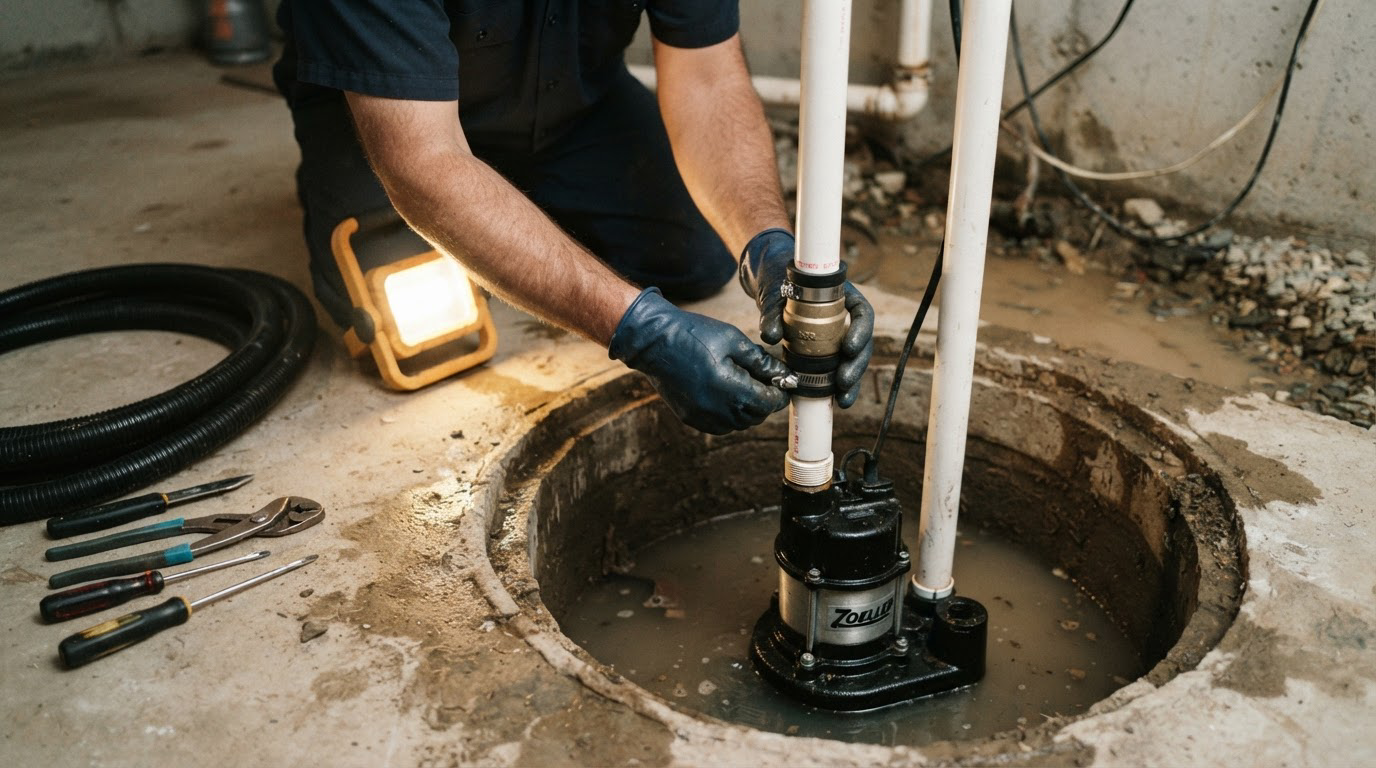
A confident DIYer can replace a pump in an existing pit for the cost of the unit plus a check valve and fittings — often $150 to $400 in parts. If the old pump pulls straight out and the new one drops into the same discharge line, this is a weekend job. That is the honest case for doing it yourself.
Hire a pro when the work touches the slab, the electrical circuit or the drainage design. A sump pump usually needs a dedicated GFCI-protected outlet, and cutting a new pit involves concrete and grading that affect how water reaches the basin. Many jurisdictions also require a permit for a new pit or a change to the discharge point, so a licensed plumber keeps the job to code and on the hook if it fails.
How to save money without cutting corners
Get three written quotes and make sure each one lists the same scope — pump type, backup, check valve, alarm and discharge routing — so you are comparing like for like. If you already have a working pit, say so; you should not pay new-pit prices for a straight swap.
Buy the pump quality up front. A $250 cast-iron submersible that lasts a decade beats a $90 plastic unit you replace in three years. Schedule the work in a dry stretch, not mid-storm, when emergency rates apply. And bundle logically: if you are already opening a wet basement for basement flood cleanup or water damage restoration, adding a pump and backup then is cheaper than a separate trip later.
Our data and methodology
Every figure on this page is compiled from published 2025–2026 cost research by Angi, HomeGuide, This Old House and Fixr, and cross-checked across at least two of those sources before we list it. Ranges reflect national averages; a straightforward swap in a low-cost market can beat the low end, and a new pit with buried discharge and dual pumps in a high-cost metro can top it. Insurance points are drawn from published guidance by Westfield, Openly and Farmers.
Official resources & free help
- FEMA — FloodSmart.gov: standard home insurance excludes flood; see how National Flood Insurance Program coverage works at floodsmart.gov.
- Ready.gov — Floods: how to prepare a basement and what to do before water rises, at ready.gov/floods.
- DisasterAssistance.gov: federal help after a declared disaster. Phone 1-800-621-3362.
- EPA — Radon: an open sump pit can be a radon entry point; sealing and cover options at epa.gov/radon.
- 211: dial 2-1-1 or visit 211.org for local home-repair and utility-assistance referrals.
Frequently asked questions
How much does it cost to install a sump pump?
A complete new system runs $1,200 to $1,800 installed per HomeGuide, with a national average near $1,100 to $1,400 (This Old House, Angi). Replacing a pump in an existing pit is $400 to $1,000.
How often should a sump pump be replaced?
Most sump pumps last 7 to 10 years, though the range runs 5 to 15 depending on how hard and how often the pump runs. The float switch is the most common failure point and is often replaced every couple of years.
Do you need a permit to install a sump pump?
It depends on your municipality. A straight pump swap often needs none, but cutting a new pit, adding a circuit or changing the discharge point commonly requires a plumbing or building permit. Check with your local building department first.
Does homeowners insurance cover sump pump failure?
Standard policies generally do not — they will not replace the pump itself, and water damage from a failed pump is excluded unless you add a water-backup or sump-overflow endorsement, per Westfield and Openly. That endorsement covers resulting damage, not the pump.
Is a sump pump worth it?
For a basement with any history of water, yes. A working pump and backup are inexpensive next to the flooring, drywall, furniture and mold remediation costs a single flood can trigger.
Prices on this page are researched estimates compiled from the cited sources; your local costs will vary with market, access and scope. Always get multiple written quotes from licensed professionals before hiring.