Last updated: July 17, 2026 · Prices reviewed quarterly
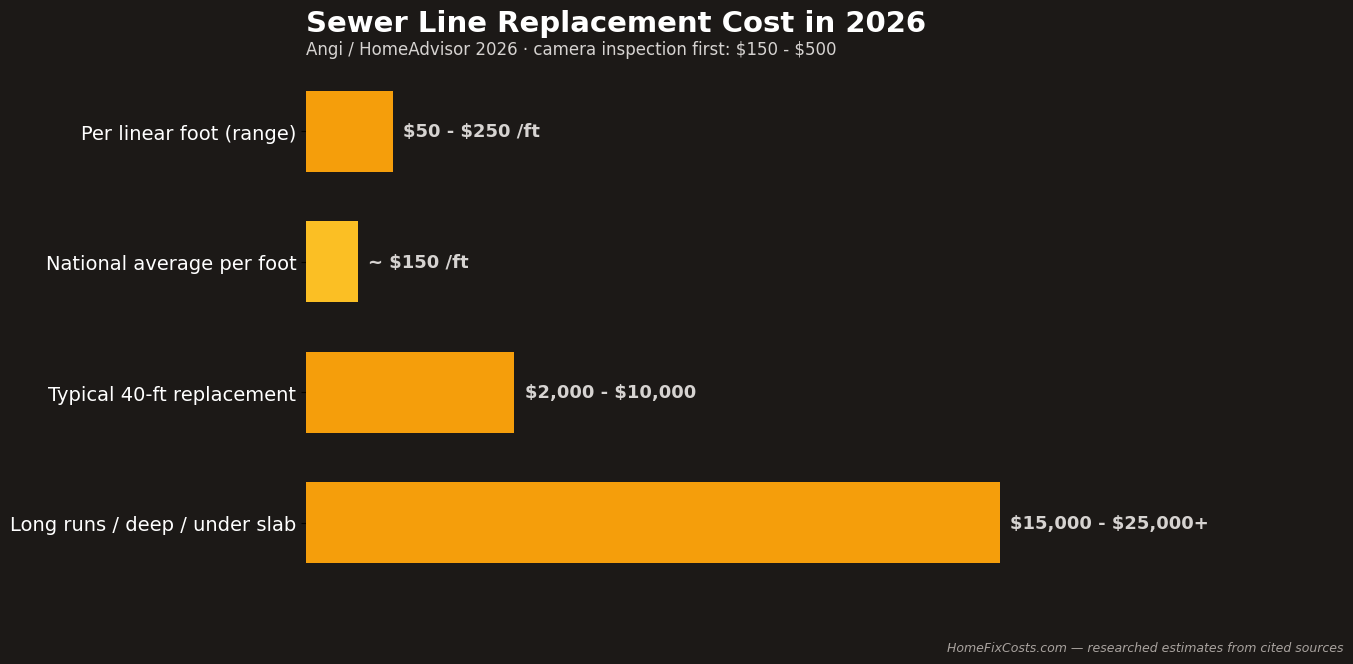
Sewer line replacement costs $50 to $250 per linear foot, or $2,000 to $10,000 for a typical 40-foot line, per HomeGuide’s 2026 data. The national average lands at $6,000, with real projects running from $500 to $20,000. The spread is enormous because two houses with identical pipe can differ by $10,000 based on one thing: what sits on top of the line.
Sewer line replacement cost by length
| Line length | HomeGuide 2026 total | Angi 2026 (trenchless) |
|---|---|---|
| 10 ft | $500 – $2,500 | — |
| 20 ft | $1,000 – $5,000 | — |
| 25–35 ft | — | $1,500 – $8,750 |
| 40 ft (most common full job) | $2,000 – $10,000 | $2,100 – $11,250 (35–45 ft) |
| 45–55 ft | — | $2,700 – $13,750 |
| 60 ft | $3,000 – $15,000 | $3,300 – $18,750 (55–75 ft) |
| 80 ft | $4,000 – $20,000 | $4,500 – $25,000 (75–100 ft) |
Both price books agree on the shape: roughly $50 to $250 per foot, and the two overlap closely at every length. If your quote falls outside $50 to $250 per foot, ask why in writing.
Cost per foot by method
| Method | Cost per linear foot | Named source |
|---|---|---|
| Traditional dig-and-replace | $50 – $250 | HomeGuide 2026 |
| Pipe bursting | $60 – $200 | HomeGuide 2026 |
| Pipe bursting + lining | $150 – $190 | Angi 2026 |
| CIPP (cured-in-place lining) | $90 – $250 | HomeGuide 2026 |
| Pipe lining | $135 – $150 | Angi 2026 |
| Spin-casting | $80 – $250 | HomeGuide 2026 |
The per-foot number is a trap on its own. Trenchless costs more per foot and often less in total, because the dig is what wrecks your yard and your budget. HomeGuide prices trench digging at $5 to $12 per linear foot and directional boring at $10 to $30, but the boring needs no repairs afterward.
What drives the price up or down
What is on top of the pipe. Soil and sod are cheap. Concrete is not. HomeGuide puts concrete removal at $3 to $8 per square foot on top of the pipe work, plus landscaping at $4 to $12 per square foot and sod at $1 to $2 to put the yard back. A line under a driveway can double a job.
Length and depth. Angi says laterals average 50 to 75 feet, and lines can sit up to 8 feet down. In cold climates the pipe must go below the frost line, which means more digging.
Materials and access that change your quote
Pipe material. Per HomeGuide’s 2026 materials-only pricing: PVC $3 to $8 per foot, ABS $3 to $11, PEX $2 to $10, cast iron $20 to $75, copper $30 to $80. Most residential jobs use PVC. If a contractor quotes copper for a buried sewer lateral, ask what problem that solves.
Labor. HomeGuide puts plumbers at $75 to $150 per hour. Angi prices trenchless excavation labor at $60 to $250 per hour.
Permits. HomeGuide reports plumbing permits at $30 to $500. Angi warns a trenchless permit can reach $1,000 depending on the city. Either way, the contractor should pull it.
The add-ons. A sewer cleanout runs $500 to $2,000 and a backflow preventer $150 to $1,200 (HomeGuide) or $150 to $1,150 (Angi) — two sources, nearly the same number. Tree removal costs $400 to $1,200. Switching off a septic system adds up to $5,500 for decommissioning, per Angi.
Get the camera inspection before anything else
A sewer camera inspection costs $125 to $500 (HomeGuide) or $175 to $350 (Angi). It is the cheapest money you will spend on this problem, and it is the only thing standing between you and a $10,000 guess.
Plenty of “you need a full replacement” diagnoses are actually roots or a clog. HomeGuide prices snaking at $150 to $500 and hydro jetting at $250 to $800; sewer line repairs overall run $150 to $3,800. Angi puts tree root removal at $100 to $600. Those are the numbers a camera can save you.
Insist on seeing the footage yourself. A reputable pro will hand you the video file and show you the defect, the depth and the distance from the cleanout. If a company diagnoses a collapsed line without putting a camera down it, get a second opinion before you sign anything.
DIY vs. hiring a pro
Replacing a sewer lateral is not a DIY job. It ties into municipal infrastructure, it needs a permit and an inspection, and a line pitched wrong drains into your house instead of the street.
The one place you can legitimately save is the digging and the landscaping afterward. Before a shovel touches dirt, call 811. It is free, it is federal, and it gets every buried utility on your property marked so you do not hit a gas line. Allow a couple of days for the locate.
Angi also notes landscapers charge $50 to $100 per hour, so restoring the yard yourself after the crew leaves is real, low-risk savings.
How to save money
- Camera first, always. $125 to $500 to find out whether you need a $400 root cut or a $9,000 replacement.
- Get three written estimates. HomeGuide recommends at least three in-person quotes and warns against taking the cheapest by default.
- Ask about partial replacement. HomeGuide notes repairs may only span 1 to 15 feet while full replacements average around 40. If the whole system is failing, compare it against a whole-house repipe before you commit. Replacing the broken 12 feet beats replacing all 60.
- Price trenchless against dig-up on the total, not per foot. Once concrete removal and re-sodding are in the math, the “expensive” method is often cheaper.
- Check who owns the break. HomeGuide is clear: you own the lateral, the city owns the main. If the failure is in the city’s line, it is not your bill.
- Check your warranty and your policy. Some home warranties cover sewer repair, per Angi.
If the line already backed up into your house, the cleanup is its own project — see basement flood cleanup cost and water damage restoration cost. And if your home is old enough to need the sewer replaced, price a whole-house repipe at the same time; the trenching overlaps.
Our data and methodology
Figures here come from HomeGuide’s 2026 sewer line cost guide (last updated December 2025) and Angi’s 2026 trenchless sewer data (updated April 2026). Where both publish the same line item — backflow preventers, camera inspections, per-foot trenchless rates — we show both so you can see the overlap. Where only one source covers it, we name that source in the sentence. We do not publish figures we cannot attribute.
Official resources & free help
- Call 811 — “Call Before You Dig”: dial 811 before any excavation on your property. Free, federally mandated, and it prevents you from hitting a gas or electric line. Required even if the contractor digs.
- NAIC — Consumer insurance help: if your insurer denied a sewer backup or collapse claim, this is how you reach your state’s Department of Insurance and file a complaint.
- EPA SepticSmart: federal guidance if you are weighing a septic system against connecting to a municipal sewer.
- DisasterAssistance.gov: if a declared disaster caused the failure, federal help may apply. FEMA helpline: 1-800-621-3362.
- 211 — dial 211 for local emergency home repair funds, utility assistance and county referrals. Many cities run low-interest sewer lateral loan programs through these channels.
Frequently asked questions
What is the average sewer line replacement cost?
$50 to $250 per linear foot, or $2,000 to $10,000 for a typical 40-foot line, per HomeGuide’s 2026 data. The national average is $6,000, and the full real-world range runs $500 to $20,000. Angi’s 2026 trenchless figures land in the same territory: $2,100 to $11,250 for a 35- to 45-foot line.
Does homeowners insurance cover sewer line replacement?
Usually not. HomeGuide notes most policies exclude wear and tear and lack of maintenance, which is what kills most sewer lines. Many policies do cover faulty workmanship, accidents or vandalism, and separate sewer line endorsements cover more. Check your declarations page, and if a claim is denied unfairly, your state Department of Insurance takes complaints.
Is trenchless sewer replacement worth it?
Often, yes. Angi’s position is that trenchless can save thousands in excavation when your old line is not severely damaged, and it works even under a slab. It costs more per foot — $135 to $150 for lining, $150 to $190 for bursting plus lining — but you skip tearing up driveways and lawns. If the pipe is fully collapsed or badly misaligned, trenchless may not be an option.
How long does sewer line replacement take?
1 to 5 days on average, per HomeGuide, depending on length and obstacles. Trenchless jobs finish faster than trenched ones because there is far less digging and no yard to rebuild.
How do I know if my sewer line needs replacing?
HomeGuide lists the common signals: foul odors, gurgling sounds, multiple clogged drains, debris backing up in the tub or basement, and puddles or soggy patches in the yard. Several fixtures backing up at once points at the main line rather than a single drain. None of these prove you need replacement — that is what the camera is for.
How long do sewer lines last?
30 to 100 years, per HomeGuide. Older Orangeburg and clay pipe lasts 30 to 60 years; PVC, cast iron and copper run 50 to 100. Angi notes trenchless liners are rated up to 50 years. Soil conditions and tree roots decide where in that range you land.
Prices on this page are researched estimates compiled from the cited sources; your local costs will vary with market, access and scope. Always get multiple written quotes from licensed professionals before hiring.