Last updated: August 14, 2026 · Prices reviewed quarterly
Cleaning up a flooded basement costs $4 to $12 per square foot for extraction, drying and sanitizing, with most jobs landing between $1,600 and $12,000+ depending on basement size and how dirty the water is, per HomeGuide’s 2026 data. Angi and HomeAdvisor put the national average around $4,000, with typical projects running $2,000 to $7,000. Two variables set your bill: the water category and whether the space was finished.
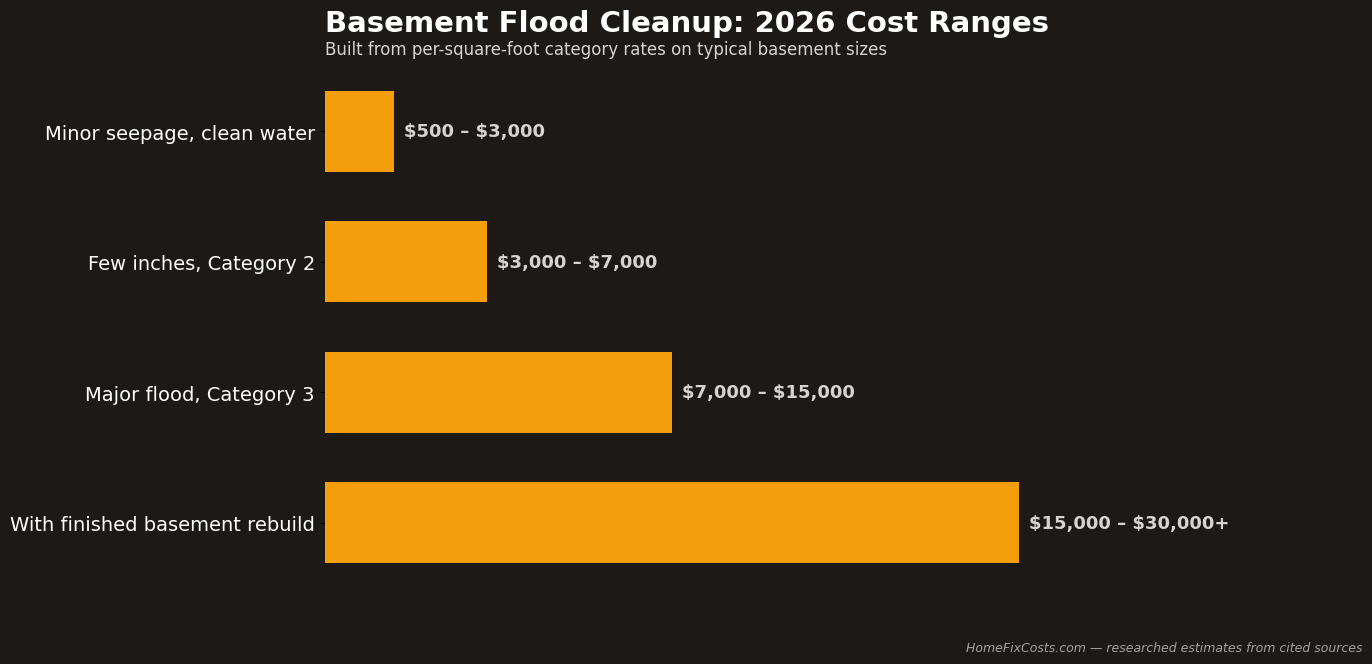
Basement flood cleanup cost by size and water type
| Basement size | Clean water | Gray water | Black water / sewage |
|---|---|---|---|
| 400 sq ft | $1,600 – $2,400 | $2,400 – $3,600 | $3,600 – $4,800+ |
| 600 sq ft | $2,400 – $3,600 | $3,600 – $5,400 | $5,400 – $7,200+ |
| 800 sq ft | $3,200 – $4,800 | $4,800 – $7,200 | $7,200 – $9,600+ |
| 1,000 sq ft | $4,000 – $6,000 | $6,000 – $9,000 | $9,000 – $12,000+ |
Why basements flood
Most basement floods trace back to five causes: heavy rain overwhelming clogged gutters and bad grading, a sump pump that failed or lost power mid-storm, a sewer or floor-drain backup, a burst pipe or failed water heater, and slow groundwater seepage through foundation cracks. The cause matters for two reasons — it decides the water category, and it decides what your insurer will say. Sump pump failure deserves special mention because it is the quiet one: pumps die of old age at seven to ten years, and the storm that kills the power is the same storm filling the pit. A water heater is on a similar clock — if yours is past its warranty and sits in the basement, it is a flood waiting for a date.
Watch for the early signs between storms: a musty smell, white mineral crust (efflorescence) on block walls, hairline floor cracks that darken after rain, or a water line on the slab. Seepage caught early is a weekend fix; the same crack under spring hydrostatic pressure is a pumped-out basement.
What it costs to fix
Pros price extraction by contamination level, because the category dictates protective gear, disposal and how much material must come out. Category 1 is a supply line or rainwater; Category 2 is appliance overflow; Category 3 — anything touching a sewer line or rising groundwater — means everything porous the water reached gets removed. Our category guide explains why the same inch of water can triple the bill.
| Water category | Extraction cost per sq ft |
|---|---|
| Category 1: clean water | $4 – $6 |
| Category 2: gray water | $6 – $9 |
| Category 3: black water | $9 – $12 |
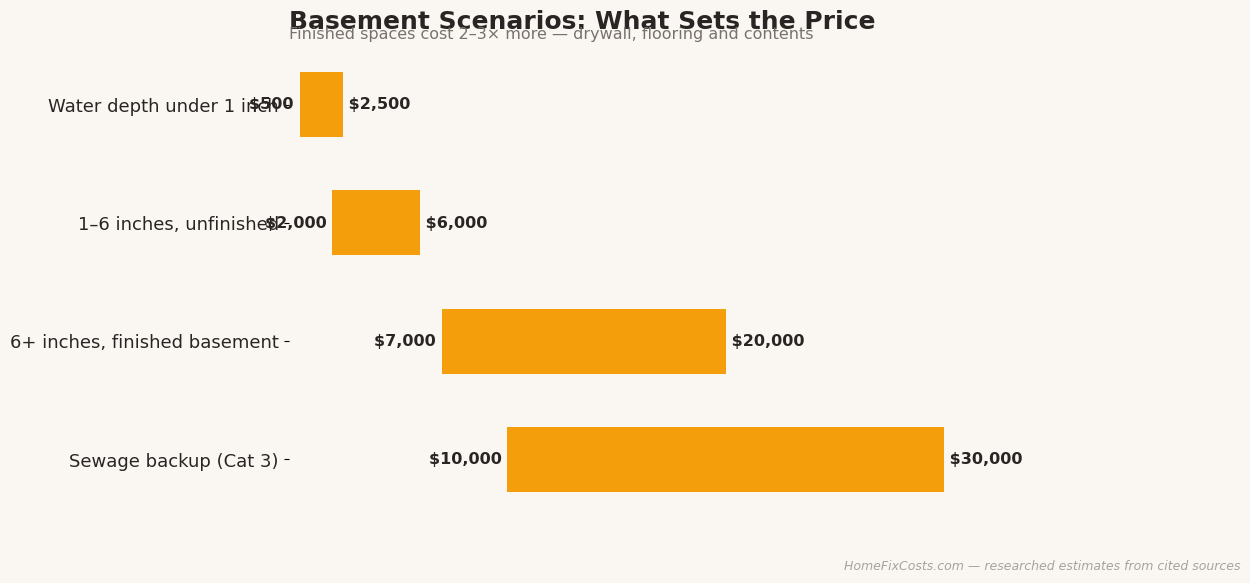
Extraction is only round one. A finished basement adds demolition, disposal and reconstruction — the same four inches of water that costs $2,500 to clear from a bare-concrete space can reach five figures in a carpeted media room. HomeGuide’s 2026 add-on figures: drywall repair at $2 to $4 per square foot, carpet replacement at $2 to $8, hardwood at $7 to $25, and mold remediation at $15 to $30 per square foot if drying starts late. For the full national picture, see our water damage restoration cost guide and the per-square-foot breakdown.
The insurance wrinkle bites hardest here. Standard homeowners policies usually cover sudden internal failures like burst pipes, but sewer backup is its own peril: it requires a water-backup endorsement that costs roughly $50 to $250 per year with coverage limits of $5,000 to $25,000, per Insure.com and The Zebra. Outside flooding needs separate NFIP flood insurance entirely. Before assuming anything, read what insurance actually pays — and photograph everything before cleanup starts.
When to call a pro
HomeGuide’s guidance is blunt: small amounts of Category 1 water in an unfinished space are DIY-viable if you act within 24 hours — rent commercial extraction fans and dehumidifiers, not household units. Anything gray or black, any finished walls, or any water that sat more than a day belongs to certified pros: the health risk and the moisture hidden inside wall cavities are not visible from the outside. Professional cleanup typically runs 3 to 5 days, per HomeGuide.
A legitimate crew does more than pump. Expect moisture mapping with meters before and after, containment to keep contamination out of the upstairs, daily equipment checks, and a documented drying log — which is exactly what your insurance adjuster will ask for. If a bidder cannot describe their drying verification process, that quote is not comparable to the ones that can.
Safety first, in order: keep clear of standing water until the electricity to the basement is off at the panel; never run a gas generator or pump indoors; and if the water table is high, pump in stages — FEMA warns that draining a basement too fast can crack the foundation inward. If sewage is present, stay out entirely and let the crew in respirators earn their Category 3 rate.
Prevention: the cheapest line in this article
Every prevention item costs less than one repeat flood. HomeGuide’s 2026 numbers: a sump pump installed runs $600 to $2,500, a battery backup for it $600 to $2,000 — pumps fail exactly when storms cut the power — an interior French drain $40 to $80 per linear foot, and gutter cleaning $100 to $400 per visit. Add the free ones: extend downspouts six feet from the foundation, regrade soil away from the house, and test the sump pump each spring by pouring in a bucket of water. If your area floods on a schedule — spring snowmelt, summer storm season — put that test on the calendar a month ahead of it.
Act fast when it happens anyway: extraction within 24 hours and drying equipment running within 48 keeps mold off the estimate. Past that window, budget for mold remediation on top.
Official resources & free help
- Flood recovery & staged pumping safety: Ready.gov/floods
- Flood insurance for future events: FloodSmart.gov (NFIP — 30-day wait, buy early)
- Declared disaster help: DisasterAssistance.gov · FEMA 1-800-621-3362
- Local emergency repair & cleanup programs: 211.org · dial 211
- Mold prevention in basements: EPA.gov/mold
Frequently asked questions
Does home insurance cover basement flooding?
It depends on the cause. Sudden internal events — a burst pipe, a failed water heater — are usually covered; outside floodwater requires separate NFIP flood insurance, and sewer backup needs its own endorsement, per HomeGuide and Insure.com. Document the source and the damage with photos before anything is removed.
Can I clean up a flooded basement myself?
Small Category 1 floods in unfinished basements, yes — within 24 hours, with rented commercial drying equipment, per HomeGuide. Sewage, finished walls, or water that has sat longer than a day are professional territory.
How long does it take to dry out a basement after a flood?
Professional cleanup typically takes 3 to 5 days from extraction to dry, per HomeGuide; severe or long-standing floods can stretch to weeks once demolition and rebuild enter the picture. Moisture readings, not looks or smell, are what declare a basement dry.
How much does it cost to pump water out of a basement?
Extraction, drying and sanitizing run $4 to $12 per square foot depending on contamination, per HomeGuide — about $1,600 to $4,800 for a 400 sq ft basement. Pumping alone is the cheap part; the drying days after it drive the bill.
Why did quotes range from $4,000 to $12,000 for the same basement?
Different category calls and different demolition scopes. Make every bidder state the water category in writing and list exactly what they will remove — then compare apples to apples. Get at least three written estimates from certified restoration companies, confirm licensing and insurance, and ask whether they bill your insurer directly — per HomeGuide, claim-handling support is a standard service worth asking for by name.
Prices on this page are researched estimates compiled from the cited sources; your local costs will vary with market, access and scope. Always get multiple written quotes from licensed professionals before hiring.