Last updated: July 25, 2026 · Prices reviewed quarterly
Contractors price water damage by the square foot, then add repairs on top — and the two numbers are worlds apart. Professional mitigation (extraction, drying and dehumidification) runs $3 to $7.50 per square foot, per Angi and HomeGuide 2026 data, while rebuilding the damaged materials afterward adds roughly $20 to $37 per square foot. What lands you at the low or high end is the water category: clean supply-line water is cheap to dry, while contaminated black water forces demolition and disposal. Across a whole job, the national average is about $3,860 (Angi, HomeGuide).
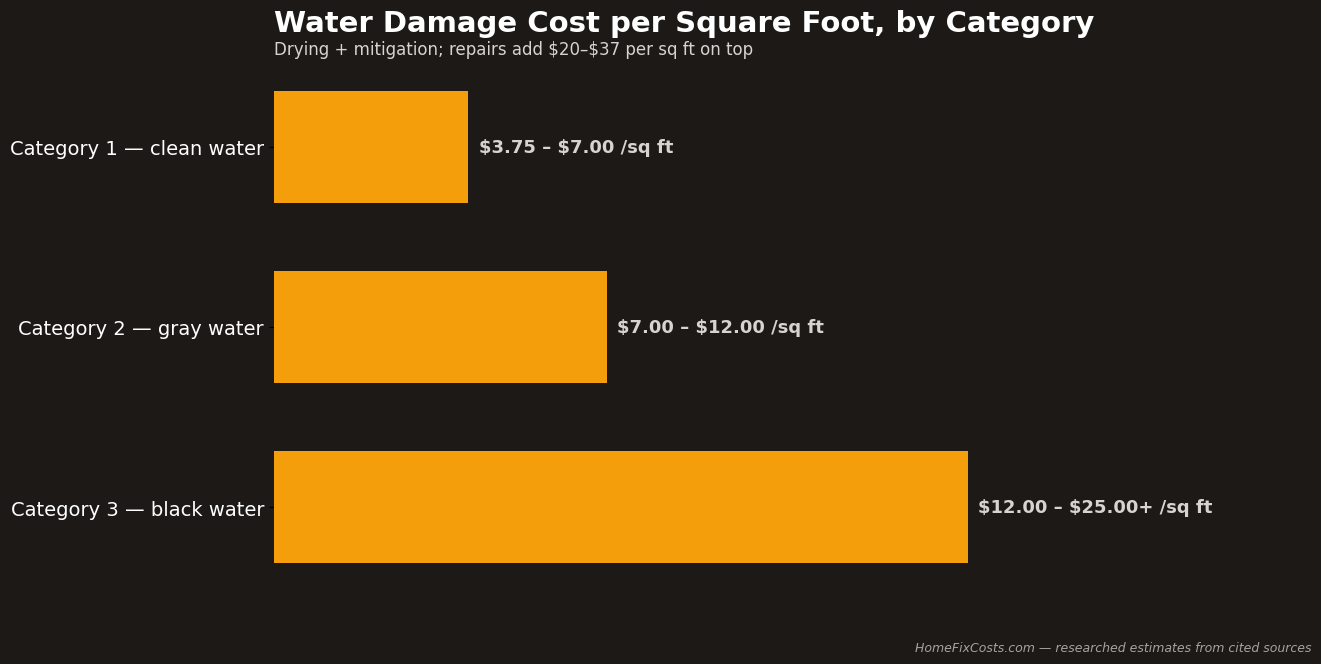
Cost per square foot by water category
| Water category | Mitigation per sq ft | What it means | Source |
|---|---|---|---|
| Category 1 — clean | $3.00 – $4.00 | Supply line, rain, no contamination | Angi / HomeGuide 2026 |
| Category 2 — gray | $4.00 – $6.00 | Appliance overflow, some contaminants | HomeGuide / Today’s Homeowner 2026 |
| Category 3 — black | $7.00 – $7.50+ | Sewage, flood, biohazard | Angi / Today’s Homeowner 2026 |
| Drying & equipment (add) | $4.00 – $12.00 | Air movers, dehumidifiers, monitoring | HomeGuide 2026 |
| Rebuild / repairs (add) | $20 – $37 | Drywall, insulation, flooring, paint | Homewyse / Angi 2026 |
What each category actually costs to dry
Category 1 is clean water from a broken supply line or rainwater with no contaminants. It is the cheapest to handle — roughly $3.00 to $4.00 per square foot for mitigation (Angi, HomeGuide) — because crews can often dry materials in place rather than tearing them out.
Category 2, or gray water, comes from a dishwasher, washing machine or overflowed sink. It carries some contaminants, so it runs about $4.00 to $6.00 per square foot (HomeGuide, Today’s Homeowner) and more materials get discarded. Category 3 — black water from sewage backups or storm flooding — averages $7.00 to $7.50 or more per square foot (Angi, Today’s Homeowner), and anything porous it touches (drywall, carpet, insulation, furniture) must be removed and replaced. If you are unsure which you have, our guide to water damage categories 1, 2 and 3 walks through the differences.
Mitigation vs. full repair — the number that fools homeowners
The per-square-foot figure a restoration company quotes on day one usually covers mitigation only: getting the water out and the structure dry. That is the $3 to $7.50 range. Rebuilding — new drywall, insulation, flooring, trim and paint — is a separate line item at $20 to $37 per square foot (Homewyse, Angi). On a Category 3 job that requires demolition, disposal and a full rebuild, total cost can reach $32 to $62 per square foot once everything is added.
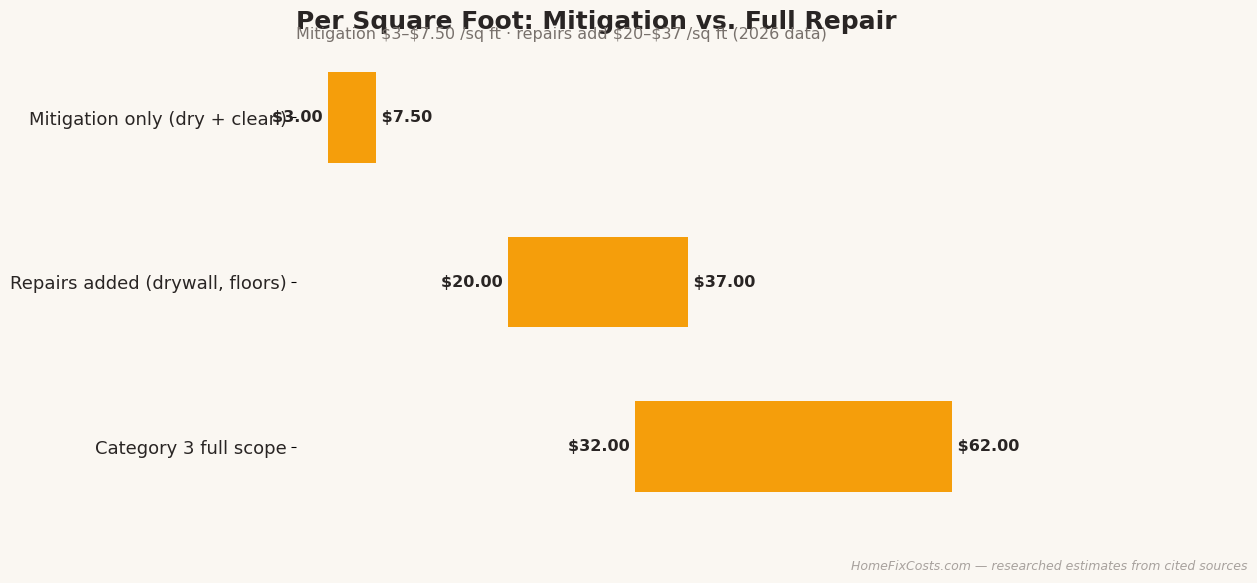
To make the ranges concrete, mitigation on a 100-square-foot area runs about $300 to $750; a 300-square-foot room, $900 to $2,250; and a 500-square-foot basement, $1,500 to $3,750 — before any rebuild. A larger flooded space is covered in our basement flood cleanup cost guide.
What drives the price up or down
Beyond category, three things move the number. Materials matter: hardwood and plaster hold water and cost more to dry or replace than tile or concrete. Access matters: water trapped behind walls or under cabinets needs demolition to reach. And time matters most — the longer water sits, the more likely you cross from a drying job into mold removal after water damage, which adds its own bill.
One thing that surprises owners: restoration companies charge for the affected square footage, not the room’s floor size. Water wicks up walls and spreads under flooring, so a 200-square-foot room with water two feet up the drywall can bill as far more surface area than the floor alone. Ask any bidder to show how they measured the affected area, and to break out equipment charges — commercial dehumidifiers and air movers are often billed per day, so a job that dries in three days costs less than one that drags to a week.
DIY vs. hiring a pro
You can handle small Category 1 spills yourself — a shop vac, fans and a rented dehumidifier for a wet spot caught within hours. Rental equipment runs a few dollars per square foot and can save a service call.
Call a professional for anything gray or black, any area larger than a small room, or any water that has sat more than 24 to 48 hours. Restoration firms carry commercial dehumidifiers, moisture meters and the training to find hidden water before it becomes mold. They also document everything, which matters for insurance.
How to save money without cutting corners
Move fast — drying within the first day keeps a job in the cheap mitigation range instead of the expensive rebuild-and-mold range. Photograph everything before cleanup for your claim. Get the scope in writing, split into mitigation and repair, so you can see exactly what you are paying for. And separate the two phases: many owners let the restoration company dry the structure, then hire their own contractor for the rebuild at a better rate. For a full-job overview, see our main water damage restoration cost guide.
One more money-saver: loop in your insurance adjuster before anyone swings a hammer. If your claim is covered, the insurer may want to inspect the damage first, and demolition done before that visit can be disputed. A quick call and a set of photos protect both your reimbursement and your timeline — and cost nothing.
Our data and methodology
Every figure here is compiled from published 2025–2026 cost research by Angi, HomeGuide, Today’s Homeowner and Homewyse, and cross-checked across at least two sources before we list it. Per-square-foot ranges are national averages; local labor rates, water category and how quickly you act will move your actual cost within — or beyond — these bands.
Official resources & free help
- FEMA — FloodSmart.gov: standard home insurance excludes flooding; see National Flood Insurance Program coverage at floodsmart.gov.
- Ready.gov — Floods: what to do before, during and after water enters a home, at ready.gov/floods.
- DisasterAssistance.gov: federal help after a declared disaster. Phone 1-800-621-3362.
- EPA — Mold cleanup: when to DIY and when to hire out, at epa.gov/mold.
- 211: dial 2-1-1 or visit 211.org for local disaster-recovery and repair referrals.
Frequently asked questions
How much does water damage restoration cost per square foot?
Mitigation runs $3 to $7.50 per square foot depending on water category (Angi, HomeGuide). Rebuilding damaged materials adds roughly $20 to $37 per square foot.
What is the difference between Category 1, 2 and 3 water?
Category 1 is clean water (about $3–$4 per sq ft to dry), Category 2 is gray water with some contaminants ($4–$6), and Category 3 is black water from sewage or flooding ($7+), which requires removing anything porous it touched.
Does homeowners insurance cover water damage restoration?
Sudden, accidental water damage (a burst pipe) is usually covered; gradual leaks, neglect and flooding generally are not. Flooding requires separate NFIP coverage through FloodSmart.gov.
How long does water damage restoration take?
Drying typically takes 3 to 5 days, depending on materials and severity. Repairs add more time once the structure reads dry on a moisture meter.
Is water damage mitigation the same as repair?
No. Mitigation dries and stabilizes the structure; repair rebuilds it. They are priced separately, and the repair phase is usually the larger bill.
Prices on this page are researched estimates compiled from the cited sources; your local costs will vary with market, access and scope. Always get multiple written quotes from licensed professionals before hiring.