Last updated: July 30, 2026 · Prices reviewed quarterly
Sudden and accidental water damage is covered; gradual leaks, sewer backups and flood are not — and the average paid water damage and freezing claim runs $15,400 according to Insurance Information Institute (Triple-I) data for 2019 through 2023. Almost every denied claim in this category comes down to one word in the adjuster’s report: gradual. Understanding how that word gets applied is worth more than any policy comparison you will ever read.
What actually gets paid
| Situation | Covered on a standard policy? | Source |
|---|---|---|
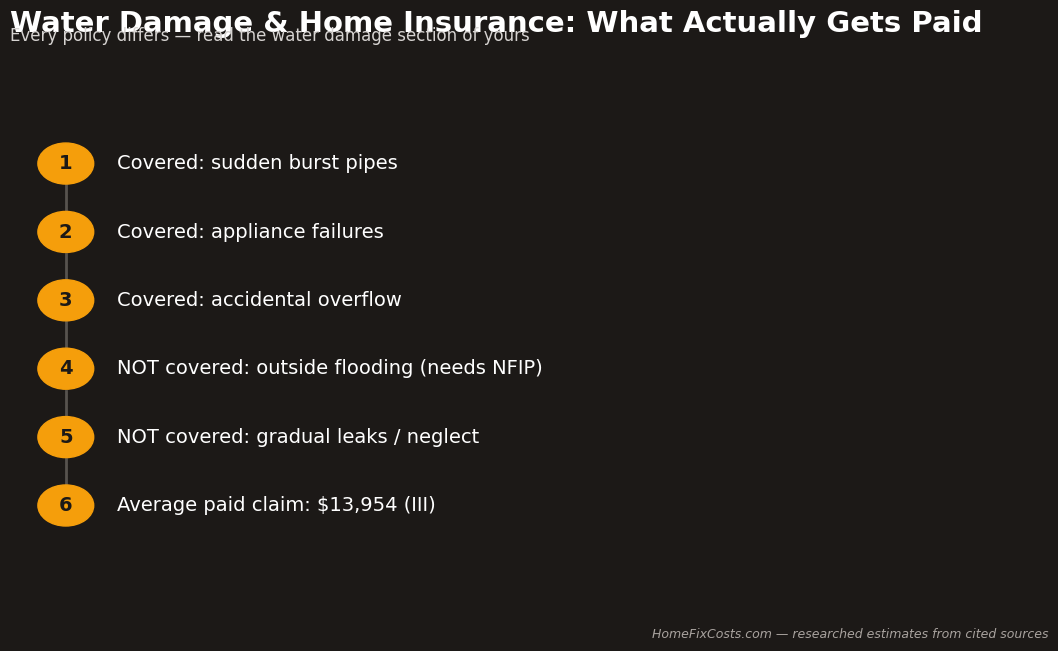
| Burst pipe or failed supply line | Yes — extraction, drying and repair of damaged material | Triple-I; USAA; Progressive |
| Water heater or appliance hose failure | Yes — sudden and accidental | USAA; Farmers |
| Storm-driven roof leak (sudden) | Yes, if reported promptly and the roof was maintained | Forbes Advisor; USAA |
| Sewer or drain backup | No — needs a water-backup endorsement, typically $5,000 to $25,000 of limit | The Zebra; Insurance.com |
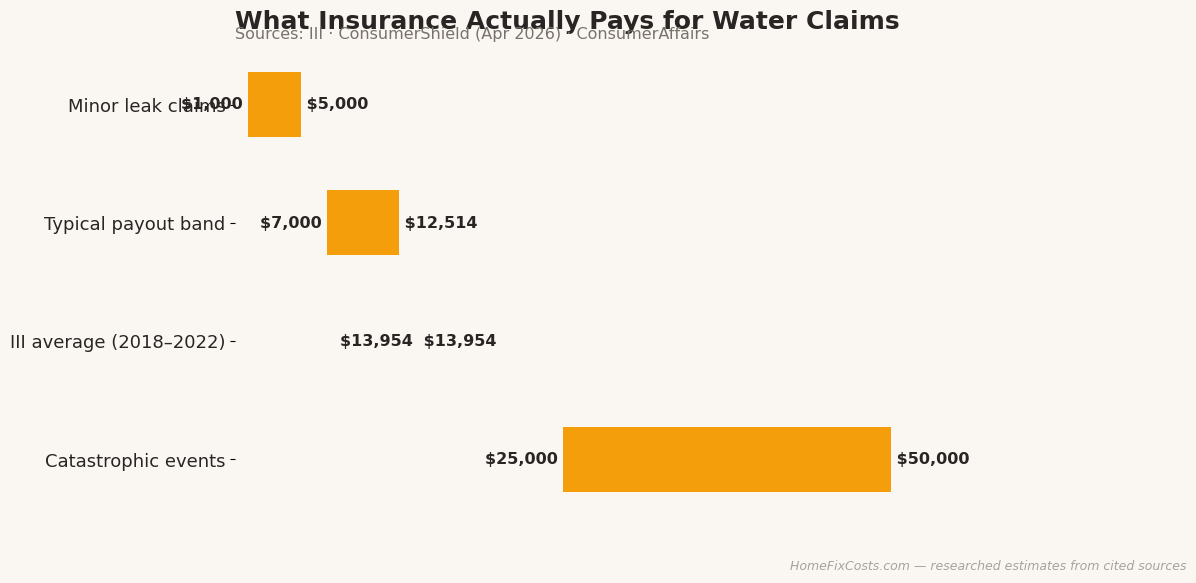
| Mold following a covered loss | Partially — standard sublimits run $1,000 to $5,000; an endorsement raises it to $25,000+ | Quote.com 2026; NerdWallet |
| Slow leak or long-term seepage | No — maintenance and wear-and-tear exclusion | Washington Office of the Insurance Commissioner; U.S. News |
| Flood, surface water, mudflow, coastal surge | No — requires NFIP or private flood coverage | FEMA FloodSmart |
| Damage from deferred maintenance | No | U.S. News; Amica |
What the claim numbers say
| Metric | Figure | Source |
|---|---|---|
| Average water damage and freezing claim paid, 2019–2023 | $15,400 | Triple-I (via ConsumerAffairs and Insurify) |
| Average paid claim, 2018–2022 | $13,954 | Insurance Information Institute |
| Share of all home insurance claims, 2019–2023 | 22.6% (peaked at 27.6% in 2022) | Triple-I |
| Odds an insured home files this claim in a year | 1 in 67 (about 1.5%) | Triple-I |
| Typical premium increase after one water claim | About 10% to 25% | insure.com; Storm Law Partners |
Two things stand out. Water damage and freezing is the second most common home insurance claim after wind and hail, so your carrier has seen thousands of these and has a settled playbook for them. And the average payout sits well above the average deductible, which means the math usually favors filing when the cause is genuinely sudden.
The counterweight is the premium. One claim commonly adds 10% to 25% to your renewal, and more if the carrier decides your property is likely to do it again. For a $2,000 loss on a $1,000 deductible, filing can cost you more over three years than paying cash. That calculation changes fast once you are into four figures — and our national water damage restoration cost guide shows how quickly a job climbs past that line.
Why claims get denied
Adjusters are not looking for reasons to deny you. They are answering four questions, and the answers write the outcome.
Was it sudden or gradual? A pipe that bursts is covered. That same pipe, weeping behind drywall for four months, is excluded as wear and tear. If the adjuster concludes intrusion happened over weeks or months — slow pipe leak, roof seepage, moisture buildup — the maintenance exclusion applies.
What was the source? Source determines category, and category determines both coverage and cost. Clean supply water, gray water and sewage are three different claims. We break that down in water damage categories 1, 2 and 3.
Did you maintain the property? A roof at the end of its life, a water heater a decade past warranty, a known drip nobody fixed — each one hands the carrier an exclusion.
Did you give prompt notice? Most policies require notice “promptly” or “as soon as possible,” and some name a window of 30, 60 or 90 days. Suit-limitation periods commonly run a year. Waiting to see whether it dries out on its own is the single most expensive decision available to you.
Six moves that protect your payout
1. Stop the water, then photograph before anything moves. Wide shot of the room, close shot of the damage, and a clear shot of the source. Do it inside the first hour, because the mitigation crew will start hauling material out.
2. Call it in the same day. Same-day notice removes the strongest denial argument the carrier has and makes the emergency mitigation spend easy to justify.
3. Keep the failed part. The split hose, the cracked fitting, the burst section of pipe. Physical evidence of sudden failure beats any description you can write.
4. Get moisture readings in writing, before and after drying. Documented readings turn your scope into something auditable. “It felt damp” is not a scope.
5. Save every receipt, including the hotel. Loss-of-use coverage exists on most policies and goes unclaimed constantly. If the home is unlivable, that is a line you are entitled to.
6. Ask whether the preferred vendor works for you or for the carrier. You may choose your own licensed contractor. If the carrier’s number and an independent bid are far apart, put the two scopes side by side and ask which line items differ and why.
Flood and sewer backup: the two gaps you have to buy
These are the two holes that surprise people mid-claim, and neither one closes by itself.
Flood is excluded from every standard homeowners policy in the country — rising surface water, river or stream overflow, mudflow, coastal surge. Coverage means an NFIP policy through FloodSmart.gov or a private flood policy, and there is a 30-day waiting period before a new NFIP policy takes effect. Buying when the forecast turns does not work. If you want the state-level picture of how this plays out, our California water damage cost guide walks through the burn-scar and atmospheric-river version of the problem.
Sewer and drain backup is also excluded by default. A water-backup endorsement typically adds $5,000 to $25,000 of limit for a modest premium, and it is the cheapest meaningful coverage most homeowners are not carrying. If you have a basement, a finished lower level, or an older sewer lateral, price it at your next renewal — see basement flood cleanup cost for what that exposure looks like in dollars.
Mold is a third partial gap. Standard policies carry a sublimit of roughly $1,000 to $5,000 for mold arising from a covered loss, and an endorsement can lift that to $25,000 or more. Given that remediation itself runs well past those sublimits, check yours before you need it. Our guide to mold removal after water damage has the current pricing.
Official resources & free help
- Your state insurance department (via NAIC) — naic.org. File a complaint or ask about a delayed or underpaid claim. Every state has a free consumer division.
- FEMA FloodSmart / NFIP — floodsmart.gov. Flood zone lookup, quotes, and the claim process. Remember the 30-day waiting period.
- DisasterAssistance.gov — disasterassistance.gov · 1-800-621-3362. Federal assistance after a declared disaster.
- Ready.gov floods — ready.gov/floods. What to document and do before, during and after.
- EPA mold guidance — epa.gov/mold. Where DIY cleanup is reasonable and where it stops being reasonable.
- 211 — 211.org or dial 211. Emergency housing and utility assistance.
Frequently asked questions
What type of water damage is covered by homeowners insurance?
Sudden and accidental damage from an internal source: a burst pipe, a failed supply line, a water heater or appliance failure, or a sudden storm-driven roof leak. Coverage normally includes extraction, structural drying, and repair or replacement of the damaged material. Gradual damage, sewer backup and flood sit outside a standard policy.
Does homeowners insurance cover water damage from rain or a leaking roof?
If wind or a storm opened the roof and rain entered as a result, that is generally covered. If rain came through an old, worn or poorly maintained roof over time, the wear-and-tear exclusion usually applies. Roof age and maintenance records carry real weight in this determination.
Does home insurance cover mold from water damage?
Partially. Most policies include a mold sublimit of about $1,000 to $5,000 when the mold results from a covered loss, per Quote.com 2026 data, and a mold endorsement can raise that to $25,000 or more. Mold from a long-term leak or from humidity is normally excluded outright.
How long do you have to file a water damage claim?
Policies require notice “promptly” or “as soon as possible,” and some specify 30, 60 or 90 days; suit-limitation periods often run about a year. Practically, report it the same day you find it. Delay is the most common reason a legitimate claim gets reclassified as gradual.
Will my insurance go up after a water damage claim?
Usually. A single water damage claim commonly raises a premium by roughly 10% to 25%, and increases can run higher where the carrier sees repeat risk. For small losses close to your deductible, paying cash is often cheaper across three renewals.
How much does the average water damage claim pay out?
Insurance Information Institute data puts the average water damage and freezing claim at $15,400 for 2019 through 2023, up from $13,954 across 2018 through 2022. These claims made up 22.6% of all home insurance claims in that period, second only to wind and hail.
Prices on this page are researched estimates compiled from the cited sources; your local costs will vary with market, access and scope. Always get multiple written quotes from licensed professionals before hiring.