Last updated: August 19, 2026 · Prices reviewed quarterly
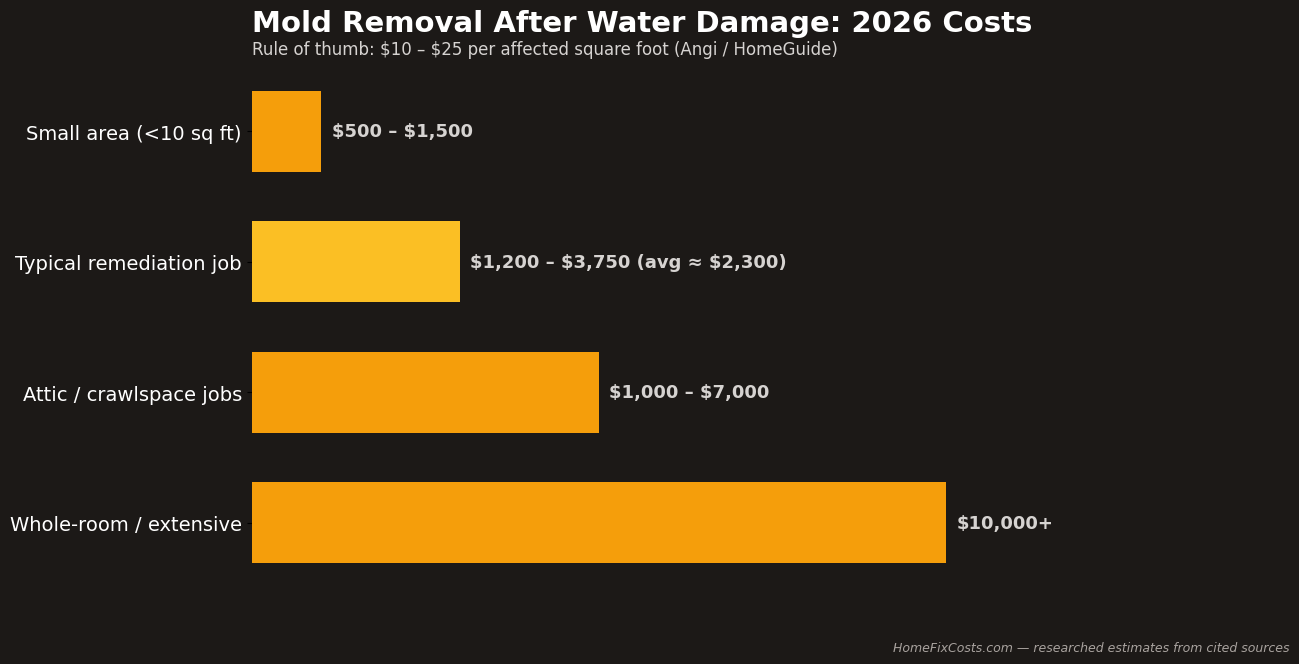
Mold remediation after water damage costs $1,223 to $3,756, with a national average of about $2,368, per HomeAdvisor’s 2026 data. Angi’s range is nearly identical at $1,125–$3,350, and pros price the work at $10–$25 per affected square foot (HomeGuide runs $15–$30). Small patches under 10 square feet are DIY-viable per EPA guidance; anything larger belongs to a pro with containment equipment.
Signs You Have a Mold Problem, Not Just a Water Problem
Mold starts colonizing wet drywall, wood and insulation within 24–72 hours of a water event. The signs that drying alone is no longer enough: a musty, earthy smell that persists after surfaces feel dry; fuzzy or speckled growth on drywall, grout or baseboards; paint or wallpaper bubbling over damp spots; and allergy-type symptoms that ease when you leave the house.
The cause is always moisture. A one-time pipe burst that got dried within two days rarely produces a mold job. Slow ceiling leaks, chronically damp basements and post-flood rooms that sat wet for a week are where the $2,000+ remediations come from. Our guides to ceiling water damage and basement flood cleanup cover those upstream fixes.
What Mold Removal Costs to Fix
| Affected Area | Typical 2026 Cost | Source |
|---|---|---|
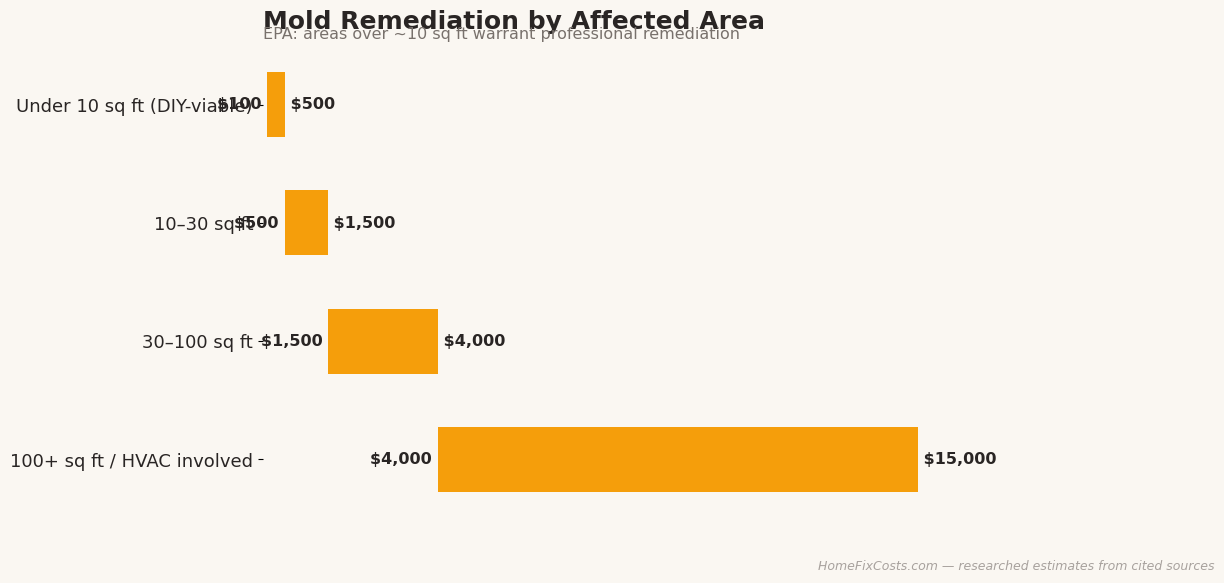
| Under 10 sq ft (DIY-viable) | $100 – $500 DIY / $500 – $1,500 pro | Angi / EPA threshold |
| Bathroom | $500 – $2,000 | HomeGuide |
| Crawl space | $500 – $2,000 (complex access: $2,000 – $10,000) | HomeGuide |
| Basement | $1,500 – $6,000 (full basement up to $15,000) | HomeGuide |
| Attic | $1,500 – $6,000 ($6,000 – $15,000 with insulation replacement) | HomeGuide |
| HVAC / ductwork involved | $3,000 – $10,000 | HomeGuide |
| Whole house | $10,000 – $30,000 | HomeGuide |
Remediation is only half the invoice. Rebuild adds, per HomeGuide’s 2026 figures, $1.50–$3.50 per square foot for new drywall, $1–$3 for painting and $2–$8 for carpet. A 100-square-foot basement wall job at $2,500 in remediation can carry another $500–$800 in rebuild. Full context on the water side is in our water damage restoration cost guide.
Why “Kill It With Bleach” Fails
Bleach whitens surface mold but does not penetrate porous drywall or wood where the roots live — and it adds moisture that feeds regrowth. Real remediation means fixing the water source, containing the area, removing colonized porous materials, HEPA-cleaning and verifying. Skip the source fix and you are renting the mold, not evicting it.
When to Call a Pro (and What a Legitimate One Does)
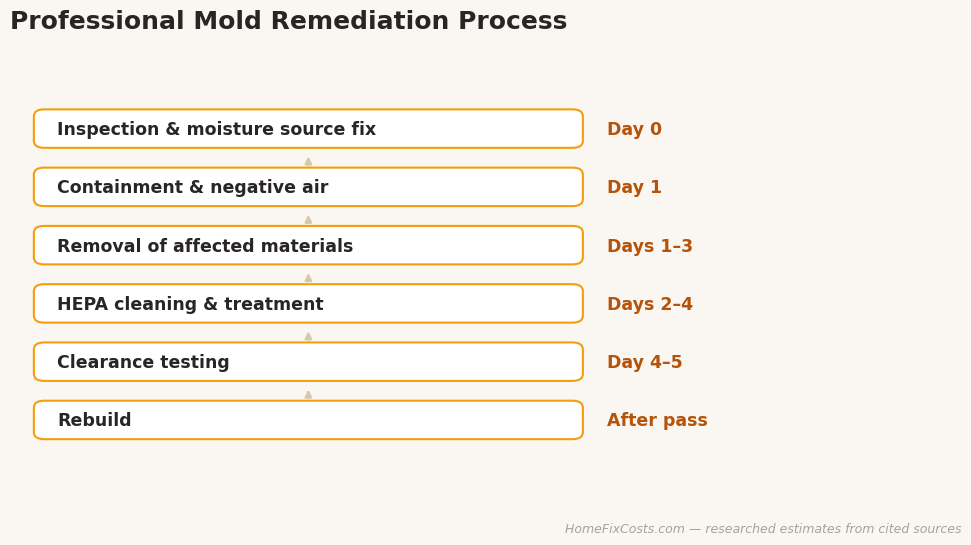
Call a pro when growth exceeds about 10 square feet (the EPA threshold), when mold follows sewage or gray water, when it is inside walls or ducts, or when anyone in the home has asthma or immune issues. A legitimate remediation quote walks through: inspection with moisture readings, containment under negative air pressure, removal of affected materials in sealed bags, HEPA vacuuming with antimicrobial treatment, clearance verification and only then rebuild.
Red flags that inflate the bill: “fogging only” solutions with no removal, no containment plan, pressure to sign same-day, and testing sold by the same company doing the remediation — a conflict of interest. Independent testing runs $250–$700 when genuinely needed, and for visible mold it usually is not: EPA guidance says if you can see it, remove it.
What Drives the Price Up or Down
Accessibility. The same 40 square feet of mold costs two or three times more in a 24-inch crawl space than on an open basement wall — HomeGuide’s complex-access crawl space range of $2,000–$10,000 versus $500–$2,000 for easy jobs shows the spread. Attics behave the same way: tight rafters and ruined blown-in insulation push a $1,500 job toward $6,000–$15,000.
Mold species and containment level. Stachybotrys (the one marketed as “black mold”) and certain Aspergillus species require stricter containment and sealed disposal, which adds labor hours and equipment time compared with common surface molds. The removal steps are the same; the protection level around them is not.
How long the water sat. Mold that grew for a weekend lives on surfaces. Mold that grew for a month lives inside wall cavities, subfloor and framing — and remediation shifts from cleaning to demolition. This is the single factor you control: same-week drying keeps most water events out of the mold table entirely.
What is attached to the moldy material. Drywall is cheap to cut out. Tiled walls, built-in cabinets and hardwood floors over wet subfloor mean the pro has to remove finished surfaces to reach the colony, and the rebuild line grows accordingly.
DIY vs. Hiring a Pro: The Honest Line
Under 10 square feet on drywall, grout or trim, with the leak already fixed: DIY is reasonable. Budget $100–$500 for an N95 respirator, gloves, plastic sheeting, a HEPA-filter shop vacuum rental and replacement materials. Scrub non-porous surfaces; cut out and bag porous ones. Do not sand dry mold — wet it lightly first so spores stay put.
Over 10 square feet, inside HVAC ducts, after sewage exposure, or in a home with asthma sufferers: hire the pro. The $1,500–$4,000 a contained professional job costs is cheaper than doing a $500 DIY job twice and then paying for the pro anyway — the most common sequence restoration firms report seeing.
Insurance: Covered, But Capped
If mold flows from a covered sudden water loss — a burst pipe, an appliance failure — cleanup is usually covered but capped, commonly at $1,000–$10,000 depending on the policy. Mold from long-term leaks, humidity or deferred maintenance is excluded almost everywhere. Document the water event with photos and dates: the causal chain is your coverage. Details in our homeowners insurance and water damage guide, and if the water was contaminated, the category matters — see water damage categories 1, 2 and 3.
Prevention: The $50 Version of a $2,400 Job
Dry any water event within 24–48 hours — fans, dehumidifier, opened wall cavities if needed. Keep indoor humidity under 60% (a $25 hygrometer tells you). Ventilate bathrooms and attics, slope soil away from the foundation, and fix drips the week they appear. Every one of those steps costs less than a single square foot of professional remediation.
Official resources & free help
- The 10 sq ft rule & DIY guidance: EPA.gov/mold — including the free “Mold Cleanup in Your Home” guide
- Health effects & safe cleanup: CDC.gov/mold
- Federal disaster aid after flooding: DisasterAssistance.gov or call 1-800-621-3362
- Renters or HUD housing with mold: report to local code enforcement / HUD.gov
- Coverage disputes: your state insurance department via NAIC
- Local emergency aid: dial 211 or visit 211.org
Frequently asked questions
How much does mold remediation cost?
Most homeowners pay $1,223–$3,756, averaging about $2,368 per HomeAdvisor’s 2026 data, at $10–$25 per affected square foot per Angi. Location drives the spread: a bathroom can be $500 while an attic with ruined insulation reaches $15,000.
Does homeowners insurance cover mold removal?
Only when the mold traces to a covered sudden water loss, and usually with a cap of $1,000–$10,000. Mold from gradual leaks or humidity is excluded. Photograph the original water event — that documentation is what gets the claim paid.
Can I remove mold myself?
Yes, for patches under about 10 square feet on non-porous or easily replaced surfaces, per EPA guidance — wear an N95, gloves and eye protection, and fix the moisture source first. Larger areas, sewage-related mold or anything in ducts warrants a pro.
Does mold removal after water damage need testing first?
Usually not for visible mold — EPA says if you can see it, remove it; testing rarely changes the plan. Independent testing ($250–$700) earns its cost for hidden-mold suspicion or clearance after large jobs.
Is black-colored mold more expensive to remove?
Color does not equal species or toxicity, and the removal process is the same careful containment-and-removal work. Some species do require stricter disposal, but do not pay a premium just for the word “black” in a sales pitch.
Prices on this page are researched estimates compiled from the cited sources; your local costs will vary with market, access and scope. Always get multiple written quotes from licensed professionals before hiring.