Last updated: August 14, 2026 · Prices reviewed quarterly
Repairing a water-damaged ceiling costs $200 to $1,500 for most homes, and up to $2,000 when the leak repair is included, per Angi 2026 data. A simple stain runs $150 to $500 to seal and repaint, while a sagging section with wet insulation can reach $2,500. The catch: none of those numbers matter until the leak above the ceiling is found and fixed, which is where the real bill — and the real savings — hides.
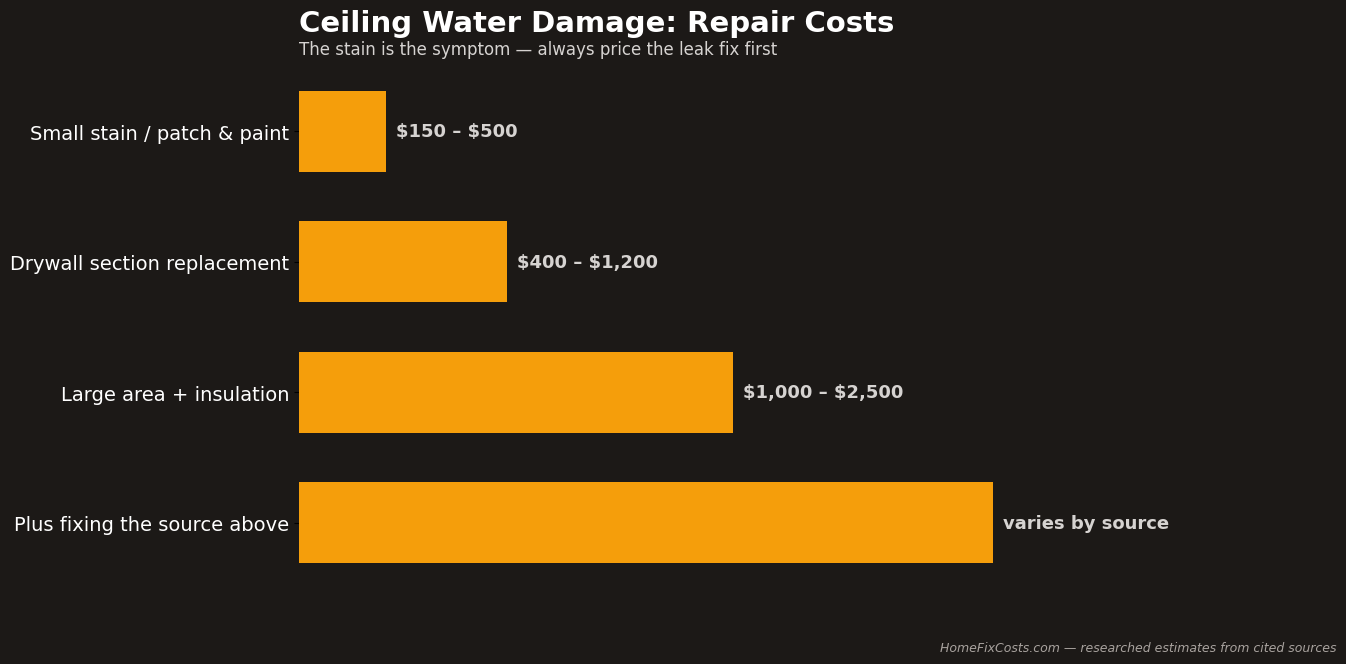
Ceiling Water Damage Repair Cost by Damage Level
| Damage level | Typical repair cost | Source |
|---|---|---|
| Water stain, drywall intact (seal + paint) | $150 – $500 | Angi / HomeGuide 2026 data |
| Soft or sagging drywall section (cut out, replace, finish) | $400 – $1,200 | Angi / HomeGuide 2026 data |
| Large area with wet insulation | $1,000 – $2,500 | Angi / Bob Vila 2026 data |
| Severe damage with structural drying or framing work | $2,500 – $10,000 | Bob Vila / restoration industry 2026 data |
| Leak source: plumbing fix | $150 – $800 | Angi 2026 data |
| Leak source: roof repair | $400 – $2,000 | Angi / HomeGuide 2026 data |
For context, general ceiling repair of any kind averages $884 nationally, with most jobs falling between $419 and $1,359, per Angi and HomeAdvisor. Water is the most common cause on that list. Ceiling drywall work itself prices at roughly $45 to $55 per square foot installed and finished, per HomeGuide, with contractors charging $60 to $90 per hour.
Three things push a quote toward the top of each range: ceiling height (staging or scaffolding adds labor), texture — popcorn and heavy knockdown finishes cost more to match, and older popcorn may need an asbestos test before disturbance — and paint matching, since a whole-ceiling repaint often makes more sense than a patch that never quite blends. None of these should double a bid; if one does, get another quote.
Signs of Trouble: Reading the Stain Before You Pay
A dry, brown ring with no softness means an old or slow leak — the cheapest scenario if the source is already dead. A dark, damp patch that grows after rain or showers means an active leak. Sagging, bubbling paint or a spongy feel means the drywall is saturated and coming down one way or another; plan on replacement, not paint.
Water travels along framing before it drops, so the stain is often several feet from the actual leak. Above a bathroom, suspect toilet seals, tub drains and supply lines. On a top floor, check roof flashing and valleys first — stains that only appear during storms point to the roof, while a steady drip points to a pressurized supply line. A plumber’s camera or roofer’s inspection at $150 to $400 beats cutting three exploratory holes in the ceiling.
What It Costs to Fix (and the Order That Saves Money)
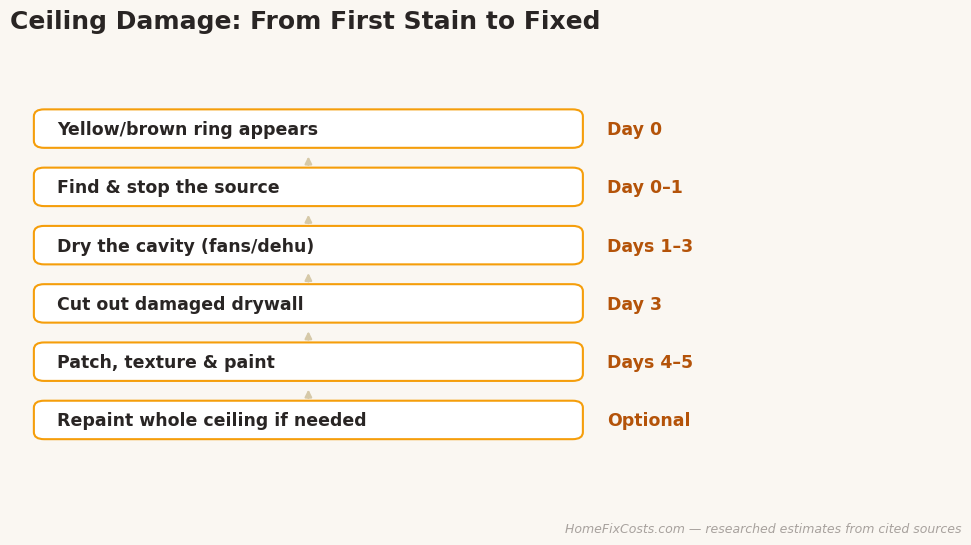
The sequence is the money-saver: stop the leak, dry the cavity, then repair cosmetics. Painting over a stain before fixing the source guarantees paying twice, and sealing moisture into the cavity feeds mold you will later pay to remove. Mold remediation costs many times more than the drywall patch it started as.
For the repair itself, small patches are flat-rate work: $150 to $500 covers stain-blocking primer and paint on intact drywall, per HomeGuide. Cut-and-replace jobs on a soft section run $400 to $1,200 including taping, texture-matching and paint, per Angi. Once wet insulation is involved, demolition grows and the range moves to $1,000 to $2,500.
If the ceiling saturated from a burst pipe or long-running leak, you may be in restoration territory: water-damaged drywall repair runs $50 to $70 per square foot including removal, replacement and finishing, per 2026 restoration industry pricing. At that point pricing works like any flood job — our cost-per-square-foot guide shows how those bills are built.
When to Call a Pro — and When It Is an Emergency
A bulging, water-filled ceiling is the one true emergency. Puncture a small drain hole over a bucket — controlled drainage beats a collapse — kill power to any affected fixtures at the breaker, and shut off the water. A saturated ceiling section can weigh well over 50 pounds, and light fixtures full of water are a shock hazard.
Call a pro when the damaged area is bigger than a couple of square feet, the same spot keeps staining, the ceiling holds insulation, or the home has plaster rather than drywall — plaster repairs run two to three times drywall rates because of labor and matching, at $60 to $120 per hour for a good plasterer. DIY is reasonable for small, verified-dry patches: a $30 moisture meter tells you the cavity is actually dry before you close it.
For insurance, sudden and accidental leaks (a burst pipe) are usually covered; slow seepage and neglected maintenance are not. File photos of the damage and the failed part before anything is repaired — our water damage insurance guide covers what adjusters actually pay.
Prevention: Cheaper Than Any Repair on This Page
Most ceiling stains trace back to a handful of preventable failures: worn toilet wax rings, unmaintained caulk around tubs, water heaters past their lifespan, and roof flashing that never gets inspected. An annual roof inspection and a five-minute look under sinks each season catch most of them early.
A stain that returns every winter in the same spot is a pattern, not bad luck — typically ice damming or a flashing failure. That calls for a roofing assessment, not another repaint. If leaks have recurred, budget for the fix once, properly: repeated wetting of the same cavity is how a $300 patch becomes a full restoration bill.
Official resources & free help
- EPA — Mold Cleanup in Your Home: epa.gov/mold — over about 10 sq ft of mold, use a professional
- Insurance Information Institute: iii.org — plain-English guides to what home policies cover
- FEMA / FloodSmart: FloodSmart.gov — flood insurance basics if water came from outside
- DisasterAssistance.gov: 1-800-621-3362 — federal help after declared disasters
- 211 (United Way): dial 211 — local emergency home repair programs for income-qualified households
Frequently asked questions
How much does it cost to fix a water-damaged ceiling?
Between $200 and $1,500 for most repairs, per Angi 2026 data — $150 to $500 for a stain, $400 to $1,200 for a replaced section. Add the leak repair itself: typically $150 to $800 for plumbing or $400 to $2,000 for a roof leak.
Can a ceiling collapse from water damage?
Yes. Saturated drywall loses strength fast, and a pooling ceiling can come down in hours. Bulging or visibly holding water means drain it through a small controlled hole immediately, cut power to nearby fixtures and keep people out of the room until it is opened and dried.
Does homeowners insurance cover ceiling water damage?
Usually yes for sudden events like a burst pipe or an appliance failure, and usually no for slow leaks and worn roofs, which insurers treat as maintenance. Document everything before repairs and keep the failed part — adjusters ask for it.
Do I need to replace drywall if it gets wet?
Not always. Drywall that got damp but dried quickly and stayed rigid can be sealed and painted. Replace it when it is soft, sagging, crumbling or stayed wet more than a day or two — and always verify the cavity is dry with a moisture meter before closing it up.
Is a plaster ceiling more expensive to repair than drywall?
Yes — plaster runs two to three times more because of labor and texture matching, with skilled plasterers charging $60 to $120 per hour versus flat-rate drywall patching. Many owners of older homes patch plaster with drywall inserts to keep costs down.
Prices on this page are researched estimates compiled from the cited sources; your local costs will vary with market, access and scope. Always get multiple written quotes from licensed professionals before hiring.