Last updated: August 15, 2026 · Prices reviewed quarterly
Restoration pros classify every water job as Category 1, 2 or 3 — and that single call can triple your cost: roughly $3–$7 per square foot for Category 1 versus $7–$25+ for Category 3, per HomeGuide and Homewyse 2026 data. The average restoration job runs $3,867 nationally ($1,384–$6,384), per HomeAdvisor. Here is what the categories mean, who decides, what each tier costs, and how to challenge a bad call.
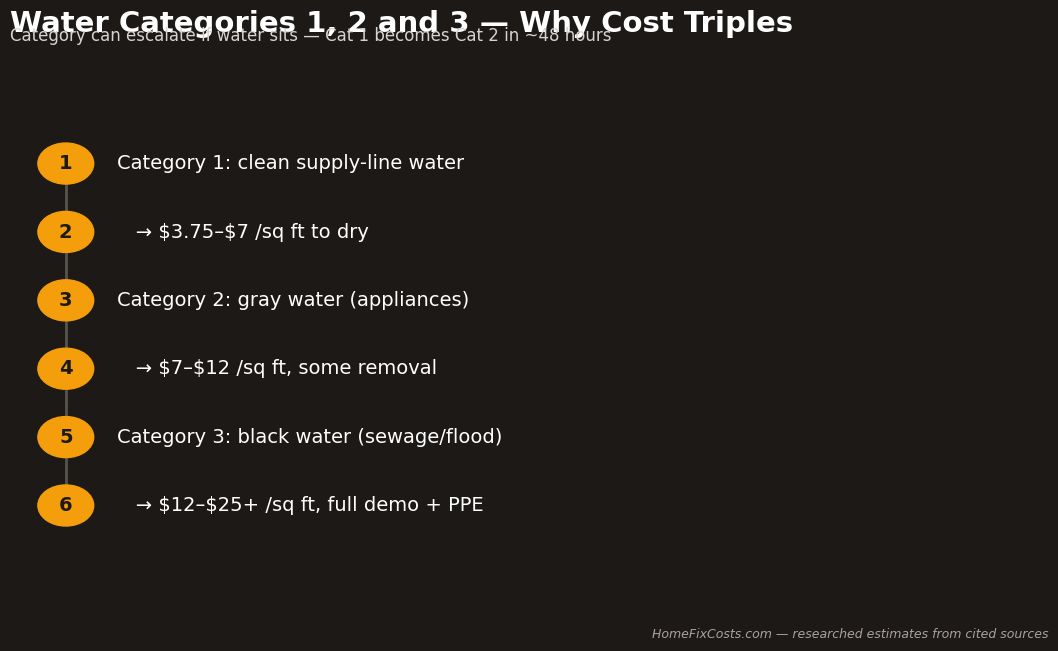
What puts your water in Category 1, 2 or 3
The category describes contamination, not volume. Category 1 is water that started clean: a burst supply line, a failed fridge line, rain through a window, a tub overflow. Category 2 (“gray water”) carries enough chemical or biological load to cause illness — washing machine discharge, dishwasher backups, toilet overflows with urine only.
Category 3 (“black water”) is grossly contaminated: sewage backups, toilet overflows with feces, rising floodwater from outside, and anything that has crossed soil or standing debris. Ground floodwater is automatically Category 3 no matter how clear it looks — it picked up whatever was in the street and the storm drains on the way in.
The source fixture matters less than what was in the water. The same toilet can produce all three categories depending on what it held when it overflowed.
What each category costs to fix
| Category | Typical sources | Cost per sq ft (2026) | What must happen |
|---|---|---|---|
| 1 — Clean | Supply lines, rain through a window, tub overflow (clean) | $3 – $7 | Extract and dry in place; minimal removal |
| 2 — Gray | Washer/dishwasher discharge, aquarium, toilet overflow (urine only) | $4 – $12 | Dry + antimicrobial treatment + remove what absorbed it (carpet pad, some drywall) |
| 3 — Black | Sewage, outside floodwater, anything 48h+ standing | $7 – $25+ | Full demo of porous materials, PPE, disposal, sanitize |
Sources: HomeGuide 2026 data (Cat 1: $3–$4; Cat 2: $4–$6.50 baseline), Homewyse 2026 data (sewage remediation $13.68–$16.89/sq ft), industry restoration pricing guides for the upper bounds.
In event terms: a contained Category 3 incident in one bathroom or laundry area runs $2,000–$8,000, with most homeowners paying $3,000–$5,000, per 2026 sewage-cleanup pricing guides. A flooded basement with sewage involvement runs $5,000–$18,000 depending on size and finishes. For the full national picture by scenario, see our water damage restoration cost guide and the per-square-foot breakdown.
The 48-hour escalator
Categories are not fixed: clean water becomes Category 2 after sitting roughly 48 hours, and gray becomes black. Bacteria multiply in warm, stagnant water regardless of where it came from. This is the single best financial argument for same-day extraction — you are literally freezing the price tier.
The escalator also runs faster in summer. Heat accelerates microbial growth, so a July supply-line leak left over a long weekend can come back Category 2 with mold starting — turning a $4-per-foot dry-out into a demo job. Timelines for each stage: how long restoration takes.
Who decides the category — and how to challenge it
The restoration contractor classifies the loss under the IICRC S500 standard, and your insurer’s adjuster can agree or dispute it. Neither call is final. If a contractor labels your dishwasher leak “Category 3” without explaining why, ask what specific contamination raised it and request the justification in writing, referencing S500.
The incentive runs both ways. An inflated category inflates per-square-foot rates and demolition scope — more tear-out, more disposal fees, more antimicrobial line items. A deflated category is the insurer-side trick: paying a Category 3 sewage loss at Category 1 rates leaves you funding the difference. Know what your policy actually covers before you sign either document.
One coverage note worth checking today: standard homeowners policies generally exclude sewer backup — the most common Category 3 event — unless you carry a sewer backup endorsement, which typically costs $40–$100 per year, per 2026 insurance guides. It is one of the cheapest riders in the industry relative to the $5,000–$18,000 losses it covers.
Category vs. Class (both appear on your estimate)
Category = how contaminated the water is. Class (1–4) = how much evaporation the structure needs — Class 1 is a corner of a room; Class 4 is saturated hardwood, plaster and concrete that dries slowest. Cost scales with both: a Category 1 / Class 4 hardwood floor can out-cost a Category 2 / Class 2 bedroom.
When you read an estimate, find both numbers. Equipment days (dehumidifiers, air movers) are driven by Class, while demolition and PPE line items are driven by Category. If the line items do not match the stated Category and Class, that is your first question for the contractor.
When to call a pro (and when DIY is defensible)
Category 1 spills caught immediately — an overflowing sink on tile, a small supply-line drip — are reasonable DIY territory if you can extract the water and run fans plus a dehumidifier the same day. Anything that reached drywall, cabinetry or subfloor deserves at least a moisture-meter inspection, because water travels sideways under flooring where you cannot see it.
Category 2 is a judgment call weighted toward pros, and Category 3 is not a judgment call. The EPA and CDC both advise against DIY sewage cleanup beyond trivial spots: the pathogens aerosolize during cleanup, and the required PPE, containment and disposal are exactly what you are paying a certified crew for.
Prevention: keeping water in Category 1 — or out entirely
Most Category 3 residential events are sewer backups and sump failures, and both have cheap countermeasures. A backwater valve on the main line blocks municipal backups; a battery backup on the sump pump covers the storm-plus-outage scenario that floods basements. Braided steel supply lines on washers and toilets eliminate the most common Category 1 source for under $20 a hose.
If water does get in, speed is everything: shut the source, photograph before touching anything, extract standing water, and get air moving. Every hour of delay pushes you toward the 48-hour escalator — and up the price table above.
Official resources & free help
- The standard your contractor should follow: IICRC S500 (ask for their certification)
- Sewage & floodwater health precautions: CDC cleanup guidance
- Flood events & recovery: Ready.gov/floods
- Flood insurance questions: FloodSmart.gov (NFIP)
- Federal disaster assistance: DisasterAssistance.gov · 1-800-621-3362
- Local emergency cleanup help: dial 211 or 211.org
Frequently asked questions
My toilet overflowed clean water. Category 1?
Tank water, yes. Bowl water with urine: Category 2. With feces: Category 3 — the fixture matters less than what was in it. Expect the contractor to classify by contents and how long the water sat, not by which fixture failed.
Rainwater through the roof — which category?
Usually Category 1–2 depending on what it crossed on the way down (roofing debris, bird droppings, attic insulation). Once it pools for 48 hours, treat it as escalated — and check the attic for saturated insulation, which holds water invisibly.
Can I clean Category 3 myself to save money?
The EPA and CDC say no for anything beyond trivial spots: sewage carries pathogens that aerosolize during cleanup. This is the one tier where pros are non-negotiable — and where cutting corners can turn a property loss into a health problem.
Does homeowners insurance cover Category 3 water damage?
Only partly. Sudden internal failures (burst pipes, appliance lines) are typically covered at any category. Sewer backups — the most common Category 3 event — are excluded from standard policies unless you carry a sewer backup endorsement ($40–$100/year). Rising floodwater is never covered by homeowners insurance; that requires separate flood insurance through the NFIP or a private carrier.
Prices on this page are researched estimates compiled from the cited sources; your local costs will vary with market, access and scope. Always get multiple written quotes from licensed professionals before hiring.