Last updated: August 10, 2026 · Prices reviewed quarterly
Structural drying takes 3 to 5 days in most homes — but “restoration” includes rebuild, so the honest full answer is a few days for a small contained leak, 1 to 2 weeks for the average job, and 2 to 6 weeks when demolition and reconstruction are involved. Restoration firms across the country report the same pattern: extraction happens in hours, drying equipment runs 3 to 7 days nonstop, and the rebuild is what decides whether you are done this week or next month.
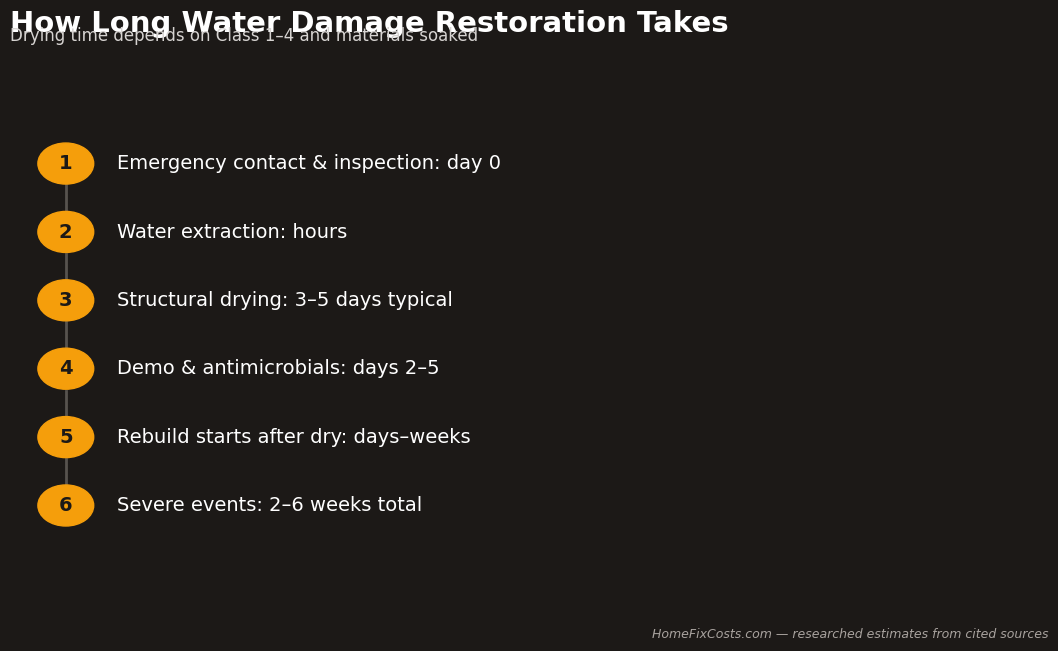
The timeline, stage by stage
| Stage | Typical duration | What happens |
|---|---|---|
| Emergency response & inspection | Same day | Moisture mapping sets the drying plan |
| Water extraction | 2 – 8 hours | Standing water pumped and vacuumed out |
| Structural drying | 3 – 5 days | Air movers + dehumidifiers, readings logged daily |
| Demo & antimicrobial treatment | Days 2 – 5 (overlaps) | Only unsalvageable materials removed |
| Reconstruction | 3 days – 4+ weeks | Drywall, flooring, paint — scope-dependent |
Timeline compiled from restoration-industry reporting (Paul Davis, RestoPros and regional restoration firms, 2025–2026), which consistently cite 3–5 day drying for moderate losses and 1–2 weeks for severe flooding.
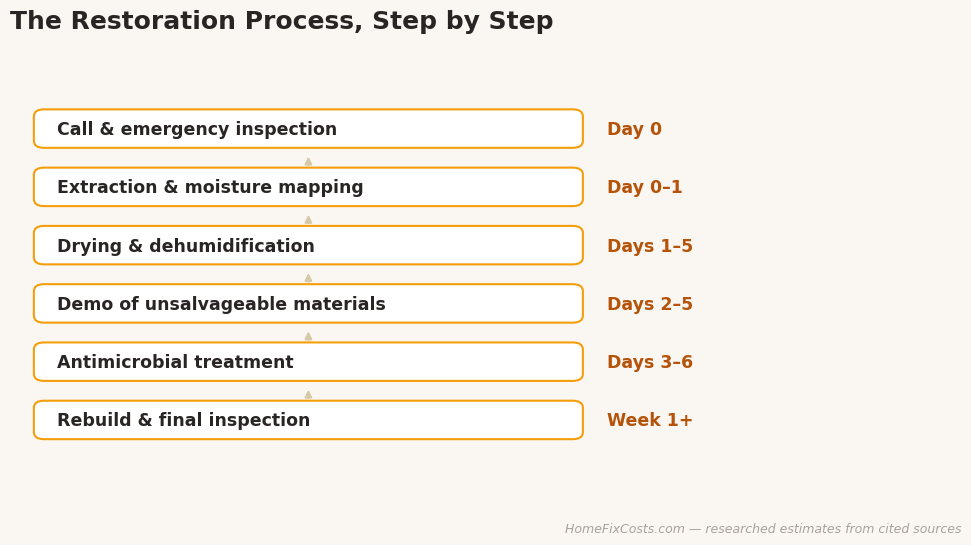
Realistic timelines by scenario
Burst supply line, caught the same day: extraction in hours, drying 3 to 5 days, often no rebuild at all. This is the best case, and it is why knowing your shutoff valve matters.
Water heater or washer failure reaching two rooms: about 1 to 2 weeks — four to five days of drying, then baseboard, drywall patches and paint.
Finished basement flood: 2 to 4 weeks. Carpet and lower drywall usually come out, drying slows against concrete, and rebuild involves flooring, framing repairs and paint.
Sewage backup or storm flooding that sat for days: 3 to 6 weeks. Full Category 3 protocol — containment, demo, disposal, sanitizing — runs before serious drying, and rebuild typically waits on the insurance scope.
What stretches the clock
Water class. Restorers grade drying difficulty from Class 1 (part of one room, little wet carpet) to Class 4 (water trapped in hardwood, plaster, concrete or masonry). Class 1 and 2 dry on the standard 3-to-5-day schedule; Class 3 means walls and ceilings absorbed water from above; Class 4 dries slowest because dense materials release moisture over days, not hours. Equipment stays until meters hit the dry standard, not until things feel dry.
Water category. Category 3 water adds containment, disposal and sanitizing steps before drying even finishes, and biohazard protocols add roughly 25% to 40% to standard labor rates per Today’s Homeowner — our guide to water damage categories explains why the same gallon of water can triple the job.
Insurance approvals. Drying starts immediately, but rebuild often waits on adjuster sign-off. Push for scope agreement in week one — our water damage insurance guide covers what adjusters actually approve.
Hidden moisture. Cavities that never got metered come back as mold weeks later — and mold remediation costs real money on top of a reopened wall.
What it costs while the clock runs
Time and money track together: every extra day of saturation moves materials from “dry in place” to “tear out and rebuild.” Angi and HomeAdvisor’s 2026 data put the average restoration job at $3,860, with a typical range of $1,383 to $6,370.
| Scope | Typical cost | Source |
|---|---|---|
| Extraction + drying only | $4 – $12 per sq ft | HomeGuide 2026 |
| Category 1 (clean water) cleanup | $3 – $4 per sq ft | Today’s Homeowner 2026 |
| Category 2 (gray water) cleanup | $4 – $7 per sq ft | Today’s Homeowner 2026 |
| Full restoration with rebuild | $20 – $37 per sq ft | HomeGuide 2026 |
| Average whole-job invoice | $1,383 – $6,370 | Angi / HomeAdvisor 2026 |
Full national pricing lives in our water damage restoration cost guide, with per-square-foot detail in the square-foot breakdown.
When to call a pro — and what a good one does
Call the same day. Mold can start on damp drywall and carpet in 24 to 48 hours, so same-day extraction matters more than any price-shopping decision you will make. Anything beyond one soaked room, any ceiling involvement, or any gray or black water is a professional job, not a shop-vac job.
A legitimate crew maps moisture on day one, logs meter readings daily, and runs equipment 24/7 — shutting fans off at night restarts drying every morning and quietly adds days. Two non-negotiables protect you: ask to see the drying log (readings should fall every day), and never let anyone pull equipment without showing final readings at or below the dry standard for your materials.
Vet the company before the equipment arrives. Look for IICRC-certified technicians, ask whether they document with photos and daily readings you can forward to your adjuster, and get the mitigation scope in writing before demo starts. You are free to choose your own restoration firm — an insurer may suggest preferred vendors, but the choice of who works on your house remains yours.
Can you live at home during it?
Category 1 or 2 with localized drying: usually yes — noisy but livable. Category 3, or drying that takes out the kitchen or your only bathroom: plan to relocate. Many policies pay Additional Living Expenses (ALE) when a covered loss makes the home uninhabitable — ask your adjuster about ALE explicitly, because it is rarely volunteered.
Prevention: keeping the next one short
The cheapest restoration is the one that stays a mop-up. Know where your main water shutoff is and label it. Replace rubber washing-machine hoses with braided stainless every 5 years or so. Put $15 leak sensors under the water heater, washer and each bathroom sink.
Twice a year, give the plumbing five minutes: check the water heater for rust or seepage once it passes year 8, look under every sink, test the sump pump by pouring in a bucket of water before storm season, and clear gutters so roof runoff drains away from the foundation.
If water does get in, act inside the first 24 hours: shut off the source, move furniture, start air movement, and photograph everything before cleanup — documentation drives what insurance ultimately pays.
Official resources & free help
- After-flood safety (power, gas, mold): Ready.gov/floods
- Federal disaster help after declared events: DisasterAssistance.gov or 1-800-621-3362
- Mold prevention while drying: EPA.gov/mold
- Flood-water contact & cleanup safety: CDC.gov/mold
- ALE / claim delays: your state insurance department via NAIC
- Local emergency housing or cleanup help: dial 211
Frequently asked questions
How long does it take for walls to dry out after water damage?
Standard drywall dries in about 3 days with professional equipment; saturated cavities, plaster and insulation can need a week or more. “Dry” means a moisture meter at the dry standard — ask for the drying log, because readings should fall daily, and flat readings mean hidden saturation.
How long does it take for mold to grow after water damage?
Growth can begin in 24 to 48 hours on damp porous materials, which is why same-day extraction beats every other decision. The EPA’s guidance is to dry wet materials within that window whenever possible.
How long should dehumidifiers run after water damage?
Continuously — 24 hours a day for typically 3 to 7 days, until readings hit the dry standard. Shutting equipment off overnight because of noise restarts the process each morning and adds days to the bill.
Can I stay in my house during water damage restoration?
Usually yes for clean-water events dried in place. Relocate for Category 3 water, or when drying takes out the kitchen or only bathroom — and check whether your policy’s ALE coverage pays for the hotel.
Why does the contractor want to demo everything immediately?
For Category 3, aggressive demo is correct — contaminated porous materials cannot be sanitized in place. For Category 1 or 2, drying in place is often possible; ask what the moisture map shows before signing a large demo scope.
Prices on this page are researched estimates compiled from the cited sources; your local costs will vary with market, access and scope. Always get multiple written quotes from licensed professionals before hiring.