Last updated: August 19, 2026 · Prices reviewed quarterly
A roof replacement costs $9,607 on average in 2026, with most projects landing between $5,900 and $14,500 for asphalt shingles, per Angi’s 2026 data. Installed cost works out to $4 to $11 per square foot for common materials, per This Old House, and premium metal, tile and slate run well past that. Here is the honest material-by-material breakdown, what actually moves the number, and where homeowners overpay.
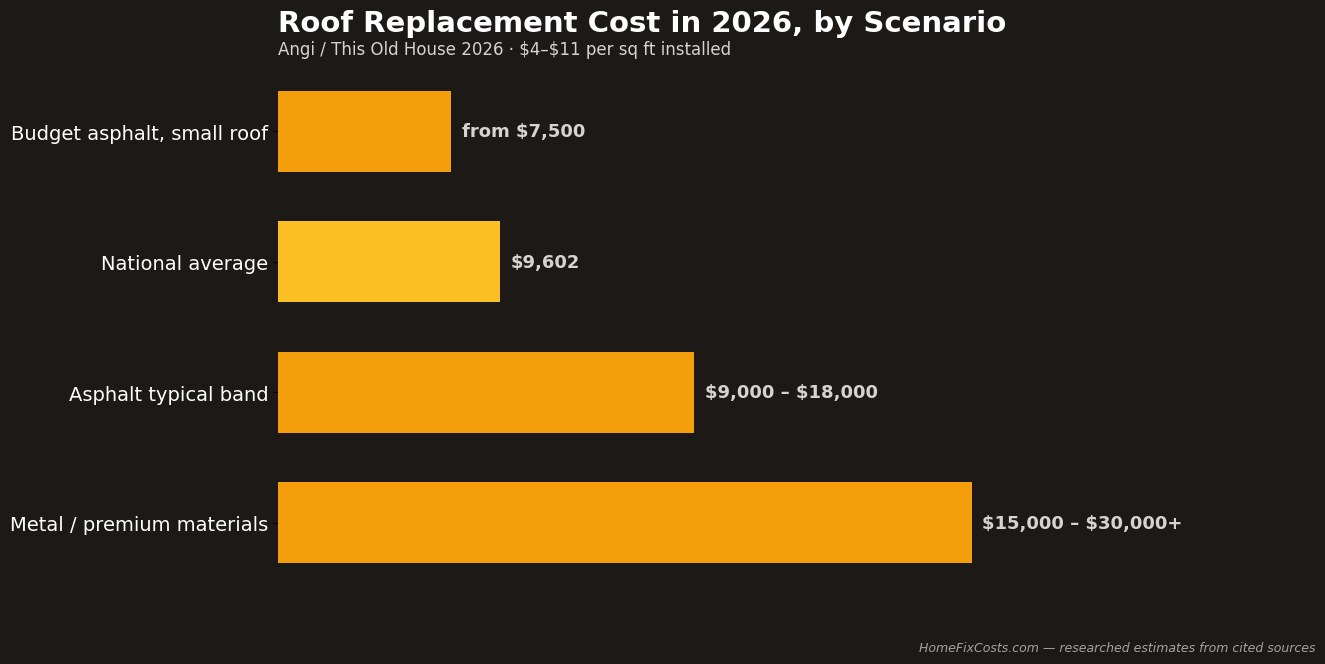
Roof Replacement Cost by Material (2026)
| Material | Installed cost (1,500–2,000 sq ft home) |
|---|---|
| 3-tab asphalt shingles | $5,840–$9,760 |
| Architectural asphalt shingles | $6,990–$14,500 |
| Metal (ribbed panels to standing seam) | $12,000–$25,000 |
| Concrete tile | $10,660–$17,800 |
| Clay tile | $15,450–$20,900 |
| Natural slate | $15–$30 per sq ft installed |
Sources: Angi and Fixr 2026 cost data; slate per This Old House.
Asphalt: still the value play
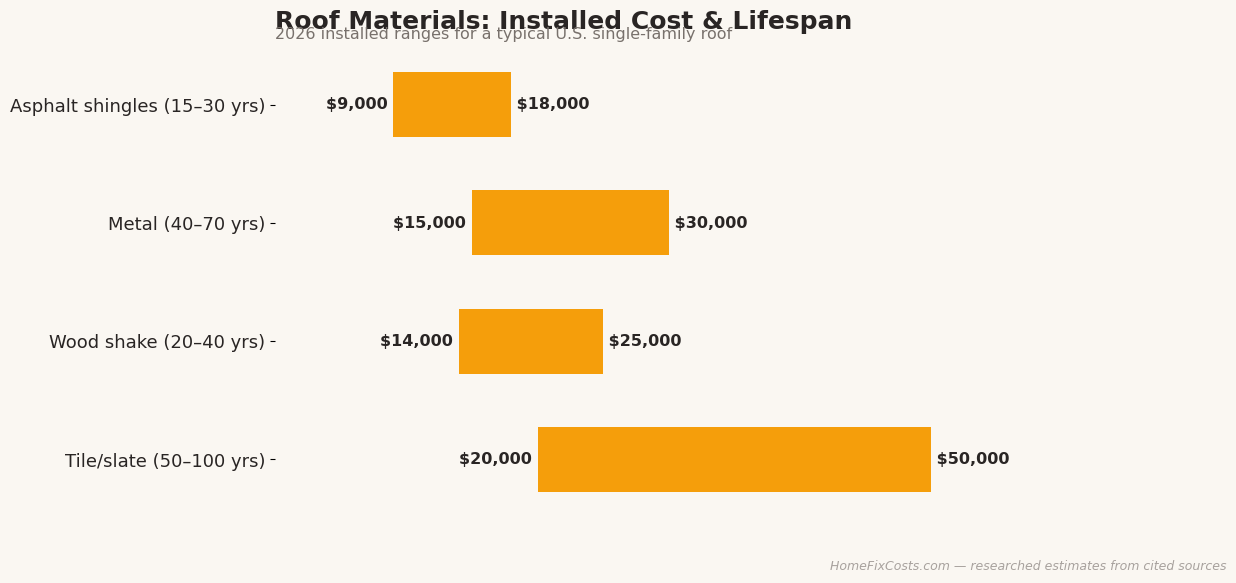
Architectural shingles cost roughly 20–40% more than 3-tab but last 25–30 years against 15–20, carry better wind ratings, and are what most insurers and buyers now expect. The upgrade usually pays for itself; bottom-tier 3-tab mainly makes sense on rentals or short-horizon sales.
Metal, tile and slate: paying for decades
Metal at $8–$14 per square foot installed (Fixr) lasts 40–70 years and shrugs off hail that totals asphalt. Tile and slate go 50–100 years but need structural review first — clay and slate are heavy, and reinforcing framing adds real money. See our full metal roof cost guide for the standing seam vs. screw-down math.
What Drives the Price Up or Down
Labor is 50–60% of the bill, per This Old House, so anything that slows the crew raises the price: steep pitch, multiple stories, dormers, valleys, skylights and chimneys. A simple one-story gable roof is the cheapest shape in roofing; a cut-up two-story with a 10/12 pitch can cost half again as much for the same square footage.
Tear-off adds $1–$5 per square foot depending on material weight and layers, per HomeGuide — shingle tear-off is typically $1–$3. Permits run $150–$500 in most jurisdictions. Decking repairs are the classic surprise: rotted sheathing discovered mid-job gets billed per sheet, so ask every bidder to state their per-sheet plywood price up front.
Timing matters in 2026: GAF announced a 5–8% price increase on residential roofing products effective April 2026, and other manufacturers followed. If your roof is at end of life, waiting a year is likely to cost more, not less.
Repair, Overlay or Full Replacement?
If damage covers less than about a quarter of the roof and the shingles have years left, repair usually wins — run the numbers in our repair vs. replacement guide. An overlay (new shingles over old) saves the $1–$3 per square foot tear-off charge but hides deck rot, voids many shingle warranties, adds weight, and most codes allow only two layers. Nearly every roofer who is not selling you the cheap option recommends tear-off.
Not sure what shape your roof is really in? A standalone roof inspection costs $75–$325 and is the cheapest insurance against replacing a roof that had five years left — or repairing one that did not.
How to Save Money on a Roof Replacement
Get three itemized bids that separate tear-off, materials, underlayment, flashing, decking repair rates and permits — single-number quotes hide markup. Schedule in late fall through winter where climate allows; crews discount when the calendar thins. Ask about last year’s shingle colors and overstock, which some suppliers move at 10–15% off.
Do not pay large deposits: reputable roofers in most markets ask 10–30% down, never half. And if a storm just hit your area, be wary of door-knockers — legitimate contractors are booked after hail events, and the ones with time to canvass are often the ones to avoid. If hail or wind caused the damage, read our hail damage claims guide before signing anything an adjuster or contractor puts in front of you.
Insurance, Wind and Hail
Homeowners insurance covers roof replacement when the cause is a covered peril — wind, hail, falling trees — not when the roof simply wore out. Two policy details decide what you actually collect: replacement-cost coverage pays for a new roof, while actual-cash-value policies deduct depreciation and can leave you with a fraction of the bill on an older roof. Many insurers now switch roofs to ACV automatically past 15–20 years of age.
After a storm, document damage with dated photos before any tarping, get your own contractor’s scope alongside the adjuster’s, and never sign an assignment-of-benefits form on the doorstep. If the numbers do not add up, your state insurance department (via NAIC below) handles complaints for free.
Our Data and Methodology
Ranges were compiled in August 2026 from Angi ($9,607 average; material ranges), Fixr (per-square-foot and material pricing), This Old House ($4–$11 per square foot; labor share; slate pricing) and HomeGuide (tear-off $1–$5 per square foot). Key figures appear in at least two sources or are attributed by name. We do not accept payment from roofing companies.
Official resources & free help
- ENERGY STAR: certified cool-roof products that cut attic heat and may qualify for utility rebates.
- DOE Energy Saver: guidance on roof ventilation, insulation and energy-smart reroofing.
- NAIC: find your state insurance department for help with denied or underpaid roof claims.
- DisasterAssistance.gov: federal help after declared storm disasters. 1-800-621-3362. For local repair-assistance programs, dial 211.
Frequently asked questions
How long does a roof replacement take?
One to three days for an average asphalt job in dry weather — tear-off in the morning, dry-in the same day, shingles by day two or three. Metal, tile and slate take one to two weeks because of panel fabrication, structural work and slower installation. Weather delays are normal; a crew that quotes weeks for basic asphalt is overbooked, and one that promises same-day completion on a large complex roof is cutting corners.
Is it cheaper to put new shingles over old ones?
Upfront, yes — an overlay saves the $1–$3 per square foot tear-off cost, per HomeGuide. Long term it usually costs more: the deck never gets inspected, trapped heat shortens the new shingles’ life, warranties are reduced or voided, and the eventual double tear-off costs extra. Most codes cap roofs at two layers, so an overlay also spends your only mulligan.
Do metal roofs really pay off?
Over a long ownership horizon, often yes. A $16,000 metal roof lasting 50+ years beats two $10,000 asphalt roofs over the same period, and insurers in hail states increasingly discount premiums for impact-rated metal. Selling within 10 years flips the math — you pay the premium and the buyer collects the lifespan. Our metal roof guide runs the full comparison.
Should I wait to replace my roof, or will prices go down?
Prices are pointed up, not down: GAF announced 5–8% increases on residential roofing effective April 2026, and competing manufacturers issued similar notices. If your roof is genuinely at end of life — widespread granule loss, curling, repeated leaks — waiting a year typically adds hundreds to a few thousand dollars. If it has real life left, there is no urgency; put the money into an inspection and targeted repairs instead.
How much does a new roof cost per square foot?
$4 to $11 per square foot installed covers most asphalt projects, per This Old House, including tear-off, underlayment and labor. Metal runs $8–$14 (Fixr), and slate $15–$30. Roofers price in “squares” (100 sq ft), so a quote of “$450 per square” means $4.50 per square foot — ask for the per-square line items to compare bids cleanly.
Prices on this page are researched estimates compiled from the cited sources; your local costs will vary with market, access and scope. Always get multiple written quotes from licensed professionals before hiring.