Last updated: July 22, 2026 · Prices reviewed quarterly
After a bad hailstorm, the real question is not “what does the repair cost” — it is “should I even file a claim.” Hail damage roof repairs average $4,250 and run from about $375 to $7,500, per Angi’s 2026 data, and a full replacement averages $9,400. But your wind/hail deductible is usually 1%–5% of your home’s insured value, so on a $400,000 dwelling limit you could owe $4,000 to $20,000 before the insurer pays a dollar. That math — repair cost versus deductible — decides whether a claim helps you or quietly costs you money.
Hail damage roof costs at a glance
These are researched ranges compiled from Angi and This Old House 2026 cost data. Use them to size up your damage before an adjuster ever climbs the ladder.
| Scenario | Typical cost | Source |
|---|---|---|
| Roof inspection (documenting damage) | $125–$600 | Angi 2026 |
| Minor spot repair (a few shingles) | $150–$375 | Angi 2026 |
| Typical hail damage repair | $375–$7,500 (avg $4,250) | Angi 2026 |
| Full replacement — 1,500 sq ft roof | $5,500–$8,000 | Angi 2026 |
| Full replacement — 2,500 sq ft roof | $9,000–$13,000 | Angi 2026 |
| Full replacement — 3,000 sq ft roof | $11,200–$16,000 | Angi 2026 |
| Full replacement — national average | $9,400 | Angi 2026 |
This Old House puts a single hail repair at an average of $940, or $4–$7 per square foot, but notes extensive damage that triggers a full replacement plus interior water repair can top $25,000. The gap between “a few shingles” and “the whole roof” is exactly why an honest inspection comes first.

The verdict in two sentences
File a claim when the damage is clearly storm-related, recent, and the repair or replacement cost comfortably clears your wind/hail deductible — that is when insurance does what you pay it for. Pay out of pocket (or don’t repair at all) when the damage is cosmetic, the bill barely beats your deductible, or your roof is old enough that the payout will be gutted by depreciation.
When filing a hail claim makes sense
Hail is a covered peril on standard homeowners policies, unlike flood or earthquake, so a legitimate storm claim is one you are entitled to. Filing makes clear financial sense in a few situations.
The damage is functional, not cosmetic. Cracked or bruised shingles that have lost their protective granules will leak — that is the kind of damage adjusters approve. If water is already showing up on your ceiling, see our roof leak repair cost breakdown, because the longer you wait the more the interior bill grows.
The repair clears your deductible with room to spare. If a 2,500 sq ft roof replacement runs $9,000–$13,000 (Angi 2026) and your deductible is $4,000, the claim is obviously worth it. When the estimated repair is only a few hundred dollars above your deductible, the calculation flips — more on that below.
The storm was recent and documented. Insurers cross-check your claim date against NOAA storm records. A claim filed days or weeks after a verifiable hail event is far stronger than one filed months later, when the carrier can argue the damage is wear and tear.
When paying out of pocket makes more sense
Sometimes the smarter move is to skip the claim, even with real damage. A single claim can raise your premium by roughly 10%–40% depending on your state and history, per insure.com, and that increase follows you for years because your claim history lives on a CLUE report for up to seven years (Quote.com). Two claims in three years is often the point where carriers non-renew.
Paying out of pocket usually wins in these cases. The damage is cosmetic — dents on a metal roof or gutters that still function. Most policies only cover functional repairs, so a cosmetic hail claim is likely to be denied anyway. A metal roof in particular can look dinged after hail without losing a day of performance.
The repair barely beats your deductible. If your out-of-pocket cost is a $2,000 deductible and the repair is $2,600, you are collecting $600 in exchange for a claim on your record and a likely premium bump — a bad trade.
Your roof is old. There is a growing industry trend of denying or non-renewing coverage on roofs 15–20 years old, and on an actual cash value policy the depreciation on an aging roof can wipe out most of the payout.
The deductible math most homeowners miss
Wind and hail claims usually do not use your flat dollar deductible. They use a separate percentage deductible — typically 1%–5% of your dwelling coverage, not the claim amount (Insureon). That distinction costs people thousands.
On a home insured for $400,000, a 1% wind/hail deductible is $4,000, a 2% deductible is $8,000, and a 5% deductible is $20,000. So even a legitimate $13,000 replacement returns nothing if you carry a 5% deductible on that home — the deductible swallows the whole loss. Check your declarations page for a separate “wind/hail” or “named storm” deductible before you assume your $1,000 all-peril deductible applies.
ACV vs. RCV: how much the check actually is
Two policies with identical coverage can pay wildly different amounts, because of how they treat depreciation.
| Policy type | What it pays | What you net |
|---|---|---|
| ACV (Actual Cash Value) | Replacement cost minus depreciation minus deductible — permanently | Least; you cover the depreciation gap yourself |
| RCV (Replacement Cost Value) | Full replacement; depreciation withheld at first, then released after work is done | Most; you recover depreciation once you finish and submit proof |
With RCV, the insurer sends an initial check for the depreciated value, then releases the “recoverable depreciation” after you complete the work and submit invoices (VIU by HUB; LegalClarity). With ACV, that depreciation is gone for good. Because hail losses have surged — NOAA logged 5,432 major hail events in 2025, led by Texas (III) — more carriers are shifting roofs onto ACV or adding roof-depreciation schedules, which quietly lowers payouts. Know which one you have before the storm, not after.
How to document damage so the claim gets approved
Most denials come down to weak evidence, not bad luck. Adjusters approve what they can see and verify, so build your file before you call the insurer.
Photograph everything, dated. Capture wide shots of each roof slope plus close-ups of bruised shingles, dented flashing, torn granules in the gutters, and any collateral hits on the AC condenser, downspouts, or siding — those support that a real hailstorm passed through.
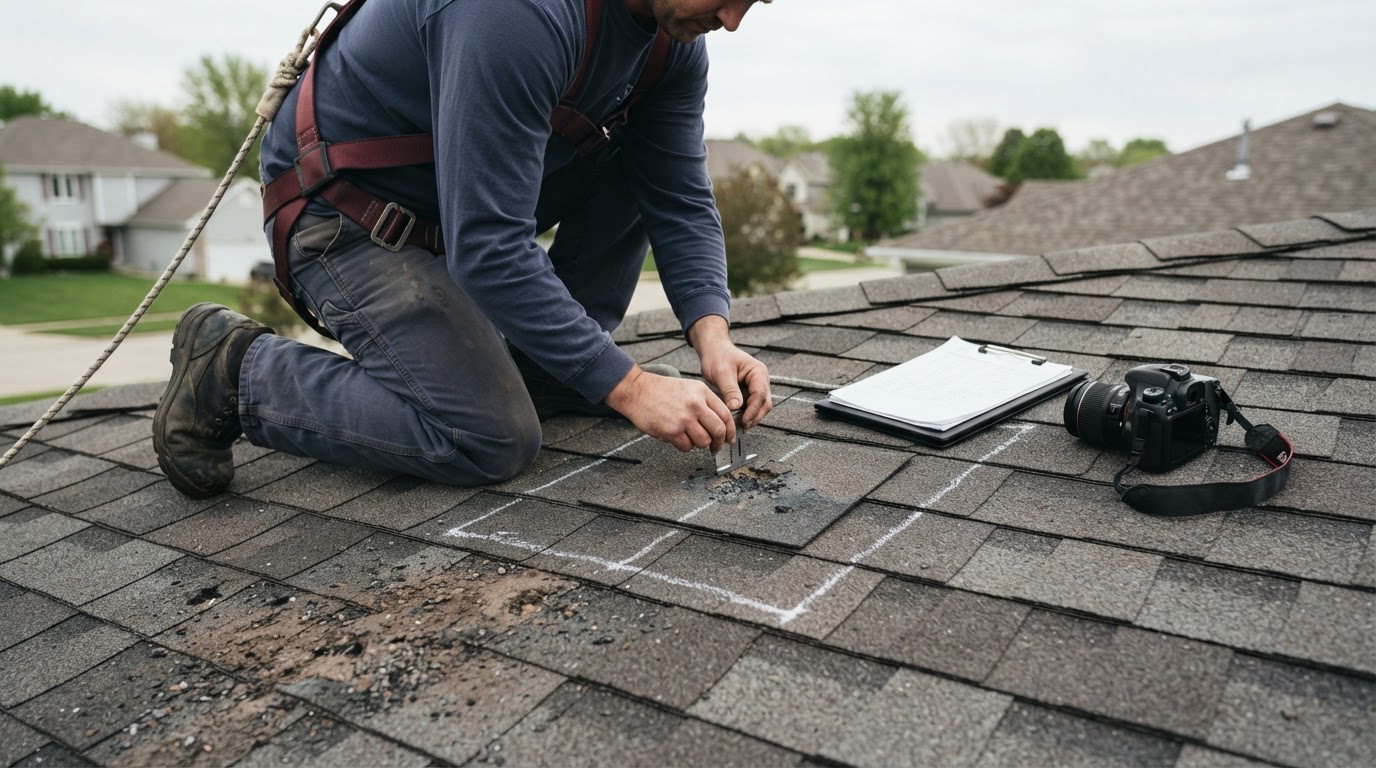
Get an independent inspection in writing. A licensed roofer’s report that marks damage inside a chalked test square is the same evidence an adjuster uses. It also gives you a number to compare against the insurer’s estimate if the two disagree.
Match the date to the storm record. Pull the hail event date from NOAA’s storm database and note it on your claim. A repair estimate that lines up with a verified storm is far harder to write off as wear and tear.
If a legitimate claim is underpaid or denied, a licensed public adjuster works for you rather than the insurer, typically for about 10% of the settlement (in Florida, fees are capped at 1% of the claim). On a small loss that fee rarely pays off; on a disputed five-figure replacement it can.
What the pros say
Contractors and adjusters converge on a few points. Always get a professional inspection before deciding — hail damage is hard to see from the ground and an inspection runs $125–$600 (Angi). Get at least three written estimates, and if you use your insurer, choose an approved contractor so the claim goes smoothly. Compare the honest repair estimate against a full replacement using our roof repair vs. replacement guide and the full roof replacement cost numbers before you commit.
If you are replacing anyway, ask about Class 4 impact-resistant shingles. They add roughly $30–$120 per square in material, but many carriers give a 10%–35% premium discount for them in hail-prone states (RoofVista 2026) — a discount that can pay for itself in a few years. And don’t forget the rest of the exterior: hail that bruises shingles usually dents gutters too, so factor in our gutter replacement cost ranges. For the insurance-coverage side of any resulting interior leak, our guide on whether homeowners insurance covers water damage explains what actually gets paid.
Official resources & free help
- NOAA Storm Prediction Center — verify the exact date and location of the hail event for your claim: spc.noaa.gov
- NAIC — look up your insurer’s complaint record and find your state Department of Insurance: naic.org
- Insurance Information Institute (III) — plain-English consumer guides on filing hail and storm claims: iii.org
- United Policyholders — nonprofit with free claim guidance and a “Roadmap to Recovery” for disputed claims: uphelp.org
- Ready.gov — severe weather and hail preparedness checklists: ready.gov/severe-weather
- FEMA Helpline — for federally declared disasters: 1-800-621-3362 · disasterassistance.gov
Frequently asked questions
How long do I have to file a hail damage roof claim?
Most policies require filing within one year of the date of loss, though the window can be as short as 30 days or as long as two years depending on the carrier (OneClick Code). Angi advises filing within six months. The clock starts on the storm date, not the day you discover the damage, so document and report quickly.
Will filing a hail claim raise my insurance premium?
It can. A single claim raises premiums roughly 10%–40% depending on your state and claim type (insure.com). Because hail is weather-related and outside your control, one claim may not move your rate — but a second claim within about three years often does, and it stays on your CLUE report for up to seven years.
Will insurance deny a claim on an old roof?
Possibly. Insurers increasingly deny or non-renew coverage on roofs 15–20 years old, and if they judge the damage to be wear, deterioration, or poor maintenance rather than a sudden storm, they can deny part or all of the claim. Actual cash value policies also factor in depreciation, so older roofs receive smaller payouts.
What is the difference between ACV and RCV on a roof claim?
An ACV (actual cash value) policy pays replacement cost minus depreciation minus your deductible, and that depreciation is gone permanently. An RCV (replacement cost value) policy pays the full replacement cost — it withholds depreciation on the first check, then releases it after you complete the work and submit proof (VIU by HUB).
Should I replace my roof after a hailstorm?
Not automatically. A severe storm can cause serious damage, but whether you need a full replacement depends on your roof’s age and prior condition. Unless the roof was already aging or in poor shape, a full replacement is often unnecessary and can be hard to get an insurer to approve. A professional inspection is the reliable way to know.
How big does hail need to be to damage a roof?
It depends on the material. Per the International Association of Certified Home Inspectors, fragile three-tab shingles can be damaged by hail about 1 inch in diameter, thicker fiberglass and wood shakes around 1.25 inches (golf-ball size), and concrete tiles around 2 inches.
Prices on this page are researched estimates compiled from the cited sources; your local costs will vary with market, access and scope. Always get multiple written quotes from licensed professionals before hiring.