Last updated: August 21, 2026 · Prices reviewed quarterly
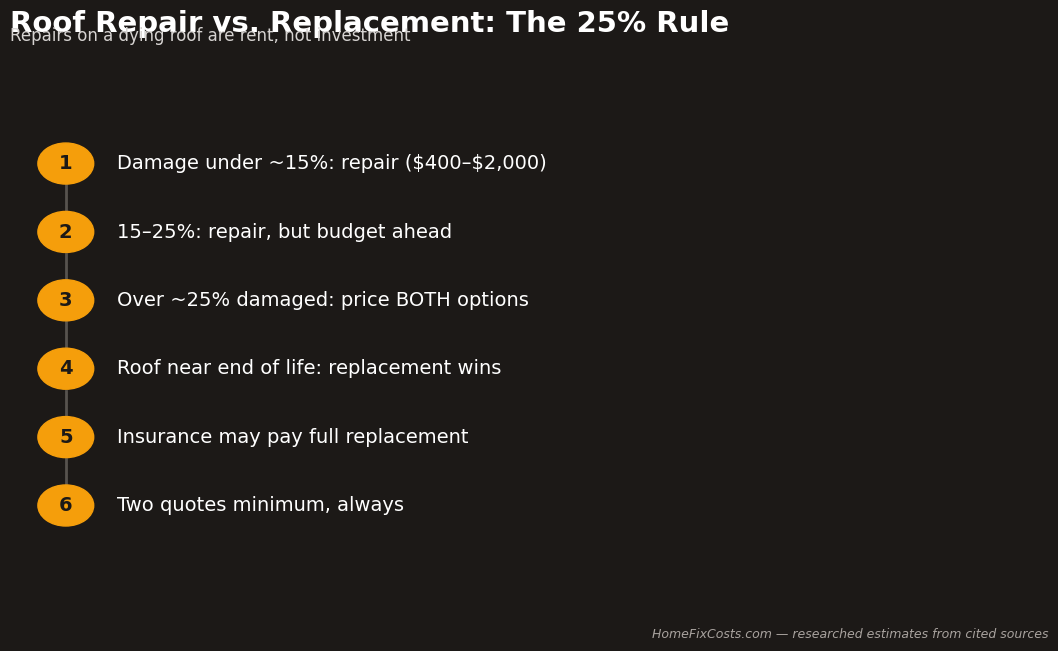
The working rule across the industry: when more than about 25% of the roof is damaged — or the roof is near the end of its material lifespan — replacement usually beats repair on cost per remaining year. Roof repairs run $395 to $1,966 per Angi’s 2026 data, while a full replacement costs $5,900 to $12,900 per Angi — and $9,000 to $18,000 for a standard asphalt roof per Modernize. Here is how to make the call with math instead of fear.
What It Costs in 2026: Repair vs. Replacement
| Scenario | Typical 2026 cost | Source |
|---|---|---|
| Minor repair (few shingles, small leak patch) | $300 – $600 | SquareDash 2026 data |
| Moderate repair (larger leak, flashing) | $600 – $1,500 | SquareDash 2026 data |
| Typical repair, full range | $395 – $1,966 (avg. ~$1,150) | Angi 2026 data |
| Full replacement | $5,900 – $12,900 | Angi 2026 data |
| Standard asphalt replacement | $9,000 – $18,000 | Modernize 2026 data |
| Asphalt shingles, installed | $4.50 – $6.50 per sq. ft. | Modernize 2026 data |
| Metal roofing, installed | $9 – $16 per sq. ft. | Modernize 2026 data |
For the full material-by-material breakdown, see our roof replacement cost guide; if the problem is a single active leak, our roof leak repair cost guide prices every leak type.
Signs It Is a Repair — and Signs It Is a Replacement
Repair territory: a few wind-lifted or missing shingles, one leak traced to a flashing joint or pipe boot, isolated hail bruising on one slope, or damage confined to a small area of a roof under 15 years old. These are localized problems on a system that still has life in it.
Replacement territory: shingles shedding granules across the whole surface, curling or clawing on multiple slopes, leaks appearing in different rooms in the same season, daylight in the attic, or any real damage on an asphalt roof past 20 years. 2026 industry guides converge on the same thresholds: replace when a repair quote passes roughly 30% of replacement cost, or when the roof has burned through about 80% of its lifespan.
The Math That Settles It
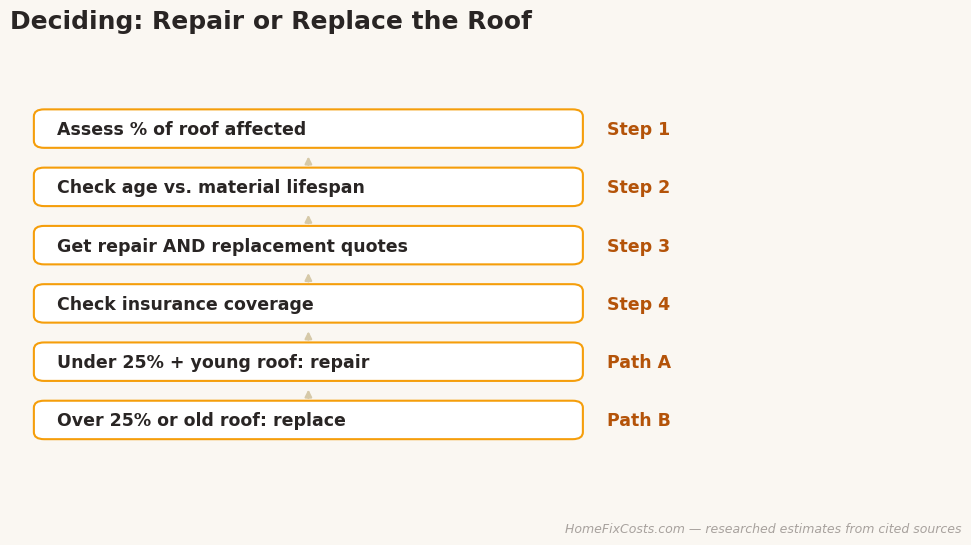
Compare cost per remaining year. A $1,500 repair that buys a 22-year-old asphalt roof three more years costs $500 per year. A $12,000 replacement lasting 25 years costs $480 per year — and removes the leak risk, the insurance friction, and the next repair bill on top.
Age thresholds by material: asphalt repairs make sense under 15 years and turn questionable past 20. Metal repairs are almost always viable inside its 40-70 year life — and if you are replacing anyway, compare against our metal roof cost guide before defaulting to asphalt. Tile roofs crack tile by tile (repair those), but the underlayment beneath lasts 20-30 years and its renewal is the real project. Wood shake past 25 years: patching chases a moving target.
What Drives a Replacement Quote Up or Down
Two roofs of identical size can quote thousands apart, and the spread is rarely about shingles. Steep pitch slows crews and adds safety rigging. A second existing layer means a heavier tear-off and disposal bill. Rotten decking discovered mid-job gets billed per sheet — ask every bidder to state their per-sheet decking price in writing before signing, because that is where “surprise” overruns live.
Material choice moves the number more than anything else: at Modernize’s 2026 rates, going from asphalt at $4.50-$6.50 per square foot to metal at $9-$16 roughly doubles the project on the same house. Complexity does the rest — valleys, dormers, skylights and chimneys each add flashing labor, which is exactly where most future leaks start.
On the repair side, access is the quiet cost driver. A one-story walkable roof takes a patch in an hour; the same patch on a three-story steep slope needs staging and a second tech, which is how a $400 job becomes a $1,200 one inside Angi’s range.
Timing helps here too: roofing crews discount late fall and winter work in most markets, while post-storm spring weeks are when prices peak and out-of-town crews with thin warranties appear. If the roof can safely wait a season, waiting is a negotiating position.
When to Call a Pro
Call a roofer the same week for: active leaks, sagging deck lines, storm damage across multiple slopes, or shingles in the yard after wind. Get three quotes on anything over $1,000 — and for a dying roof, insist each bidder prices both the repair and the replacement so you can run the cost-per-year math yourself.
A standalone roof inspection costs a fraction of a wrong decision and gives you a damage count that is not attached to a sales pitch. That count matters for insurance too: if storm damage crosses the ~25% line, or your shingle model is discontinued, many policies and several states’ “matching” rules push toward paying full slopes or full replacement rather than patchwork — our hail damage claims guide walks through that fight. Document the extent precisely before accepting a small patch settlement.
Prevention: Making Either Choice Last
Whichever way you go, the cheap habits are the same: clear gutters twice a year, trim overhanging limbs, re-seal exposed flashing when it lifts, and walk the attic with a flashlight after major storms looking for pinhole daylight and damp sheathing. Catching a $400 flashing fix before it becomes a $2,000 deck repair is the whole game.
And if a ceiling stain has already appeared, act on it — trace it properly instead of painting over it. Stains are evidence for your claim and an early warning for your deck.
Official resources & free help
- NAIC — storm claim disputes and state matching rules, via your state insurance department
- DisasterAssistance.gov — post-disaster repair help · FEMA: 1-800-621-3362
- Ready.gov — storm preparation checklists for your roof and home
- 211 — local home repair assistance programs: dial 211
- Your state contractor licensing board — verify any roofer before signing
Frequently asked questions
Is it better to repair or replace a roof?
Repair when damage is localized and the roof is under 15 years old; replace when damage tops ~25% of the surface, repairs quote past ~30% of replacement cost, or the roof is past 80% of its lifespan. The cost-per-remaining-year math above settles borderline cases.
How do I know if my roof needs to be replaced or just repaired?
Count the affected area. One slope, one leak, one flashing joint: repair. Granule loss everywhere, curling on multiple slopes, or recurring leaks in different rooms: replacement. An independent inspection gives you a number that is not a sales pitch.
What percentage of roof damage requires replacement?
There is no single legal threshold, but the industry’s working line is about 25% of the surface. Above it, repeated repair mobilizations usually cost more per year than one replacement — and insurers in matching-rule states often owe full slopes anyway.
Can I replace only half of my roof?
Yes — slope-by-slope replacement is common after one-sided storm damage. Color matching is imperfect; some insurers and states have matching provisions worth invoking before you accept a two-tone roof.
How much does it cost to fix a leaking roof?
Small leak patches run $300 to $600 and moderate leak or flashing work $600 to $1,500 per SquareDash’s 2026 data, with Angi’s overall repair range at $395 to $1,966 depending on access and material.
A roofer says the whole roof needs replacing after one leak. Should I believe it?
Get two more opinions. One leak on a young roof is a flashing or penetration fix — the 25% rule exists precisely to resist upsells.
Prices on this page are researched estimates compiled from the cited sources; your local costs will vary with market, access and scope. Always get multiple written quotes from licensed professionals before hiring.