Last updated: August 14, 2026 · Prices reviewed quarterly
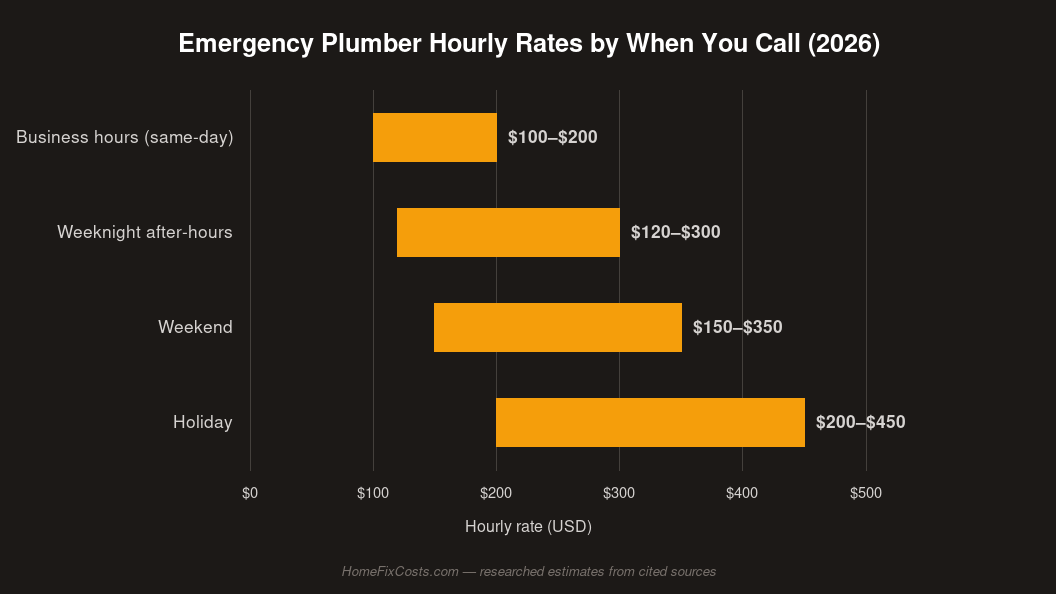
Calling a plumber outside normal business hours costs $100 to $350 per hour on average, plus a $150 to $250 emergency service fee just to get a truck in your driveway, per HomeGuide’s 2026 data. Angi puts most emergency visits between $100 and $500 all-in, with hourly rates averaging $170. The biggest price driver is not the repair itself — it is the clock. Here is what the same hour of work costs depending on when you call.
Emergency plumber rates by when you call
| When you call | Average hourly rate |
|---|---|
| Same-day visit, business hours | $100 – $200 |
| Weeknight, after hours | $120 – $300 |
| Weekend | $150 – $350 |
| Holiday | $200 – $450+ |
On top of the hourly rate, most companies add a service call fee of $150 to $250 for non-business-hours dispatch, per HomeGuide. Fixr reports flat emergency call-out fees of $200 to $300 plus $50 to $200 in trip charges. Today’s Homeowner pegs after-hours work at 1.5x to 3x a plumber’s standard rate. Always ask for the full fee structure on the phone, before anyone is dispatched.
The verdict in two sentences
If water or sewage is actively entering your home and the shut-off valve cannot stop it, pay the after-hours premium — a few hundred extra dollars in labor is cheap insurance against a water damage restoration bill that routinely runs into four figures. If the water is off and the problem can sit — one slow drain, a dripping faucet, a single clogged toilet in a two-bathroom house — wait for morning and pay standard weekday rates.
Emergency vs. waiting: what common jobs cost
| Emergency | Typical after-hours cost |
|---|---|
| Burst or leaking pipe | $500 – $5,000 |
| Clogged drain or toilet (snaking) | $300 – $800 |
| Severe clog (hydro jetting) | $600 – $1,600+ |
| No hot water (water heater repair) | $150 – $750+ |
| Water heater replacement (40–50 gal. tank) | $800 – $3,000+ |
| Sewer backup | $500 – $3,800 |
| Gas leak at an appliance line | $350 – $2,000 |
| Gas leak in a buried line | $1,000 – $5,000 |
Burst pipes sit at the top of that table because access drives the price: a supply line under a kitchen sink is a quick swap, while a line inside a wall or under the foundation means demolition — see our slab leak repair cost guide for that worst case. Sewer backups escalate the same way. Snaking out roots is a few hundred dollars; a collapsed line moves you into sewer line replacement territory.
A failed water heater is the most common “no heat, no hot water” call. If the tank itself has breached, repair is off the table and you are into full replacement — worth knowing before you approve emergency labor on a unit that is already past its lifespan.
One caution if you are considering an upgrade under pressure: HomeGuide puts tankless water heater replacement at up to $5,600. That is a decision for a calm weekday with three quotes in hand — not for midnight with a wet floor.
When calling tonight makes sense
Pay the premium when delay multiplies the damage or creates a health risk. That covers a burst pipe you cannot isolate because the main shut-off is stuck or broken, sewage backing up through floor drains or tubs, a complete loss of water to the house, and a frozen pipe that has split or is visibly bulging. It covers a break in the main water line, and — in winter, or in a household with infants or elderly members — a total loss of hot water. It also covers the only toilet in a one-bathroom home when it is fully blocked — HomeGuide lists that as a legitimate emergency, not an indulgence.
Two caveats from the safety side. If you smell gas near a water heater, leave the house and call your gas utility’s emergency line first; the plumber comes second. And if water is reaching outlets, panels or ceiling fixtures, shut off the electricity to those circuits before anyone starts working in it.
What to do while you wait for the plumber
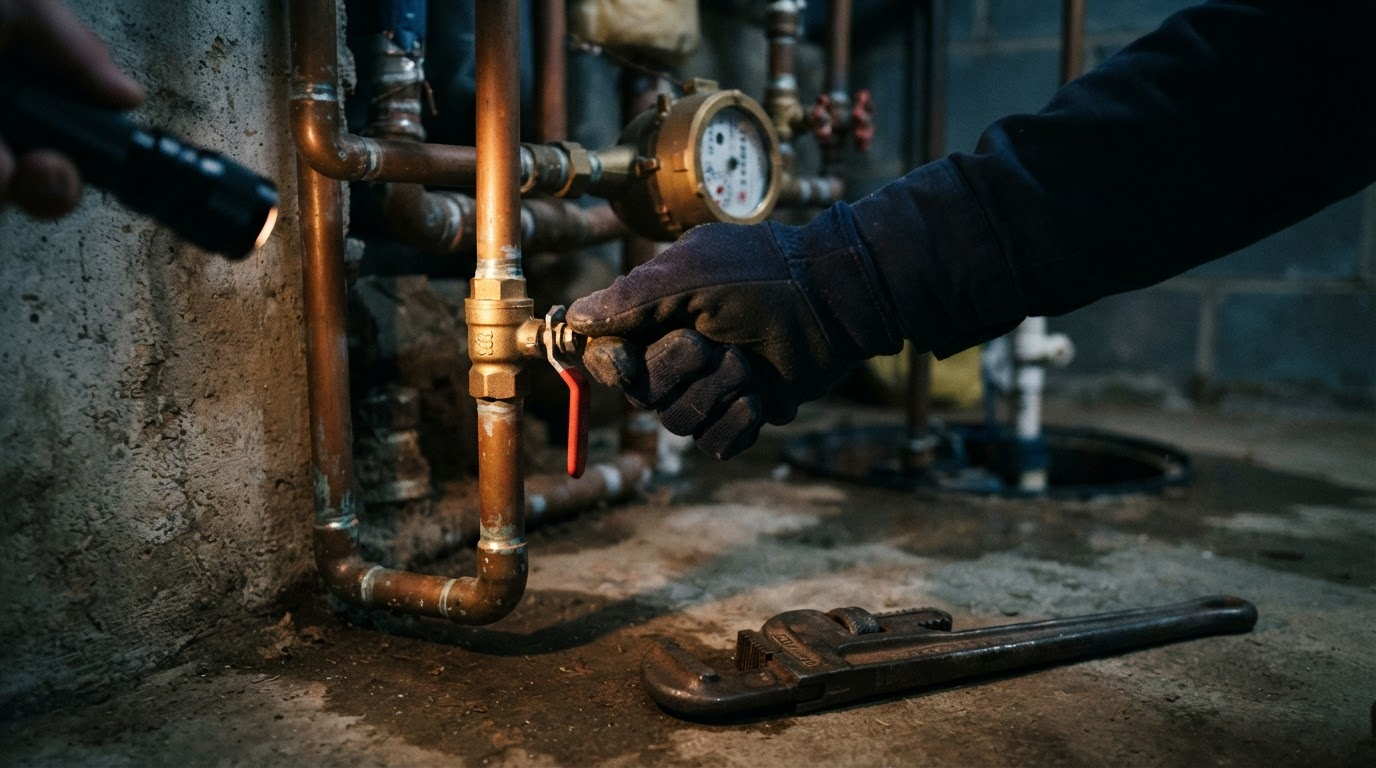
The 30 to 120 minutes before the truck arrives are where you protect your wallet. First, stop the water: close the fixture’s stop valve if the problem is local, or the main shut-off if it is not, then open the lowest faucet in the house to drain pressure out of the lines. If the water heater is leaking or its tank is emptying, turn off its gas valve or breaker so the element does not burn out dry — that mistake turns a repair into a replacement.
Then protect the claim and the job. Kill power to any circuits near standing water at the breaker panel. Take photos and video of the leak, the water line on walls, and anything damaged before you mop — insurers pay on documentation, not memory. Move furniture and rugs out of the wet zone, clear a path to the valve or fixture, and confine pets. For a frozen pipe that has not yet split, open the cabinet doors and warm the pipe gently with a hair dryer — never a torch — working from the faucet end back.
When waiting until morning makes sense
Most 10 p.m. plumbing problems are not emergencies once the water is off. A dripping faucet, a running toilet, a slow drain, one clogged fixture among several, a water heater that quit heating but is not leaking — all of these can sit overnight without further damage. Close the fixture’s stop valve or the main, put a bucket under the drip, and book the first weekday slot at the standard rate.
That single move — knowing where your main shut-off valve is and confirming it actually turns — is the cheapest insurance in plumbing. Find it now, not at 2 a.m.: it is usually where the supply line enters the house, near the water meter, or in the garage or crawl space. If yours is seized or corroded shut, replacing it is a small scheduled job that prevents a very expensive unscheduled one. While you are at it, test the stop valves under sinks and behind toilets — they seize from disuse, and each working valve is one emergency that stays a minor repair.
The cost difference in real numbers
Run the math on a two-hour repair using HomeGuide’s 2026 rate table. On a weekday afternoon at $100 to $200 per hour, labor comes to $200 to $400. The identical job on a holiday at $200 to $450 per hour runs $400 to $900 — before adding the $150 to $250 emergency dispatch fee. Same pipe, same fitting, roughly double to triple the bill. Weekends sit lower on that curve than holidays — typically 1.5x to 1.75x the weekday rate, per trade pricing guides.
That spread is why the smartest question you can ask on the phone is: “Can you stabilize it tonight and finish at your standard rate?” A pro who caps a line or isolates a fixture in one billed hour tonight, then returns Tuesday for the full repair, can cut hundreds off the total. Reputable shops offer this on their own; the rest will usually agree if you ask.
Why after-hours rates run high
The premium is not arbitrary. Plumbing companies pay overtime to keep techs on call, and every night dispatch is an hour that tech is not sleeping before a full Tuesday route. Parts are the other squeeze: supply houses mostly close on weekends, so a repair needing anything beyond what is on the truck either carries a parts premium or gets a temporary fix until Monday — another argument for stabilize-now, repair-later.
Before you say yes on the phone, get four numbers: the dispatch or trip fee, the hourly rate that applies right now, the minimum charge, and whether the fee is credited toward the repair if you approve the work. HomeGuide’s data shows response times of 30 minutes to 2 hours, so you have time to make one more call — quotes on those four numbers vary widely between companies even at midnight.
Location, trip fees and the rural surcharge
Where you live moves every number on this page. HomeGuide notes that plumbers in high cost-of-living metros charge more per hour, while homeowners outside a company’s standard service area pay for distance instead: mileage or travel-time charges on top of the $50 to $200 trip fee range Fixr reports. In rural areas, ask directly whether travel time bills at the emergency hourly rate — over a 40-minute drive each way, that answer can matter more than the repair itself.
One more phone question worth asking: whether the company waives or discounts after-hours dispatch fees for service-plan members. Many shops use membership plans exactly this way, and if you are already paying for one with your HVAC or plumbing company, tonight is when it earns its keep.
Official resources & free help
- 811 — Call Before You Dig (call811.com): free utility marking, required before any digging for water or sewer line work. Dial 811.
- DisasterAssistance.gov (disasterassistance.gov): federal help with home repairs after declared disasters, including flooding. Call 1-800-621-3362.
- 211 (211.org): connects homeowners with local emergency home-repair and utility assistance programs. Dial 211.
- EPA WaterSense (epa.gov/watersense): plain-English guidance on finding and fixing household leaks before they become emergencies.
- Ready.gov (ready.gov): how to locate and shut off your home’s water, gas and electricity in an emergency.
- USDA Section 504 Home Repair program (rd.usda.gov): repair loans and grants for lower-income rural homeowners.
Frequently asked questions
What is considered a plumbing emergency?
Anything that threatens immediate property damage, a health hazard, or total loss of water service: burst pipes, sewage backups, no water to the house, a gas leak at a water heater, frozen pipes at risk of splitting, or the only toilet in the home fully blocked. A slow drain or dripping faucet is not an emergency — it just feels like one at night.
Do plumbers charge more on weekends and at night?
Yes. HomeGuide’s 2026 data shows weeknight calls at $120 to $300 per hour, weekends at $150 to $350, and holidays at $200 to $450 or more, versus $100 to $200 during business hours. Today’s Homeowner reports the same pattern as a multiplier: 1.5x to 3x standard rates.
Why are emergency plumbers so expensive?
You are paying for standby capacity: overtime wages for on-call techs, trucks stocked for problems that cannot wait, and parts sourced while supply houses are closed. The dispatch fee covers the trip whether the fix takes twenty minutes or four hours.
Does homeowners insurance cover plumbing emergencies?
Usually for sudden, accidental events — a burst pipe and the water damage it causes — but not for damage from slow leaks or deferred maintenance, per HomeGuide. Photograph everything before cleanup, keep the failed part if you can, and call your insurer as soon as the water is off.
How quickly can an emergency plumber get to my house?
Typical response runs 30 minutes to 2 hours depending on your location, weather and how many calls are ahead of you, per HomeGuide. Ask for the estimated arrival time and the fee structure in the same phone call.
What should I ask an emergency plumber on the phone?
Four numbers and two policies: the dispatch or trip fee, the after-hours hourly rate, the minimum charge, whether the fee is credited toward the repair — plus confirmation they are licensed and insured, and their estimated arrival time. If the answers are vague, call the next company. Even at midnight you are allowed to comparison shop.
Prices on this page are researched estimates compiled from the cited sources; your local costs will vary with market, access and scope. Always get multiple written quotes from licensed professionals before hiring.