Last updated: July 13, 2026 · Prices reviewed quarterly
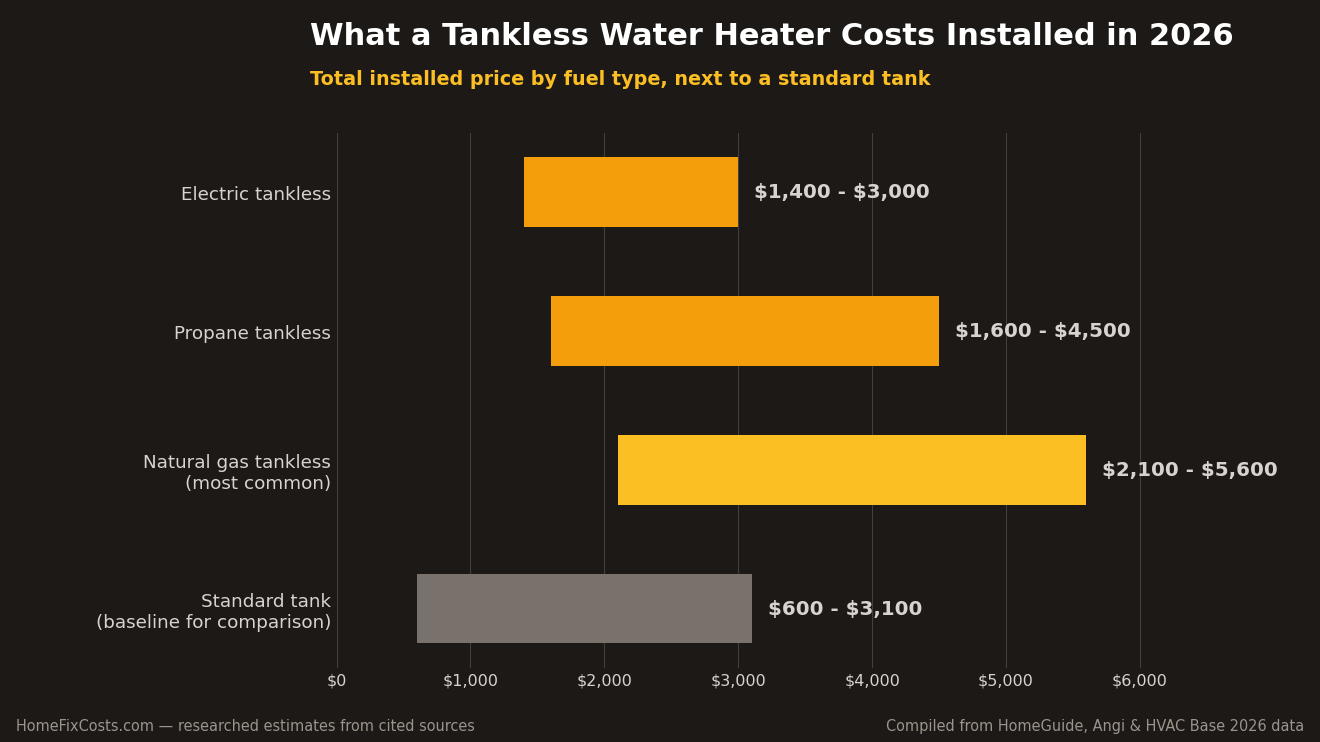
A tankless water heater costs $1,400 to $5,600 installed in 2026, with electric on-demand units at the low end ($1,400 to $3,000) and natural-gas models at the top ($2,100 to $5,600), per HomeGuide 2026 data. The unit itself is only 40% to 45% of the bill — the rest is labor, venting, gas-line, or electrical work that a tank-to-tankless switch can trigger. One thing to know before you shop: the federal tax credit that used to cover gas tankless units expired on December 31, 2025. Here is the full install math, fuel by fuel, plus where the real money hides.
| Fuel type | Unit only | Total installed (2026) |
|---|---|---|
| Electric | $600 – $1,000 | $1,400 – $3,000 |
| Propane | $1,000 – $2,000 | $1,600 – $4,500 |
| Natural gas | $1,500 – $2,600 | $2,100 – $5,600 |
Tankless water heater cost by fuel and unit type
Fuel type is the first fork in the road. Electric tankless units run $1,400 to $3,000 installed and are cheaper and simpler to put in, since there is no venting or gas line, per HomeGuide. The catch: a whole-home electric model draws serious amperage and often needs a dedicated circuit or a panel upgrade.
Natural gas is the most common choice for whole-house hot water at $2,100 to $5,600 installed, because gas units push higher flow rates and handle cold incoming water better. Propane lands in between at $1,600 to $4,500, per HomeGuide 2026 data. Gas models cost more to install but usually cost less to run than electric resistance units.
Size and design matter too. A whole-house unit is $600 to $2,600 for the equipment alone, while a single-point unit that feeds one fixture runs just $150 to $250, per HomeGuide. Condensing units cost more up front but capture exhaust heat for lower bills; non-condensing units install for about 25% less but burn more fuel over their life. If you are weighing this against staying with a storage tank, our water heater replacement cost guide breaks down the tank side.
What drives the price up or down
The equipment is the predictable part. What separates a $1,800 job from a $5,000 job is the work needed to fit a tankless unit into a house built for a tank:
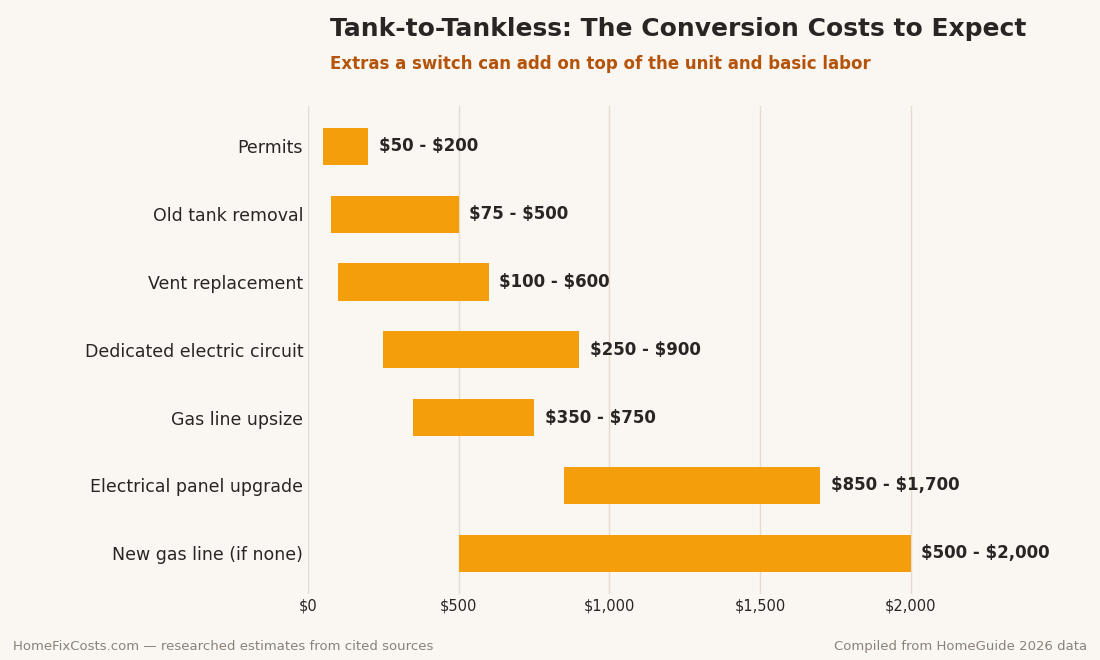
- Gas line upsizing. Tankless burners need more gas than a tank, so many homes must go from a ½-inch to a ¾-inch line: $350 to $750, per HomeGuide, and up to $2,000 if a brand-new line is run.
- Venting. Old tank vents cannot be reused. Replacing gas exhaust venting runs $100 to $600, and condensing units need special PVC venting and a condensate drain.
- Electrical. A dedicated circuit is $250 to $900; a full panel upgrade for a large electric unit is $850 to $1,700, per HomeGuide.
- Flow rate (GPM). A 7+ GPM unit for a busy household costs more than a 3.5 GPM unit sized for one bathroom.
- Labor and complexity. Plumbers and HVAC techs charge $75 to $150 an hour; electricians $50 to $130. A straight swap takes 3 hours; a full retrofit can run 10.
Those conversion extras are exactly what makes a tank-to-tankless switch cost more than the sticker on the box. Here is the range on the ones that catch people off guard:
Tankless vs. tank: the real payback math
Tankless costs more up front but lasts far longer and trims your energy bill. A standard tank installs for $600 to $3,100 and lasts 8 to 12 years; a tankless unit runs $1,400 to $5,600 and lasts 15 to 20 years, per HomeGuide. Over two decades you would buy roughly two tanks to one tankless.
| Factor | Tankless | Standard tank |
|---|---|---|
| Installed cost | $1,400 – $5,600 | $600 – $3,100 |
| Annual energy cost | $220–$480 gas / $340–$540 electric | $250–$420 gas / $530–$600 electric |
| Lifespan | 15 – 20 years | 8 – 12 years |
Here is the honest part. For gas homes the annual savings are modest — sometimes $30 to $100 a year — so most analyses put break-even between years 6 and 12. HomeGuide is more optimistic at 3 to 7 years when rebates and energy savings line up; other 2026 analyses put average households nearer year 8 to 10. Tankless wins clearly on lifespan, endless hot water, and space, not on a fast cash payback.
The 2026 tax credit and rebate reality
Read this before you trust an older guide. The federal Energy Efficient Home Improvement Credit (Section 25C) that gave up to $600 back on a qualifying gas tankless unit expired for equipment placed in service after December 31, 2025, confirmed by ENERGY STAR and the terms of the 2025 budget law. If your unit was running by that date, claim it on your 2025 return with IRS Form 5695. Installed in 2026? There is no federal credit for it.
Here is the part most sites skip: in 2026, tankless gas and electric units qualify for almost no rebate programs. The state and Department of Energy rebate money is written for heat pump water heaters, which are two to three times more efficient than electric resistance, and can draw up to $1,750 for income-qualified households. A handful of gas utilities still offer their own small rebates — UGI in Pennsylvania pays $400 on a certified natural-gas tankless, for example — so run your ZIP through the ENERGY STAR Rebate Finder before you assume there is nothing. Just go in knowing that chasing incentives usually points toward a heat pump unit, not a gas tankless.
DIY vs. hiring a pro
A gas tankless install is not a DIY job. It combines gas fitting, combustion venting, a permit, and an inspection — get any one wrong and you risk a gas leak or carbon-monoxide hazard. Labor runs $600 to $2,500, but that fee usually covers the permit, the venting, and the safety check you cannot do yourself.
- Gas connections and venting require a licensed plumber or gas fitter plus a code inspection in nearly every jurisdiction.
- Whole-home electric units often need a new circuit or panel work — electrician territory, not a weekend project.
- Most manufacturers void the warranty if a licensed pro does not perform the install.
- A pro sizes the unit to your peak GPM and temperature rise so you are not left with lukewarm showers.
The reasonable DIY zone is a small single-point electric unit for a remote sink or shed, where flow and amperage demands are low. Anything feeding the whole house belongs with a pro. If your project also touches aging supply lines, price it alongside a whole-house repipe so you are not opening the same walls twice.
How to save money on a tankless install
- Get three written quotes. Tankless pricing swings widely with gas and electrical scope. Compare what each quote includes, not just the total.
- Right-size the GPM. Buying more flow than you use wastes money up front and at the meter. Have the installer calculate peak demand and temperature rise.
- Reuse a gas line that is already big enough. If your ¾-inch line is sized correctly, you skip the single most common upcharge.
- Weigh non-condensing vs. condensing honestly. Non-condensing saves about 25% on install but costs more to run; condensing is the reverse. Pick based on how long you will stay.
- Bundle the old-tank removal. Many plumbers fold the $75 to $500 disposal into the quote — ask so it is not a surprise line item.
- Chasing rebates? Compare a heat pump water heater. That is where 2026 incentive money actually sits.
Our data and methodology
Every range on this page was compiled from published 2026 cost data at HomeGuide, then cross-checked against Angi, HVAC Base, and This Old House. Incentive and tax-credit status comes from ENERGY STAR, the U.S. Department of Energy, and the IRS. Where sources disagreed — as they did on payback period — we show the working range and explain the spread instead of picking one tidy number. We do not invent prices, and we flag any figure that rests on a single source. Big plumbing jobs like a sewer line replacement follow the same method.
Official resources & free help
- DOE Energy Saver – Tankless Water Heaters — sizing and efficiency basics at energy.gov/energysaver/tankless-or-demand-type-water-heaters
- ENERGY STAR Rebate Finder — enter your ZIP for utility rebates at energystar.gov/rebate-finder (ENERGY STAR hotline: 1-888-782-7937)
- DSIRE — searchable database of state and utility incentives at dsireusa.org
- DOE Home Energy Rebates — heat pump water heater rebates by state at energy.gov/save/home-upgrades
- LIHEAP — energy-cost help for income-qualified households: 1-866-674-6327
- 211 — dial 211 or visit 211.org for local utility and repair assistance referrals
Frequently asked questions
How much does it cost to switch from a tank to a tankless water heater?
Budget $2,100 to $5,600 for a gas conversion and $1,400 to $3,000 for electric, per HomeGuide 2026 data. The switch usually adds one or more conversion costs a simple swap does not — gas-line upsizing ($350 to $750), new venting ($100 to $600), or electrical work ($250 to $1,700) — which is why a tank-to-tankless job lands above a like-for-like tank replacement.
Is a tankless water heater cheaper to run than a tank?
Usually yes, but the gap is modest for gas. HomeGuide puts annual energy cost at $220 to $480 for gas tankless versus $250 to $420 for a gas tank, and $340 to $540 for electric tankless versus $530 to $600 for an electric tank. The savings are real but not dramatic, so lifespan and endless hot water tend to matter more than the monthly bill.
Gas or electric tankless — which is cheaper to install?
Electric is cheaper to install, typically 30% to 40% less, because it skips venting and gas-line work. Expect $1,400 to $3,000 for electric versus $2,100 to $5,600 for natural gas, per HomeGuide. Gas units cost more to install but push higher flow rates, which larger households often need.
Do tankless water heaters still qualify for a federal tax credit in 2026?
No. The Section 25C credit that gave up to $600 on a qualifying gas tankless unit expired for systems placed in service after December 31, 2025. Units installed in 2026 do not qualify. Some gas utilities still offer small local rebates, but most state and federal rebate money now targets heat pump water heaters.
What size tankless water heater do I need for a family of four?
A busy four-person home running multiple fixtures at once generally needs 7 GPM or more, per HomeGuide sizing guidance. Two-to-three fixtures at a time call for about 5 GPM, and a single shower-plus-sink setup can work on 3.5 GPM. Cold-climate homes need extra capacity because the incoming water starts colder.
How long does a tankless water heater last?
A tankless water heater lasts 15 to 20 years with proper maintenance, roughly double a standard tank’s 8 to 12 years, per HomeGuide. Annual descaling to clear mineral buildup from the heat exchanger is the single biggest factor in reaching the top of that range and keeping the warranty valid.
Prices on this page are researched estimates compiled from the cited sources; your local costs will vary with market, access and scope. Always get multiple written quotes from licensed professionals before hiring.