Last updated: July 8, 2026 · Prices reviewed quarterly
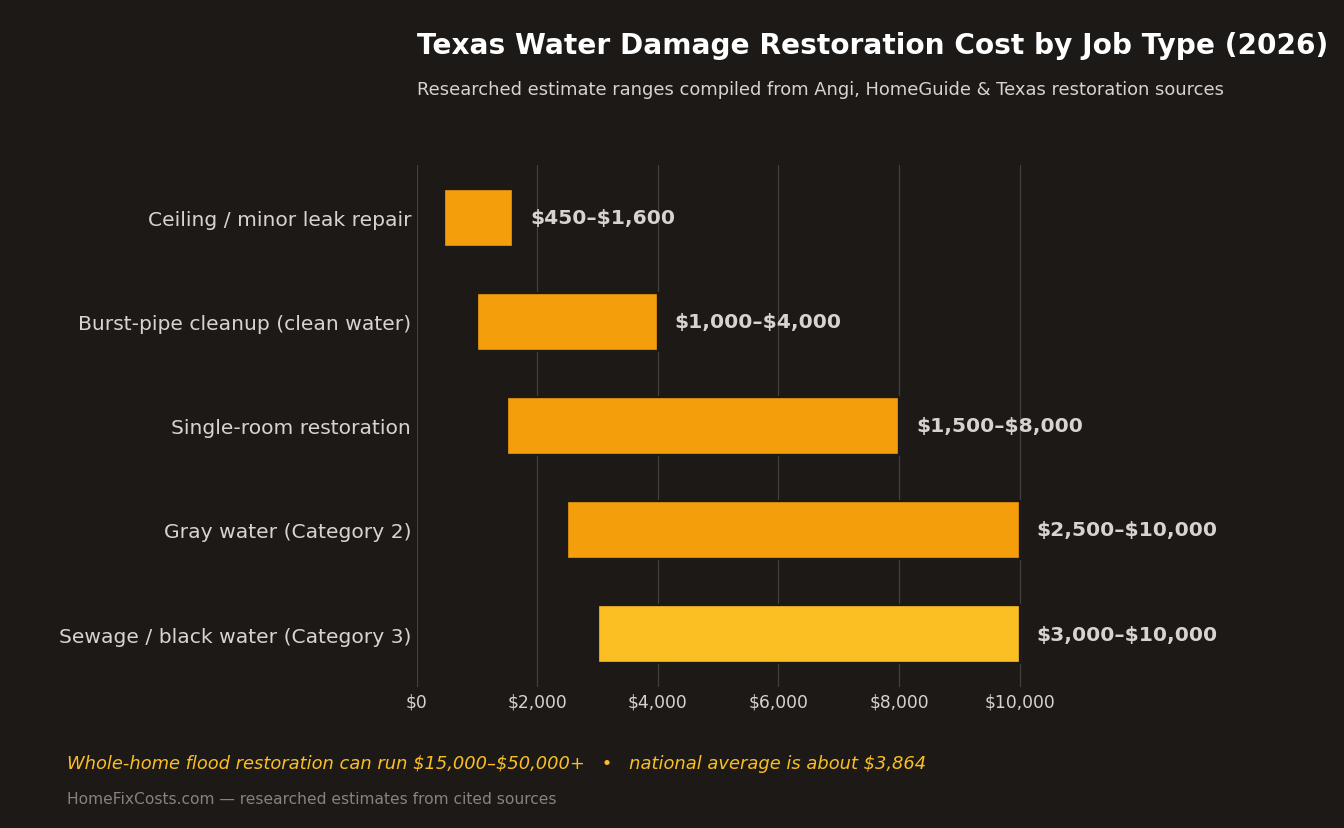
Most Texas homeowners pay about $1,000 to $15,000 for water damage restoration, with the national average landing near $3,864 (Angi / HomeAdvisor 2026 data). A single wet room from a clean-water leak often runs $1,500 to $3,000. A sewage backup or a storm-flooded floor can push past $10,000, and a whole-home flood can reach $15,000 to $50,000 or more.
What you actually pay comes down to four things: the category of water, the square footage soaked, how fast drying started, and whether mold set in. Texas then adds its own twists — below-average labor rates, expensive coastal insurance, and a strict state mold law that most homeowners never hear about until they need it.
Texas Water Damage Restoration Cost at a Glance
| Scenario | Typical Texas cost | Source |
|---|---|---|
| Ceiling / minor leak repair | $450–$1,600 | Angi 2026 data |
| Burst-pipe cleanup (clean water) | $1,000–$4,000 | Angi / HomeAdvisor 2026 |
| Single-room restoration | $1,500–$8,000 | Houston market data 2026 |
| Gray water — Category 2 | $2,500–$10,000 | HomeGuide / Angi 2026 |
| Sewage / black water — Category 3 | $3,000–$10,000+ | HomeGuide / Angi 2026 |
| Whole-home flood | $15,000–$50,000+ | Houston / Texas market data 2026 |
How Water Damage Restoration Is Priced
Restoration crews price the mitigation stage — extraction, drying, and sanitizing — at roughly $3.00 to $7.50 per square foot, according to Angi’s 2026 figures. Rebuild work (new drywall, flooring, paint) is billed separately and can add $20 to $37 per square foot once you are replacing materials, not just drying them.
The single biggest price driver is the water category, because it decides how much material has to come out:
- Category 1 — clean water (a supply line, rainwater, a leaking heater): about $3.00–$7.50 per sq ft. Most porous material can be dried in place.
- Category 2 — gray water (dishwasher, washing machine, sump overflow): about $4–$7 per sq ft nationally, and often $7–$12 in Houston once drywall and flooring come out.
- Category 3 — black water (sewage, river or storm flooding): $7–$7.50+ per sq ft, and $12–$25+ per sq ft in Houston when full demolition is needed. Every porous item the water touched must be removed and replaced.
A sewage backup is the classic Category 3 job, and it usually means tearing out and replacing the affected drain lines — see our sewer line replacement cost guide for that side of the bill. A slow supply-line failure in older galvanized plumbing can flood a wall cavity for days; if your pipes are near end of life, our house repipe cost breakdown shows what prevention runs.
What Your Restoration Dollars Actually Buy
A restoration bill is not one line item — it is five stages, and knowing them helps you read an estimate and spot padding.
- Inspection and moisture mapping. Crews use meters and infrared cameras to find water hiding inside walls and under floors. This is usually bundled into the job at no separate charge.
- Water extraction. Truck-mounted pumps and vacuums pull out standing water. This is the stage where a fast response saves the most material — and money.
- Structural drying. Commercial air movers and dehumidifiers run for 3–5 days, and you are billed per piece of equipment per day. Skipping days here is what lets mold take hold.
- Cleaning and antimicrobial treatment. Sanitizing surfaces, and for gray or black water, treating or hauling out porous materials that cannot be saved.
- Reconstruction. Replacing drywall, flooring, trim, and paint, billed separately at roughly $20–$37 per square foot.
The first three stages are the “mitigation” work insurers expect you to start right away. Reconstruction is a separate scope, and bidding it on its own — rather than letting one crew bundle everything — is where many Texas homeowners trim the final number.
Why Texas Prices Differ
Labor runs below the national average
Texas restoration labor is cheaper than in much of the country. The Bureau of Labor Statistics put the mean wage for construction laborers in the Houston metro at $20.13 an hour (May 2024), below the national median of about $22.47. That gap is one reason a straightforward Texas single-room dry-out often lands at the lower end of the national range.
Texas climate creates more — and worse — water damage
Texas files more water damage insurance claims than any other state, and the reasons stack up. Gulf hurricane season runs June through November. Flash floods hit hard and fast — the July 2025 Hill Country flood caused an estimated $18–$22 billion in damage. Just one inch of floodwater in a home can cost around $25,000 to put right, per FEMA.
Geology matters too. Much of Dallas–Fort Worth sits on expansive clay soil that swells and shrinks with the weather, cracking foundations and snapping the water lines beneath a slab. Those hidden slab leaks are common in North Texas and add $2,000–$8,000 on top of a standard restoration.
Insurance is its own Texas puzzle
A standard Texas HO-3 or HO-A policy covers sudden, accidental water from inside the home — a burst pipe, an overflowing toilet, a broken washer hose. It does not cover flooding from outside: rain, storm surge, an overflowing bayou, or street water. For that you need a separate National Flood Insurance Program policy, where the median Texas premium is about $779 a year. On the coast, wind and hail claims often route through the Texas Windstorm Insurance Association (TWIA), which covers 14 first-tier counties plus part of Harris County — but TWIA covers wind and hail only, never flood.
On the coast — Galveston, Corpus Christi, the Rio Grande Valley — many homeowners end up carrying three layers of coverage at once: a homeowners policy for internal leaks, TWIA for wind and hail, and an NFIP policy for flood. After a hurricane, a single wet house can involve all three adjusters, and sorting out which peril caused what is often where payouts stall.
Water Damage Restoration Cost by Texas City
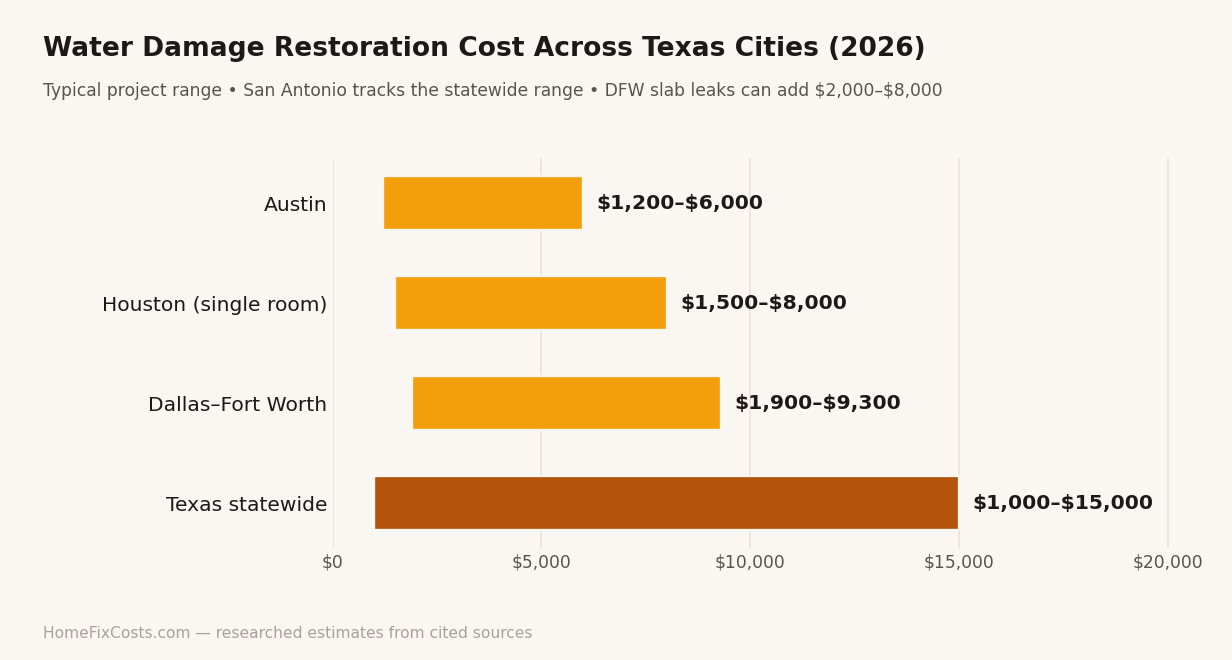
- Houston: $1,500–$8,000 for a single room; whole-home flood restoration runs $15,000–$50,000+. Gulf humidity means mold can start within a day or two, so drying speed is everything here.
- Dallas–Fort Worth: $1,900–$9,300 per Angi’s Dallas data. Budget an extra $2,000–$8,000 if a clay-soil slab leak is the source.
- Austin: $1,200–$6,000 for most jobs, with minor drying at the low end and structural flood damage at the top.
- San Antonio: no separate city index, so plan on the statewide $1,000–$15,000+ range and get local quotes.
A leaking or ruptured water heater is one of the most common single-room claims across all four metros; if yours is aging, our water heater replacement cost guide is cheaper reading than a flooded utility closet. Overflowing AC condensate lines are another quiet culprit in Texas summers — our guide on why an AC stops cooling covers the drain-line clogs that cause it.
Texas Rules, Permits, and the Mold Law You Cannot Skip
Texas does not license general contractors or water-restoration firms at the state level. You can hire anyone to extract water and set drying fans. Once demolition and rebuild start, though, your city may require permits for electrical, plumbing, or structural work — call your local building department before the crew opens a wall.
Mold is where Texas gets strict, and it catches homeowners off guard. Under the Texas Mold Assessment and Remediation Rules (Texas Occupations Code §1958, enforced by TDLR), any mold job affecting 25 contiguous square feet or more must be handled by a licensed Mold Remediation Contractor, working from a protocol written by a separate licensed Mold Assessment Consultant. You receive a Certificate of Mold Remediation at the end, which matters at resale. You can do the work yourself on your own home under the owner exemption, but if you hire out, those two licenses are not optional — and they raise the price versus a plain dry-out.
Two more Texas details worth knowing: your policy carries a “duty to mitigate,” meaning you must take reasonable steps (shut off the water, extract, start drying) or risk a reduced payout, and non-wind/hail deductibles commonly run $1,500–$5,000. Even where no state license is required for restoration, most insurers will only work with IICRC-certified firms, so that credential is the real floor for who to hire.
How to Keep the Bill Down
None of these steps need a lawyer or a general contractor — they come down to moving fast and asking for the right paperwork.
- Move in the first 24–48 hours. Drying itself takes 3–5 days; the faster it starts, the less material rots and the lower your Category jumps.
- Get two or three written estimates that separate mitigation from rebuild, so you can compare line by line.
- Photograph everything before you touch it, and know your deductible before you file — a $2,000 job under a $2,500 deductible is not worth a claim.
- Handle small clean-water areas yourself. Mold under 25 contiguous square feet does not require a licensed contractor in Texas, so a bathroom-sized dry-out can stay a DIY job.
- Verify licenses. Check any mold contractor at tdlr.texas.gov/mld before signing.
- Buy flood insurance before the storm. NFIP policies take 30 days to take effect, so waiting for a hurricane forecast is too late.
Official resources & free help
- FEMA Disaster Assistance — DisasterAssistance.gov · 1-800-621-3362. Apply for federal help after a declared disaster.
- Texas Department of Insurance Help Line — tdi.texas.gov · 800-252-3439. Free help with claim disputes and coverage questions.
- 2-1-1 Texas — dial 211 or 877-541-7905. Local disaster-recovery referrals and the STEAR registry.
- NFIP / FloodSmart — FloodSmart.gov. Flood insurance basics (standard home policies do not cover flooding).
- EPA Mold Guide — epa.gov/mold. “A Brief Guide to Mold, Moisture and Your Home.”
- TDLR Mold License Search — tdlr.texas.gov/mld. Confirm a mold contractor is licensed in Texas.
Frequently asked questions
Does homeowners insurance cover water damage in Texas?
Usually, yes — for sudden, accidental water from inside the home, such as a burst pipe or an overflowing appliance. Flooding from outside (rain, storm surge, street water) is never covered by a standard Texas policy; that requires separate NFIP flood insurance. Gradual leaks and long-term seepage are also typically excluded.
How much does water damage restoration cost per square foot in Texas?
Mitigation (extraction and drying) runs about $3.00–$7.50 per square foot for clean water. Gray water climbs to roughly $7–$12 per square foot in Houston once materials come out, and Category 3 black water reaches $12–$25+ per square foot when full demolition is required.
How long does water damage restoration take?
The drying phase typically takes 3–5 days with commercial fans and dehumidifiers. Any rebuild — drywall, flooring, paint — adds time on top of that, depending on how much material was removed.
What is the average insurance payout for water damage in Texas?
It tracks the cost of the job minus your deductible. With most Texas non-wind/hail deductibles at $1,500–$5,000 and typical restoration around the $3,864 national average, many single-room payouts land in the low thousands. Larger flood and sewage losses pay more, but only if the cause is a covered peril.
Do you need a license for mold remediation in Texas?
Yes, once the affected area reaches 25 contiguous square feet or more. Texas law then requires a licensed Mold Remediation Contractor plus a licensed Mold Assessment Consultant to write the protocol. Homeowners remediating their own property are exempt regardless of size.
Does flood insurance cover water damage in Texas?
NFIP flood insurance covers rising-water and storm-surge flooding that a standard policy excludes, with a median Texas premium near $779 a year. It does not cover internal plumbing failures — those fall under your homeowners policy. Note the 30-day waiting period before a new flood policy takes effect.
Prices on this page are researched estimates compiled from the cited sources; your local costs will vary with market, access and scope. Always get multiple written quotes from licensed professionals before hiring.