Last updated: July 9, 2026 · Prices reviewed quarterly
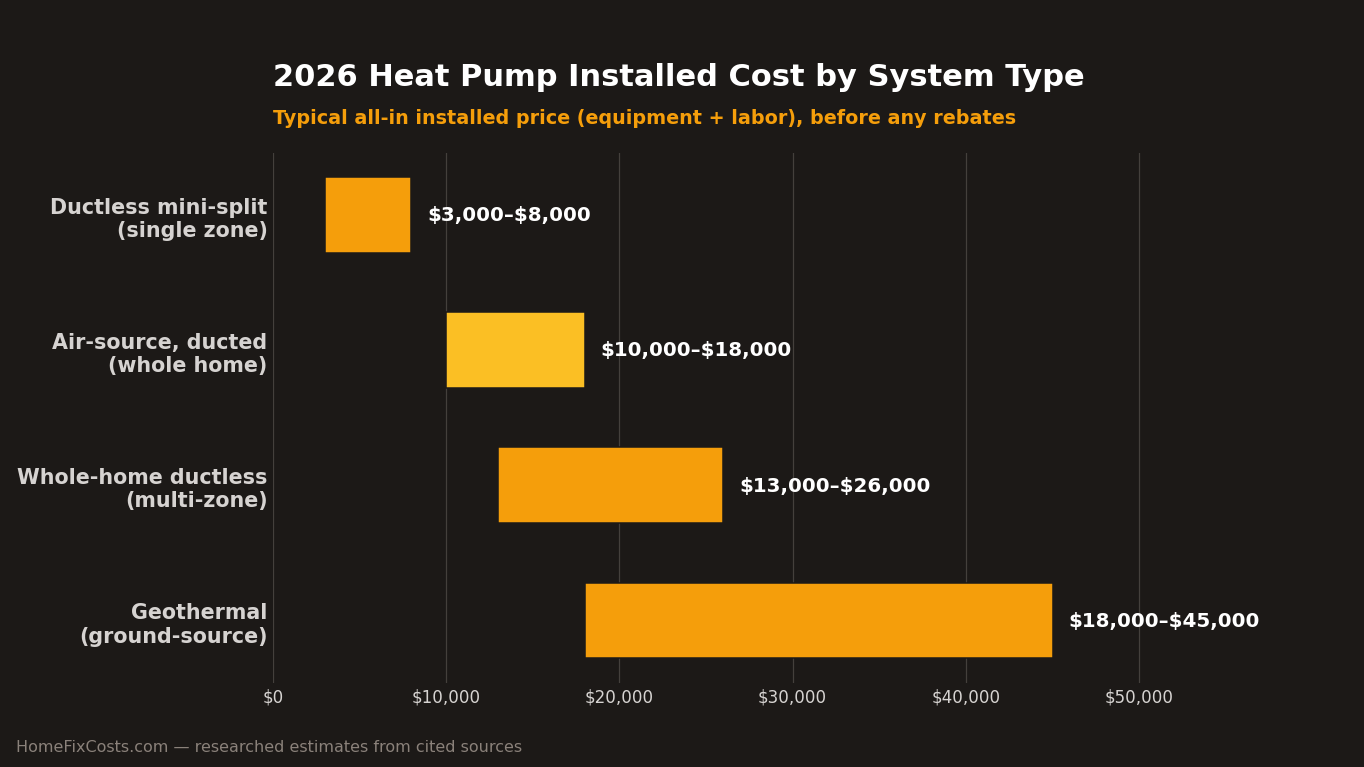
Most homeowners pay $10,000 to $18,000 to install a whole-home, ducted air-source heat pump in 2026, with the national average landing near $15,400, according to Angi and HomeGuide. A single-room ductless mini-split runs $3,000 to $8,000, while a ground-source (geothermal) system can reach $18,000 to $45,000 installed. The gap is huge because “heat pump” covers four very different systems. Below is what each one actually costs, what pushes your quote up or down, and how to keep the number honest.
| System type | Typical installed range (2026) | Best fit |
|---|---|---|
| Ductless mini-split (single zone) | $3,000–$8,000 | One room, additions, no ductwork |
| Air-source, ducted (whole home) | $10,000–$18,000 | Homes with usable ductwork |
| Whole-home ductless (multi-zone) | $13,000–$26,000 | Whole homes without ducts |
| Geothermal (ground-source) | $18,000–$45,000 | Long-term owners, top efficiency |
Heat Pump Installation Cost by System Type
An air-source heat pump is what most people mean by “heat pump.” It pulls heat from outside air to warm your home in winter and reverses in summer to cool it. If you already have ductwork, a whole-home ducted swap is the common path at $10,000 to $18,000 installed, per This Old House and HomeGuide.
Ductless mini-splits skip the ducts and mount an indoor head on the wall. One zone runs $3,000 to $8,000. Adding zones is where it climbs: a whole home covered by several heads averages close to $26,000, per Angi, because you are effectively buying multiple systems.
Geothermal moves heat through loops buried in your yard. It is the most efficient and the most expensive, at $18,000 to $45,000 installed, driven almost entirely by the drilling or trenching. HomeAdvisor puts the typical geothermal spend at $12,000 to $32,000, with complex sites going higher.
Because a heat pump both heats and cools, many owners use it to retire a separate furnace and central AC at once. If you are only weighing the cooling side, our AC unit replacement cost guide breaks down the straight air-conditioner numbers for comparison.
What You’ll Pay by Home Size
Square footage gives a rough starting point for a ducted air-source system, but it is not how a good contractor sizes the unit. Use the ranges below as a sanity check on your quote, not a final number.
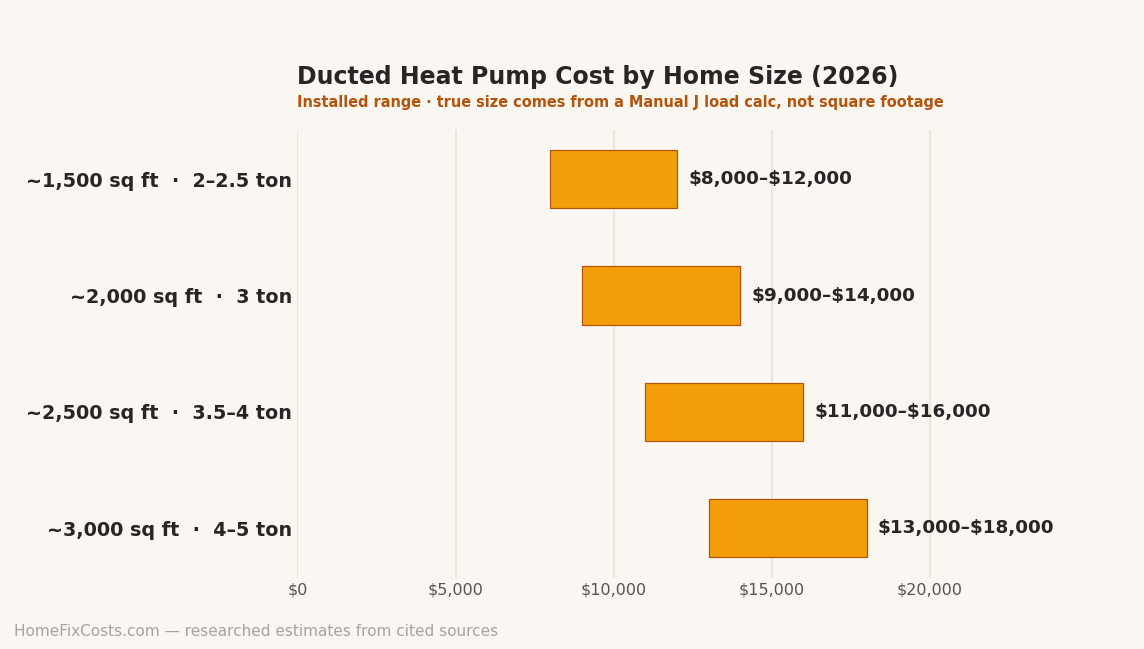
A 2,000-square-foot home usually needs about 3 tons of capacity and lands around $9,000 to $14,000 installed, per HomeGuide. The right size comes from a Manual J load calculation, which weighs insulation, windows, orientation and climate, not just floor area. A contractor who sizes by square footage alone is guessing.
What Drives the Price Up or Down
Two neighbors with the same house can get quotes $6,000 apart. These are the line items that explain the spread.
| Cost driver | Typical add-on | What triggers it |
|---|---|---|
| Labor | $75–$125/hour (50–70% of the bill) | Always; regional rates vary widely |
| Electrical panel upgrade | $1,500–$4,000 | Older 100-amp panel, needs 200-amp service |
| Permit | $50–$300 (geothermal up to $2,000) | Required in most jurisdictions |
| Ductwork repair or modification | $1,000–$5,000+ | Leaky, undersized or missing ducts |
| Cold-climate / variable-speed unit | +$2,000–$4,000 | Northern climates, premium efficiency |
Efficiency ratings also move the price. A higher SEER2 (cooling) and HSPF2 (heating) unit costs more upfront but cuts monthly bills. Ducted systems typically hit SEER2 15–20; premium ductless models reach SEER2 20–28, per EnergySage. If your home already struggles to stay cool, read why your AC is not cooling before assuming you need the largest, most expensive unit.
DIY vs. Hiring a Pro
Heat pump installation is not a DIY job for the refrigerant circuit. Charging lines requires EPA Section 608 certification, and a botched charge or brazing job voids most manufacturer warranties. Electrical tie-ins and permits also demand a licensed pro in nearly every jurisdiction.
Where a handy owner can save is the prep work: clearing the equipment pad, improving attic insulation, or sealing obvious duct leaks before the crew arrives. A DIY-friendly ductless mini-split kit exists, but self-installing usually forfeits the warranty and any rebate that requires a certified installer. For most homes, the labor is 50–70% of the bill for a reason.
How to Save Money
Buy in the off-season. Spring and fall are the cheapest times to install. In a mid-summer heat wave or a winter cold snap, crews are slammed and prices peak, per Trane and Carrier dealer data. If your current system is limping but alive, scheduling for a shoulder month can shave real dollars and get you a manufacturer promotion.
Get at least three written quotes that each include a Manual J calculation. Bids without a load calc tend to oversize the unit, which costs more and short-cycles. Do not overbuy tonnage; bigger is not better with heat pumps.
Check current rebates before you sign. The federal 25C tax credit that once returned up to $2,000 on heat pumps expired December 31, 2025 under the One Big Beautiful Bill Act, so there is no federal heat pump tax credit in 2026. State and utility rebates still exist in many areas, and income-qualified households may still find HEAR (Home Electrification and Appliance Rebate) funds worth up to $8,000, though several state programs are already fully reserved or waitlisted. Search your address on DSIRE (below) and ask your utility directly.
If you are already electrifying the house, bundling upgrades can lower per-project labor. Pairing a heat pump with rooftop solar panels or a heat pump water heater in the same season often means one panel upgrade instead of two.
Our Data and Methodology
The ranges on this page are compiled from 2025–2026 pricing published by Angi, HomeGuide, This Old House, EnergySage, Carrier, Fixr and HomeAdvisor. Every headline figure was cross-checked against at least two of those sources; where a number came from a single source, we name it in the text. We do not publish invented estimates. Local quotes will still vary with market, access and scope.
Official resources & free help
- U.S. DOE Energy Saver — heat pump basics and sizing guidance: energy.gov/energysaver
- ENERGY STAR — qualified models and the rebate finder: energystar.gov
- DSIRE — search state and utility incentives by ZIP code: dsireusa.org
- LIHEAP — help with home energy bills: 1-866-674-6327
- Dial 211 — free local referrals for energy assistance and licensed contractors
Frequently Asked Questions
How much does it cost to install a heat pump for a 2,000-square-foot house?
Plan on roughly $9,000 to $14,000 for a ducted air-source system in a 2,000-square-foot home, per HomeGuide, which usually calls for about 3 tons of capacity. Old ductwork, a panel upgrade or a cold-climate unit can push it higher.
How long does a heat pump installation take?
A straightforward single-zone or ducted swap takes about 4 to 8 hours. Multi-zone ductless jobs, ductwork changes or an electrical upgrade can stretch it to two or three days.
Is a heat pump worth the cost?
For most homes, yes over time: a heat pump replaces both heating and cooling with one efficient system and lowers monthly bills, especially versus electric-resistance or older oil and propane heat. The upfront price is higher than a like-for-like AC or furnace, so the payback depends on your energy rates, climate and how long you will stay.
What size heat pump do I need?
The correct size comes from a Manual J load calculation, not a square-footage rule of thumb. As a rough guide, a well-insulated home needs about one ton per 500 to 600 square feet, but insulation, windows and climate can shift that meaningfully. Insist on the load calc.
Does a heat pump replace both a furnace and an air conditioner?
Yes. A heat pump heats and cools, so it can retire a separate furnace and central AC. In very cold regions, many homeowners keep a backup furnace or add electric heat strips for the coldest days, which is called a dual-fuel or hybrid setup.
Are there still tax credits or rebates for heat pumps in 2026?
The federal 25C tax credit of up to $2,000 expired December 31, 2025, so there is no federal heat pump tax credit for systems installed in 2026. If you installed a qualifying unit on or before that date, you can still claim it on your 2025 return with IRS Form 5695. State and utility rebates remain in many areas, and income-qualified HEAR rebates up to $8,000 exist where funding is left, so check DSIRE and your utility before hiring.
Prices on this page are researched estimates compiled from the cited sources; your local costs will vary with market, access and scope. Always get multiple written quotes from licensed professionals before hiring.