Last updated: August 15, 2026 · Prices reviewed quarterly
The average central AC repair costs about $350, with most common fixes landing between $171 and $662, per Angi’s 2026 data. A full replacement now runs $5,500 to $12,000 installed. That gap is why the repair-or-replace call matters more than almost any other decision you will make about your cooling system — and why contractors sometimes push replacement when a $200 part would do.
The verdict in two sentences
If your AC is under 10 years old and the fix is a capacitor, a fan issue, or a simple refrigerant top-off, repair it — you are usually looking at a few hundred dollars, not thousands. If it is 12+ years old and the quote involves the compressor, the evaporator coil, or an R-22 refrigerant leak, put that money toward a new system instead.
Repair costs vs. replacement: the numbers
| Scenario | Typical 2026 cost | Source |
|---|---|---|
| Diagnostic / service call | $100 – $250 | Angi 2026 data |
| Capacitor replacement | $80 – $400 (avg. ~$175) | This Old House / Angi 2026 data |
| Refrigerant recharge | $200 – $500 | HomeAdvisor / Angi 2026 data |
| Evaporator coil replacement | $600 – $2,000 (avg. ~$1,000) | Angi / HomeAdvisor 2026 data |
| Compressor replacement | $800 – $2,800 (avg. ~$1,550) | Fixr 2026 data |
| Full central AC replacement, installed | $5,500 – $12,000 | 2026 industry pricing guides |
When repair makes sense
Repair is usually the right call when the system is under 10 years old and the failed part is cheap relative to the whole. Capacitors, contactors, condensate issues and fan problems fall into Angi’s $171–$662 common-fix band. These parts wear out on good systems too — one failure says nothing about the unit’s future.
Repair also wins when your equipment is still under a parts warranty. Most manufacturers cover major components for 10 years from registration, which can turn a $2,000 compressor job into a labor-only bill of a few hundred dollars. Dig out your paperwork before approving any major repair quote.
One caveat: a system that has been maintained annually is worth repairing far more often than one that has been ignored. A neglected 9-year-old unit can be in worse shape than a maintained 13-year-old one.
When replacement makes sense
Replacement earns its price when the unit is 12–15+ years old, when the failed part is the compressor or evaporator coil, or when the repair quote crosses roughly 30–40% of a new system’s cost — a threshold cited across 2026 industry guides. Central systems typically last 12–17 years per Angi, or 15–20 with consistent maintenance per Carrier.
Any system built before 2010 that develops a refrigerant leak is effectively a replace decision. Those units run R-22, which has been phased out — the refrigerant alone is now so expensive that even a modest leak repair rarely pencils out.
Repeated breakdowns are the other tell. Two or more service calls in a single cooling season means you are paying repair prices for replacement-grade problems. At that point, get quotes for a new AC unit and compare honestly.
The $5,000 rule (and its limits)
Multiply your system’s age by the repair quote. Over $5,000, replacement deserves serious consideration; under it, repair is usually fine. A $700 compressor-adjacent repair on a 10-year-old unit scores $7,000 — replace territory. A $250 capacitor job on the same unit scores $2,500 — just fix it.
The rule is a screen, not a verdict. It ignores warranty status, maintenance history and efficiency gains, so use it to frame the decision, then pressure-test with the factors above.
The cost difference in 2026 — why replacement got pricier
Replacement quotes jumped roughly 10–20% over last year, and the main driver is the federally mandated switch to A2L refrigerants like R-454B. The new refrigerant runs about $25 per pound versus $12 for R-410A, and redesigned coils plus required leak-detection sensors added roughly $1,500 to base installs, per 2026 HVAC industry reporting.
Efficiency partially offsets this. Stepping from a 14 to a 16 SEER2 unit trims cooling bills 10–12% per month, and a modern high-efficiency system can cut 30–50% versus a 10-to-15-year-old unit. Over a 15-year life in a hot climate, that difference is real money.
One honest warning on incentives: the federal 25C tax credit — worth up to $2,000 for qualifying equipment — expired December 31, 2025 and does not apply to 2026 installs. State and utility rebates still exist, and income-qualified households may access HEAR rebates up to $8,000. Check DSIRE (below) before assuming any discount.
What the pros say
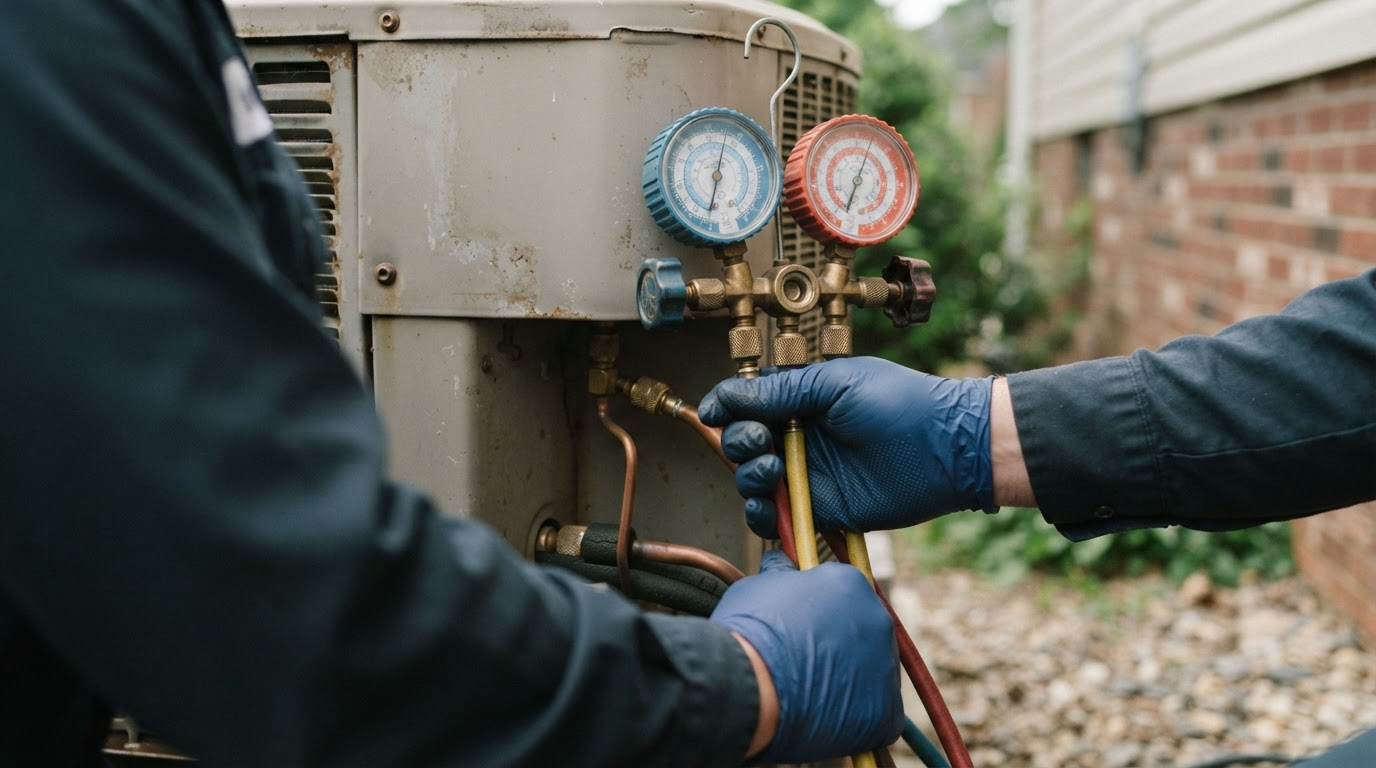
Techs consistently point to the same pattern: homeowners overpay when they make the decision during a heat wave with a dead system and one quote in hand. If your AC is limping, get quotes in spring or fall. If it dies in July, a window unit for two weeks costs $300 and buys you time to collect three written bids.
Timing also affects repair pricing itself. After-hours and weekend emergency calls carry premium rates across the industry, so a failure you can limp through until Monday morning is usually worth the wait. Keep the system off if it is making grinding or burning smells — running a failing unit can turn a $400 repair into a $2,000 one.
Ask any replacement bidder to itemize equipment, labor, permits and refrigerant. In 2026, R-454B supply is tight and some markets quote six-week install waits — a contractor who can start tomorrow at a steep discount deserves extra scrutiny, not less. If airflow is the real culprit, the problem may be your ductwork, not the unit — and if the system cools poorly but runs, start with the five common causes before assuming the worst.
Three walk-throughs with real numbers
Scenario 1: 6-year-old system, weak airflow, $220 quote. The tech finds a failed capacitor — squarely inside the $80–$400 band This Old House reports. The $5,000 rule scores 6 × 220 = $1,320. Clear repair. Pay it, ask whether the matching start components are worth replacing in the same visit, and move on.
Scenario 2: 11-year-old system, warm air, $1,900 coil quote. An evaporator coil at the top of Angi’s $600–$2,000 range. The rule scores 11 × 1,900 = $20,900 — deep in replace territory. But check the warranty first: if the coil is covered and the real bill is $600 of labor, the score drops to $6,600 and the decision tightens. No warranty? Put the $1,900 toward a new system, especially since a new coil bolted to an 11-year-old compressor leaves the next failure fully on you.
Scenario 3: 15-year-old R-22 unit, refrigerant leak, $1,400 quote. This one is not close. R-22 is phased out, the leak will recur, and the repair buys you months, not years. Every dollar spent here is a dollar not spent on the replacement you will need soon anyway. Get three written replacement bids and choose deliberately rather than in a panic later.
Notice what drives all three outcomes: age, warranty status and refrigerant type — not the brand of the unit or how loud the failure was. Bring those three facts to any quote conversation and you are ahead of most buyers.
Reading a replacement quote line by line
A trustworthy 2026 replacement bid itemizes five things: the equipment (brand, model number, SEER2 rating), labor, the electrical work, permit fees, and disposal of the old unit. If a quote shows one lump sum, ask for the breakdown in writing. Model numbers matter — they let you verify online that you are getting the efficiency tier you are paying for.
Watch for line items that quietly inflate the total: “refrigerant surcharge” beyond the factory charge, “code upgrade” bundles that are not itemized, and extended labor warranties priced above 10% of the job. None of these are automatically scams, but each should be explained to your satisfaction before you sign.
Sizing is the other silent budget killer. A contractor who quotes tonnage over the phone without a load calculation (Manual J) is guessing — and an oversized system short-cycles, dehumidifies poorly and dies younger. Insist on a measured calculation for any full replacement; reputable installers do this as standard practice.
If you repair: how to keep the bill down
Approve the diagnostic first, then ask for the repair price as parts plus labor before work starts. Angi puts service calls at $100–$250, and many shops credit that fee toward the repair — ask, because it is rarely offered unprompted.
Check your parts warranty before paying for any major component. If the unit was registered at install, compressors and coils are commonly covered for 10 years — you pay labor only. If the previous owner never registered it, some manufacturers still honor a shorter base warranty tied to the manufacture date on the nameplate.
For repairs over $1,000, a second opinion is worth the extra service fee. Misdiagnosed “compressor failures” that turn out to be a $30 start component are common enough that techs have a name for them. A one-hour second visit can save four figures.
The heat pump question
If you are replacing anyway, price a heat pump alongside a straight AC swap. A heat pump cools identically in summer and also displaces your heating fuel in winter; installed prices ran roughly $7,500–$15,000 in 2026 industry guides, against $5,500–$12,000 for cooling-only. In mild and mixed climates, the winter savings can close that gap within the system’s life — see our full heat pump installation cost guide for the math.
The case is strongest if you currently heat with electric resistance, propane or oil. It is weakest where winters are severe and natural gas is cheap — in those markets, a cooling-only replacement plus your existing furnace usually wins on total cost.
Official resources & free help
- U.S. Dept. of Energy — Energy Saver guides on central AC and efficiency: energy.gov/energysaver
- ENERGY STAR — equipment specs and rebate finder: energystar.gov
- DSIRE — every state and utility incentive in one database: dsireusa.org
- LIHEAP — help paying cooling bills for eligible households: 1-866-674-6327
- 211 — local emergency utility and cooling assistance: dial 211 or 211.org
- EPA — refrigerant transition rules and certified technician requirements: epa.gov
Frequently asked questions
How long does a central air conditioner last?
Typically 12–17 years per Angi, and 15–20 years with consistent annual maintenance per Carrier. Units in hot, humid or coastal climates land at the short end of that range.
Is it worth fixing a 10-year-old AC unit?
Usually yes for minor repairs — a capacitor or fan fix under $400 is money well spent. For a compressor or coil failure at that age, run the $5,000 rule and get a replacement quote before committing; the repair often fails the math.
What is the $5,000 rule for AC replacement?
Multiply the system’s age in years by the repair quote in dollars. Above $5,000, replacement is generally the smarter long-term spend; below it, repair. It is a screening tool — warranty coverage and maintenance history can override it.
Why is AC replacement so much more expensive in 2026?
The mandated switch to A2L refrigerants (R-454B) added redesigned coils, leak-detection sensors and refrigerant that costs about twice as much per pound. Comparable systems run 10–20% more than in 2025, per industry pricing reports.
Can I still get a federal tax credit for a new AC in 2026?
No. The 25C Energy Efficient Home Improvement Credit expired December 31, 2025. Systems installed and placed in service by that date can still be claimed on 2025 returns. For 2026 installs, look to state and utility rebates via DSIRE, plus HEAR rebates for income-qualified households.
Should I replace my R-22 air conditioner or repair it?
If an R-22 (pre-2010) system needs refrigerant work, replace it. R-22 production has ended, reclaimed supply is expensive, and any repair that touches the refrigerant circuit costs a large fraction of a new system without extending the unit’s life much.
Prices on this page are researched estimates compiled from the cited sources; your local costs will vary with market, access and scope. Always get multiple written quotes from licensed professionals before hiring.