Last updated: July 17, 2026 · Prices reviewed quarterly
Replacing the ductwork in a typical 2,000-square-foot home costs $2,000 to $5,600, based on 2026 pricing from Angi and HomeGuide. HomeGuide puts the national average at $3,500 across 399 reported projects. Angi’s average lands far lower, at $1,251. That gap is not a typo, and it is the most useful thing on this page: the industry’s own price books disagree with each other, so a quote is not automatically fair just because a contractor wrote it down.
Ductwork replacement cost by home size
Contractors price duct jobs by the foot, not by the room. Angi’s 2026 data says most homes hold 150 to 350 linear feet of duct. Here is what the two most granular price books say the same house should cost.
| Home size | Approx. duct | Angi 2026 data | HomeGuide 2026 data |
|---|---|---|---|
| 1,000 sq ft | 150 ft | $1,200 – $2,500 | $1,400 – $3,400 |
| 1,500 sq ft | 200 ft | $1,600 – $3,500 | $2,100 – $4,500 |
| 2,000 sq ft | 250 ft | $2,000 – $4,500 | $2,800 – $5,600 |
| 2,500 sq ft | 300 ft | $2,500 – $5,500 | $3,500 – $6,700 |
| 3,000 sq ft | 350 ft | $3,000 – $7,000 | $4,200 – $7,800 |
Notice the two columns never match. HomeGuide runs roughly 20% to 40% higher at every size. Angi’s $1,251 national average almost certainly reflects a mix of partial jobs and single-run swaps rather than whole-house tear-outs, while HomeGuide’s $3,500 average reflects bigger scopes. When a contractor quotes you $4,200 for a 2,000-square-foot house, that number is defensible under one price book and high under the other. Both can be right.
Cost by duct material
Material is where a salesperson can move your total by thousands. These are material-only prices, before labor and markup, and HomeGuide and This Old House land in nearly the same place, which is a good sign the numbers are real.
| Duct type | Material only, per ft (HomeGuide / This Old House 2026) | Realistic lifespan |
|---|---|---|
| Flexible, non-insulated | $1 – $3 (both sources agree) | 10 – 20 yrs |
| Flexible, insulated | $2 – $4 (both sources agree) | 10 – 20 yrs |
| Fiberboard / fiberglass | $4 – $6 / $4 – $7 | 10 – 15 yrs |
| Sheet metal (galvanized or aluminum) | $7 – $13 / $7 – $15 | 20+ yrs |
Installed, Angi’s 2026 figures put flexible duct at $10 to $18 per foot and sheet metal at $15 to $25. Sheet metal costs more up front and lasts twice as long as cheap flex. In a dry basement, flex is fine. In a humid crawl space, flex is a mold farm with a 10-year clock on it.
What drives the price up or down
Where the ducts live. This is the biggest lever, and it is the one you cannot negotiate. A crawl space job costs roughly double a basement job for the identical footage, because a tech is dragging sheet metal through 30 inches of headroom.
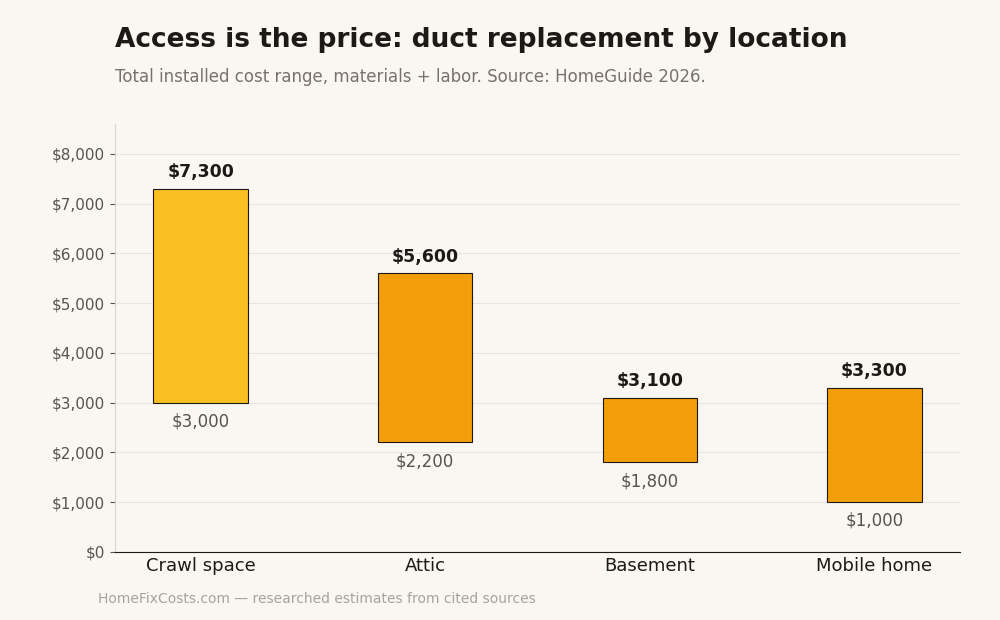
Labor rates. Angi puts HVAC labor at $50 to $150 per hour, or $5 to $10 per foot for installation alone. Metro markets sit at the top of that band.
Permits. HomeGuide reports $50 to $250 for a duct-only permit; Angi’s range is $50 to $400. If the ducts go in as part of a full system swap, HomeGuide says the permit climbs to $250 to $1,500. A contractor who offers to skip the permit is offering you a failed inspection at resale.
What is hiding in the walls. Homes built through the 1970s often have asbestos duct insulation. HomeGuide prices asbestos testing at $250 to $700 and removal at $700 to $2,200; mold remediation runs $450 to $6,000. This Old House notes asbestos or mold work can add upward of $2,000 on its own. None of this shows up in the original quote.
The extras nobody mentions. Per Angi’s 2026 data: cleanup and debris removal $150 to $500, HVAC redesign or airflow balancing $200 to $600, post-install inspection $100 to $300. HomeGuide adds drywall repair at $300 to $1,500 and duct insulation at $800 to $2,000.
Before you replace: the test that can save you $4,000
Here is the honest part. Most ducts that “need replacing” need sealing.
ENERGY STAR reports that in a typical house, about 20% to 30% of the air moving through the duct system is lost to leaks, holes and badly connected joints. Energy auditor Paule Scheckel, quoted by This Old House, says duct leakage can account for 20% or more of a home’s heating and cooling energy loss, and that uninsulated duct in an unconditioned space loses another 10% to 15%. The Department of Energy puts it plainly: ducts leaking into unheated space can add hundreds of dollars a year to your bills.
Every one of those problems is a sealing problem, not a replacement problem. And sealing is far cheaper:
- Manual sealing with mastic: $400 to $1,900, per HomeGuide’s 2026 data. Best for exposed, accessible duct with big leaks at the joints.
- Aerosol sealing (Aeroseal): $1,300 to $2,700, per HomeGuide. Injected from inside; seals cracks up to 5/8 inch. Best for duct you cannot reach.
- Targeted repair: $200 to $700 (HomeGuide) or $300 to $1,000 (Angi) for a leak, a torn section or a bad vent.
- Duct inspection: $40 to $100 (HomeGuide). A home energy audit runs $200 to $500.
Replacement earns its keep when the duct is rusted through, crushed, mold-lined, asbestos-wrapped, undersized for a new system, or simply worn out. This Old House sets the practical line at 10 to 15 years for cheap flex and 20-plus for sheet metal. Angi’s rule of thumb: if repair costs approach 50% of full replacement, replace.
So spend $40 to $100 on an inspection, or $200 to $500 on an energy audit, before you spend $4,000 on new duct. If a contractor quotes a full replacement without testing your system first, get another quote.
DIY vs. hiring a pro
Do not DIY a duct replacement. This is not gatekeeping, it is math.
HomeGuide notes that unlicensed duct replacement is illegal in most states, and that DIY work can void your HVAC warranty and your homeowners coverage, and fail inspection. This Old House recommends against it because duct sizing is engineering: get the static pressure wrong and you have a new system that heats unevenly and dies early. Meanwhile the savings are thin. You still pay $10 to $25 per foot for material (Angi), you rent the crimper and snips, and a pro crew finishes in one to three days what will cost you three weekends.
What you can reasonably do yourself: seal accessible joints with mastic, add duct wrap in the attic, replace a register, and clear the crawl space before the crew arrives.
When you hire, ask whether the contractor runs a Manual D duct-design calculation and a Manual J load calculation, and whether they leak-test the system after install. A contractor who does neither is guessing, and you are paying for the guess.
How to save money on duct replacement
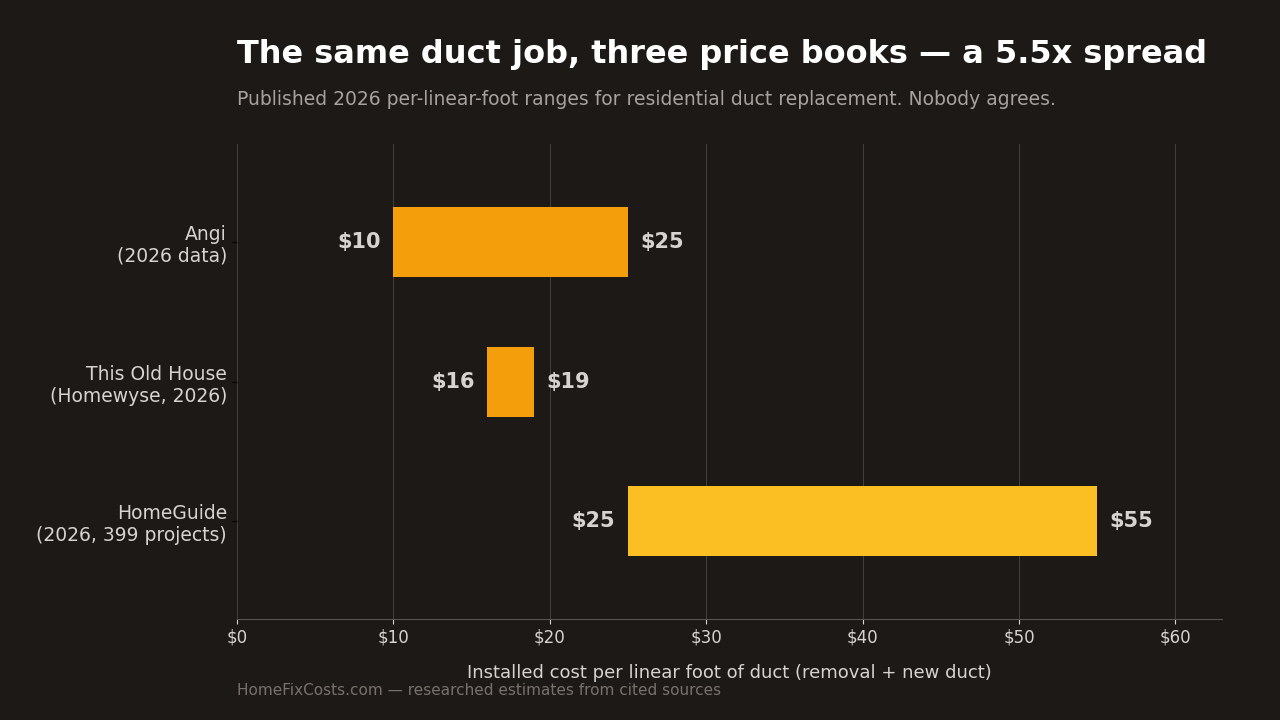
- Get three written quotes. Given that the price books disagree by 5x per foot, so will your bids. Insist each one lists linear footage, material and access.
- Check if you qualify for free work. The DOE Weatherization Assistance Program covers duct testing and sealing at no cost for eligible households. Eligibility is generally 200% of the federal poverty level, and SNAP, SSI or TANF recipients are automatically income-eligible in most states.
- Bundle with equipment. If your furnace or AC unit is already on the way out, doing both at once saves a mobilization and a second permit. See our full HVAC replacement cost breakdown before you commit.
- Schedule off-peak. Angi recommends booking outside summer and winter peaks. Mid-spring and late fall are when crews discount.
- Do not pay to replace what can be sealed. The single biggest saving on this page.
- Skip the upsells you do not need. Adding a vent to existing duct costs $250 to $500 (HomeGuide), and HomeGuide warns that adding vents can actually lower overall system efficiency.
One number worth knowing before you sign: Angi puts duct replacement ROI at 50% to 70%, and estimates new duct lowers heating and cooling bills by 10% to 30%. HomeGuide’s range for replacing leaky duct is 10% to 40%. On a $200 monthly bill, a 20% cut is $480 a year, which pays back a $3,500 job in about seven years. Real, but not fast. If your ducts are sound, that money does more work elsewhere.
If the symptom that sent you here is uneven cooling, read why your AC is not cooling first, and consider an HVAC tune-up before assuming the duct is the culprit.
Our data and methodology
Every figure here comes from a named 2026 source, and we cross-checked each key cost against at least two of them: HomeGuide (based on 399 member-reported projects), Angi’s 2026 cost data, and This Old House, whose pricing is sourced from the Homewyse database. Efficiency claims come from ENERGY STAR and the U.S. Department of Energy.
We publish the disagreement rather than averaging it away. When three price books say $10 to $25, $16 to $19 and $25 to $55 per foot for the same job, an “average” invents a precision that does not exist. What is real: the shape of the ranges is consistent. Basements are cheap, crawl spaces are not, sheet metal outlives flex, and sealing beats replacing more often than the industry admits.
Official resources & free help
- ENERGY STAR — Duct Sealing: the federal guidance on why 20–30% of your conditioned air escapes, and what sealing fixes.
- EPA — Should You Have the Air Ducts in Your Home Cleaned?: read this before paying for duct cleaning. The EPA does not recommend it routinely.
- DOE Weatherization Assistance Program: covers duct testing, duct sealing and insulation at no cost for eligible households. Apply through your state office.
- LIHEAP — help with heating and cooling bills and energy crises. National Energy Assistance Referral line: 1-866-674-6327, weekdays 9:00 a.m.–7:00 p.m. ET.
- USAGov — Weatherization and energy efficiency assistance: the plain-English index of every federal energy program you might qualify for.
- 211 — dial 211 for local utility assistance, emergency repair funds and referrals in your county.
Frequently asked questions
How much does it cost to replace ductwork in a 2,000 square foot house?
$2,000 to $5,600. Angi’s 2026 data gives $2,000 to $4,500 for a 2,000-square-foot home with roughly 250 linear feet of duct; HomeGuide’s 2026 range for the same size band is $2,800 to $5,600. Expect the top of that range if your ducts run through a crawl space, the bottom if they are exposed in a basement.
How long does ductwork last?
10 to 20 years on average, per HomeGuide. This Old House breaks it down by material: flexible duct 10 to 20 years, fiberboard 10 to 15, and sheet metal 20 years or more. Cheap flex in a hot attic fails at the short end of those ranges.
Do you need to replace ductwork when replacing an AC unit?
Not automatically. HomeGuide says replace the duct when it is moldy, cracked, or more than 20 years old, and notes that installers should inspect first and recommend cleaning, repair or replacement. If your duct is sound, properly sized for the new equipment and leak-free, keep it. If you are replacing the equipment anyway, doing both at once saves labor and a second permit.
Is it better to seal or replace ductwork?
Seal first, in most cases. ENERGY STAR attributes 20% to 30% of duct air loss to leaks and bad joints, and HomeGuide prices manual sealing at $400 to $1,900 versus $1,400 to $5,600 for replacement. Replace when the duct is rusted, crushed, mold-lined, asbestos-wrapped, or undersized. Angi’s threshold: if repairs hit 50% of replacement cost, replace.
Can I install my own ductwork?
In most states, not legally without a license, per HomeGuide. Beyond the legal issue, DIY duct work risks failed inspections, voided HVAC warranties and insurance, and leaky duct that raises the bills you were trying to lower. Sealing accessible joints and adding duct insulation are reasonable DIY jobs; a full replacement is not.
How long does ductwork replacement take?
1 to 2 days for a standard home, per both HomeGuide and This Old House. Large or complex systems run up to 4 days, and more if walls and ceilings need opening and patching afterward.
Prices on this page are researched estimates compiled from the cited sources; your local costs will vary with market, access and scope. Always get multiple written quotes from licensed professionals before hiring.