Last updated: July 10, 2026 · Prices reviewed quarterly
Replacing a furnace in 2026 costs most homeowners between $1,900 and $12,000 installed, and the fuel you choose sets the number. A gas furnace runs $3,800 to $12,000 installed (HomeGuide 2026 data), while an electric furnace runs $1,900 to $5,600 installed (HomeGuide 2026 data) — electric is roughly 40% cheaper on installation day. The catch shows up on your utility bill: an electric furnace costs about two to two-and-a-half times more to run every winter. This guide lays out the real numbers on both sides so you can see which one is cheaper for your home over its whole life, not just at checkout.
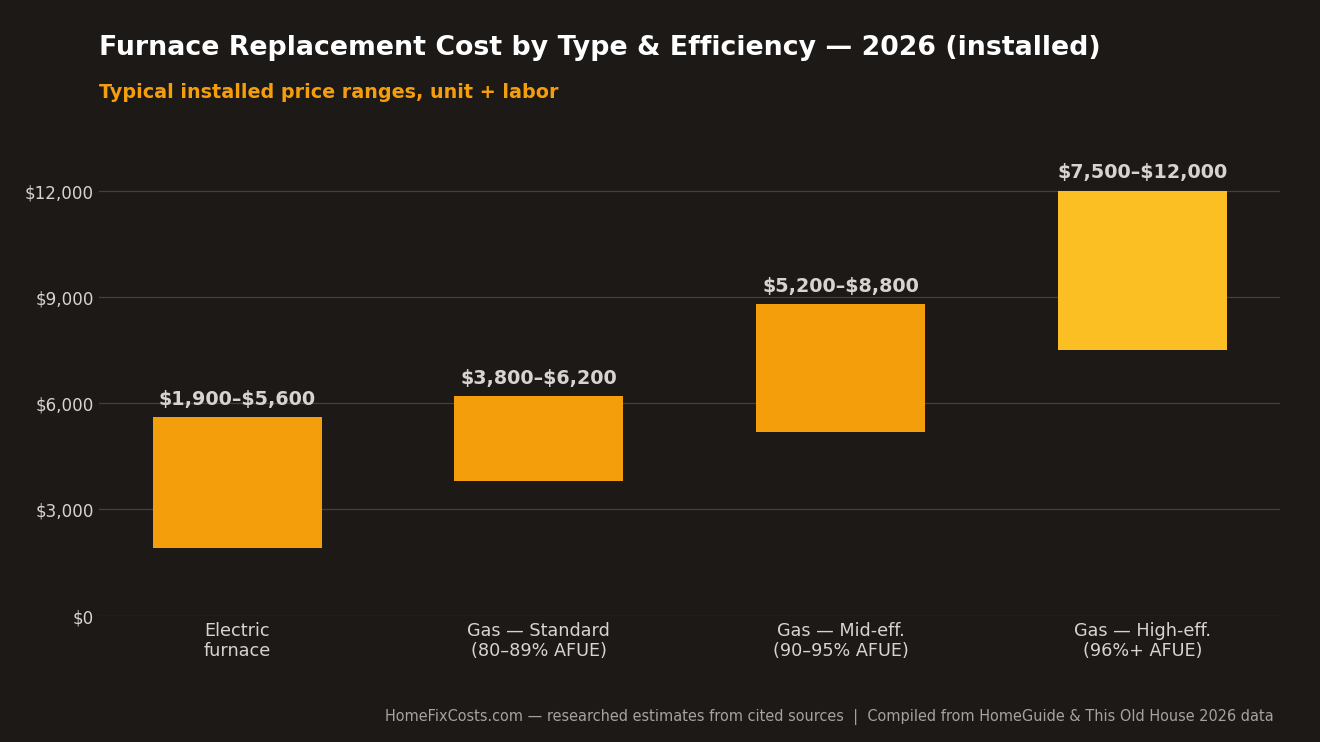
Furnace Replacement Cost at a Glance
| Scenario | Typical installed range (unit + labor) |
|---|---|
| Electric furnace (mild climate) | $1,900 – $5,600 |
| Gas — standard (80–89% AFUE) | $3,800 – $6,200 |
| Gas — mid-efficiency (90–95% AFUE) | $5,200 – $8,800 |
| Gas — high-efficiency (96%+ AFUE) | $7,500 – $12,000 |
| Add: run a new gas line | $500 – $2,000 |
| Add: 200-amp panel upgrade (electric) | $1,300 – $2,500 |
The Verdict in Two Sentences
If you have natural gas at the street and real winters, a gas furnace almost always wins on total cost, even though it costs more to install. If you live in a mild climate, have no gas line, or plan to lean on solar, an electric furnace is cheaper to buy, simpler to maintain, and lasts longer — so it earns its keep.
Gas vs. Electric: Side by Side
| Factor | Gas furnace | Electric furnace |
|---|---|---|
| Installed cost | $3,800 – $12,000 | $1,900 – $5,600 |
| Efficiency (AFUE) | 80% – 98% | 100% |
| Annual running cost | $500 – $1,200 | $1,600 – $2,200 |
| Lifespan | 15 – 20 years | 20 – 30 years |
| Best climate | Cold winters | Mild winters |
| Maintenance | Higher (combustion + safety checks) | Lower (fewer parts) |
| What it needs | Gas line + venting | Enough electrical panel capacity |
Notice the efficiency line. An electric furnace turns 100% of the power it draws into heat, and a gas unit tops out around 98% (HomeGuide). That sounds like electric should be cheaper to run — but it isn’t, because electricity costs far more per unit of energy than natural gas. The U.S. Bureau of Labor Statistics pegged natural gas near $1.40 per therm in 2024 against home electricity around $0.17 per kWh, and that price gap is why gas heat stays cheaper in most of the country.
When a Gas Furnace Makes Sense
Pick gas when you already have a gas line and your winters actually bite. Gas puts out hotter air and recovers temperature faster, which matters when it is 10°F outside. Over a full heating season it costs $500 to $1,200 a year to run (HVAC Project Cost), often half of what an electric furnace costs in the same house.
The trade-offs are real: higher install price, a combustion system that needs annual safety checks, and a 15-to-20-year lifespan (HomeGuide) that is shorter than electric. If you are replacing a whole system, price it alongside a full HVAC system replacement so the furnace and AC are matched and sized together.
When an Electric Furnace Makes Sense
Electric wins in mild climates and in homes with no gas service. It is cheaper to install at $1,900 to $5,600 (HomeGuide), has no flue, no gas line, and no carbon-monoxide risk, and it runs 20 to 30 years (HomeGuide). Maintenance is lighter because there is no burner or heat exchanger to inspect.
Watch two things. First, a large electric furnace may need a 200-amp panel, which adds $1,300 to $2,500 (HomeGuide). Second, if you are in a mild climate and want the lowest running cost, a heat pump uses about half the electricity of an electric furnace and cools your home too — often the smarter buy where an electric furnace is on the table.
The Real Cost Difference Over 10 Years
Upfront price is only half the story. Run the numbers for a typical 2,000-square-foot, cold-climate home and the ranking can flip.
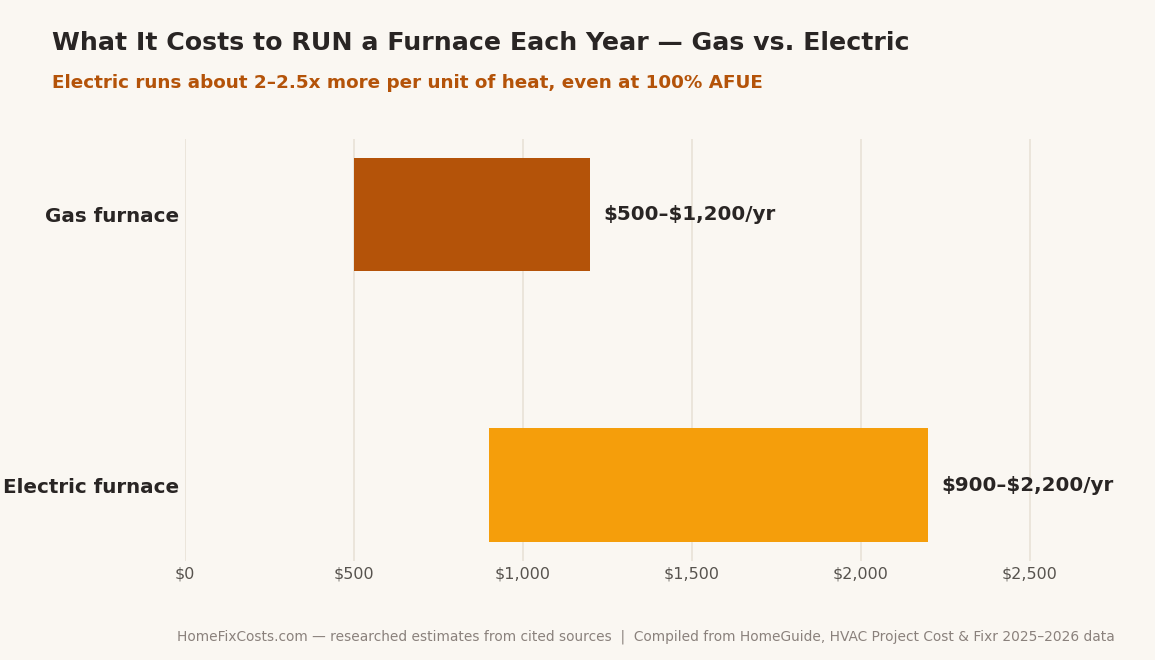
Say a mid-efficiency gas furnace runs about $6,000 installed and $850 a year to heat. Over 10 years that is roughly $14,500. An electric furnace in the same cold-climate home might cost $3,750 installed (HomeGuide national average) but $1,900 a year to run — about $22,750 over 10 years. Electric saves around $2,250 at install, yet gas saves close to $8,000 across the decade.
That gap is why the higher gas install price usually pays for itself in about five to nine years in cold climates (The Furnace Outlet). In a mild climate, where the electric furnace barely runs, the gap shrinks or disappears — so the “right” answer really does depend on your winters and your local rates.
What the Pros Say
Three habits separate a fair furnace quote from an expensive one. Get at least three written bids that name the exact model and AFUE rating, so you are comparing the same unit — not one contractor’s premium line against another’s builder-grade box. Ask for a Manual J load calculation instead of a “same size as the old one” guess; oversizing wastes fuel and money. And buy in the off-season if you can — This Old House notes furnace prices drop in spring and summer when demand is low, which is exactly why planning a fall replacement now can save you real money.
One more honest note for 2026: the federal 25C tax credit that gave up to $600 for a high-efficiency gas furnace ended for equipment placed in service after December 31, 2025 under the One Big Beautiful Bill. Do not let a salesperson quote it as a live discount. State and utility rebates often still exist, though — check the official links below before you sign. If your old system also struggles to cool and your AC is not keeping up, ask about pricing the AC replacement at the same time to save on a second labor trip.
Official resources & free help
- U.S. DOE Energy Saver — Furnaces & Boilers: sizing, AFUE and efficiency basics — energy.gov/energysaver/furnaces-and-boilers
- ENERGY STAR — Furnaces & Rebate Finder: find current local rebates by ZIP — energystar.gov/rebate-finder
- DSIRE — state & utility incentives database: the go-to source now that the federal 25C credit has ended — dsireusa.org
- LIHEAP — help paying heating bills or repairing/replacing heating equipment: call 1-866-674-6327 — acf.hhs.gov/ocs/programs/liheap
- 211 — local energy and utility assistance: dial 2-1-1 — 211.org
Furnace Replacement FAQ
How much does it cost to replace a furnace in 2026?
Most furnace replacements land between $1,900 and $12,000 installed, with This Old House putting the national average near $4,799. Electric furnaces sit at the low end ($1,900–$5,600) and high-efficiency gas units at the top ($7,500–$12,000), per HomeGuide 2026 data.
Is gas or electric cheaper to run?
Gas is cheaper to run almost everywhere. A gas furnace costs about $500 to $1,200 a year (HVAC Project Cost), while an electric furnace runs roughly two to two-and-a-half times more per unit of heat (Fixr), even though it is 100% efficient. The difference comes down to the price of electricity versus natural gas.
Is it worth replacing a gas furnace with an electric one?
Only in specific cases. Converting gas to electric costs $2,900 to $9,500 (HomeGuide) and usually raises your heating bill in a cold climate. It can make sense in a mild climate, if you are dropping gas service entirely, or if you are moving to a heat pump instead of a straight electric furnace.
How long does a furnace last?
A gas furnace lasts about 15 to 20 years and an electric furnace about 20 to 30 years, according to HomeGuide. Annual maintenance and correct sizing push both toward the top of their range.
Should I replace a 20-year-old furnace?
Usually yes. This Old House notes furnaces start breaking down more often after year 15, and a 20-year-old unit is near the end of its life. If a repair quote tops half the price of a new furnace, replacement is the better spend.
Why is furnace installation so expensive?
The unit itself is a big chunk — This Old House puts an average gas furnace near $6,900 — and the job takes a licensed crew 5 to 18 hours (HomeGuide). Gas venting, a new gas line, ductwork changes, or a panel upgrade for electric all add to the bill.
Prices on this page are researched estimates compiled from the cited sources; your local costs will vary with market, access and scope. Always get multiple written quotes from licensed professionals before hiring.